Nagaland Police has directed all police stations not to register FIRs in purely civil and commercial disputes, citing Supreme Court rulings against misuse of criminal law for debt recovery and contractual disagreements.
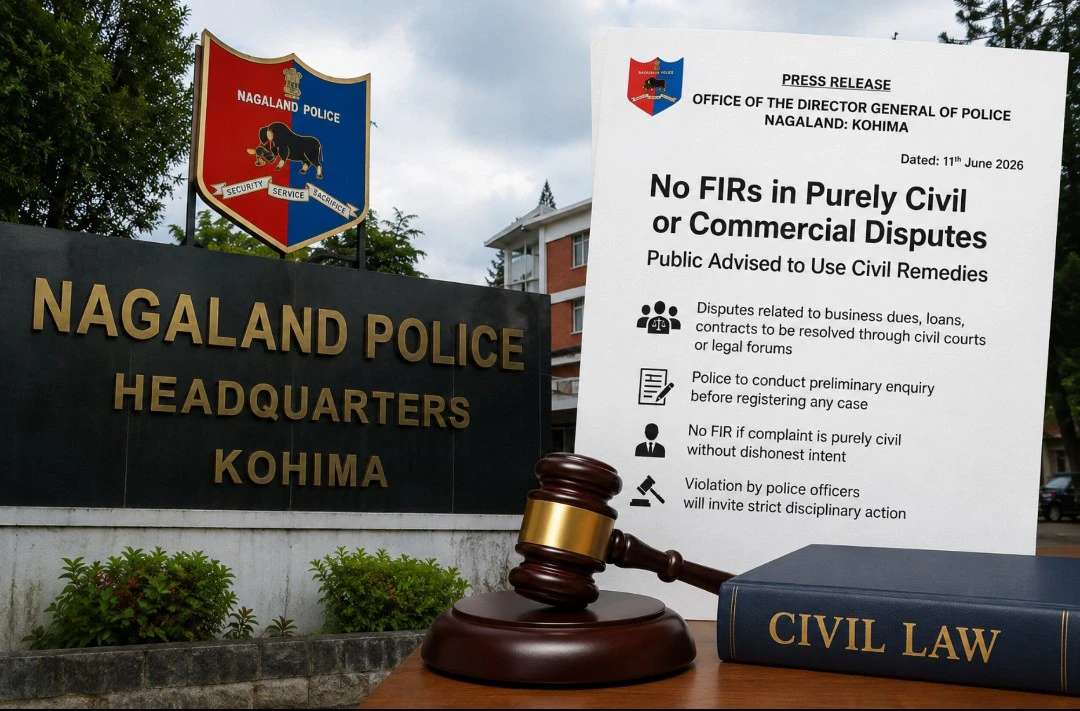
Kohima, June 12: The Nagaland Police Headquarters (PHQ) has issued fresh statewide guidelines directing police stations not to register First Information Reports (FIRs) in purely civil and commercial disputes, including matters related to business dues, loan defaults, contractual disagreements and debt recovery, unless there is clear evidence of fraudulent or dishonest intent from the outset.
The directive, issued by the Office of the Director General of Police (DGP), follows a series of judgments and directions of the Supreme Court of India aimed at preventing the misuse of criminal law in matters that are essentially civil in nature.
According to a circular dated June 10, 2026, all police stations and Deputy Superintendents of Police (DEPs) across Nagaland have been instructed to refrain from registering criminal cases in disputes arising from recovery of business dues, trade credits, pending loans, contractual breaches and other commercial transactions unless a cognizable criminal offence is evident.
The circular states that non-payment of dues, breach of contract or failure to repay loans in the ordinary course of business does not automatically amount to cheating or criminal breach of trust under the Bharatiya Nyaya Sanhita (BNS). It emphasises that criminal law should not be used as a mechanism to pressure parties into settling civil claims.
Under the new guidelines, Station House Officers (SHOs) and Officers-in-Charge have been directed to personally scrutinise complaints involving loans, business transactions and contractual matters.
Where criminality is not immediately apparent, police are required to conduct a Preliminary Enquiry (PE) under the Bharatiya Nagarik Suraksha Sanhita (BNSS) to determine whether a cognizable offence exists.
The circular further states that if a complaint reveals only a civil dispute and lacks prima facie evidence of dishonest intent at the commencement of the transaction, no FIR should be registered. Instead, complainants are to be advised in writing to seek appropriate relief through civil courts or other legal forums.
Police stations have also been instructed to prominently display copies of the circular for public awareness.
The directive warns that any police officer who registers an FIR in a purely civil matter in violation of the guidelines may face strict disciplinary action, including major penalty proceedings.
Nagaland Police has advised citizens to pursue appropriate civil remedies for recovery of money and enforcement of contractual obligations.
The circular lists several legal options available to aggrieved parties, including civil suits under the Code of Civil Procedure, summary suits for claims based on written contracts or negotiable instruments, arbitration proceedings where contractual clauses permit, proceedings under the Negotiable Instruments Act for dishonoured cheques, and complaints before Consumer Forums or Debt Recovery Tribunals where applicable.
The circular also addresses disputes arising from private lending arrangements and refers to provisions under the Nagaland Money Lenders Act, 2005.
According to the police, disputes involving non-payment of loans or instalments between private parties are fundamentally civil matters governed by contract law. The Act regulates money lending activities in the state by requiring annual licences for lenders, prescribing documentation requirements and limiting interest rates to a maximum of three percent above the prevailing average bank rate on a simple interest basis.
The police clarified that a borrower's failure to repay a loan does not, by itself, constitute a criminal offence under the Act. Violations such as unlicensed money lending or charging excessive interest may attract legal consequences, but enforcement primarily falls within the jurisdiction of designated inspectors and civil courts.
The circular notes that Extra Assistant Commissioners (EACs) function as inspectors under the Act and that police have only a limited supportive role in such matters.
Nagaland Police said the measure seeks to protect bona fide businessmen, borrowers and citizens from harassment through frivolous criminal proceedings while ensuring that criminal justice resources remain focused on genuine offences involving fraud or dishonest intention.
The circular also reiterates Supreme Court observations that police should not be used as "recovery agents" in commercial or loan-related disputes.
District Police Chiefs have been directed to circulate the instructions widely and submit compliance reports to Police Headquarters.
The public has been advised to approach competent civil courts, consumer forums, debt recovery mechanisms, arbitration panels or mediation processes for speedy resolution of commercial disputes, while cases involving genuine cheating or criminal breach of trust with clear evidence of dishonest intent will continue to be investigated in accordance with law.