NIELIT Imphal hosted a workshop on future-ready youth, focusing on skills, employment, entrepreneurship and emerging opportunities in the digital economy.
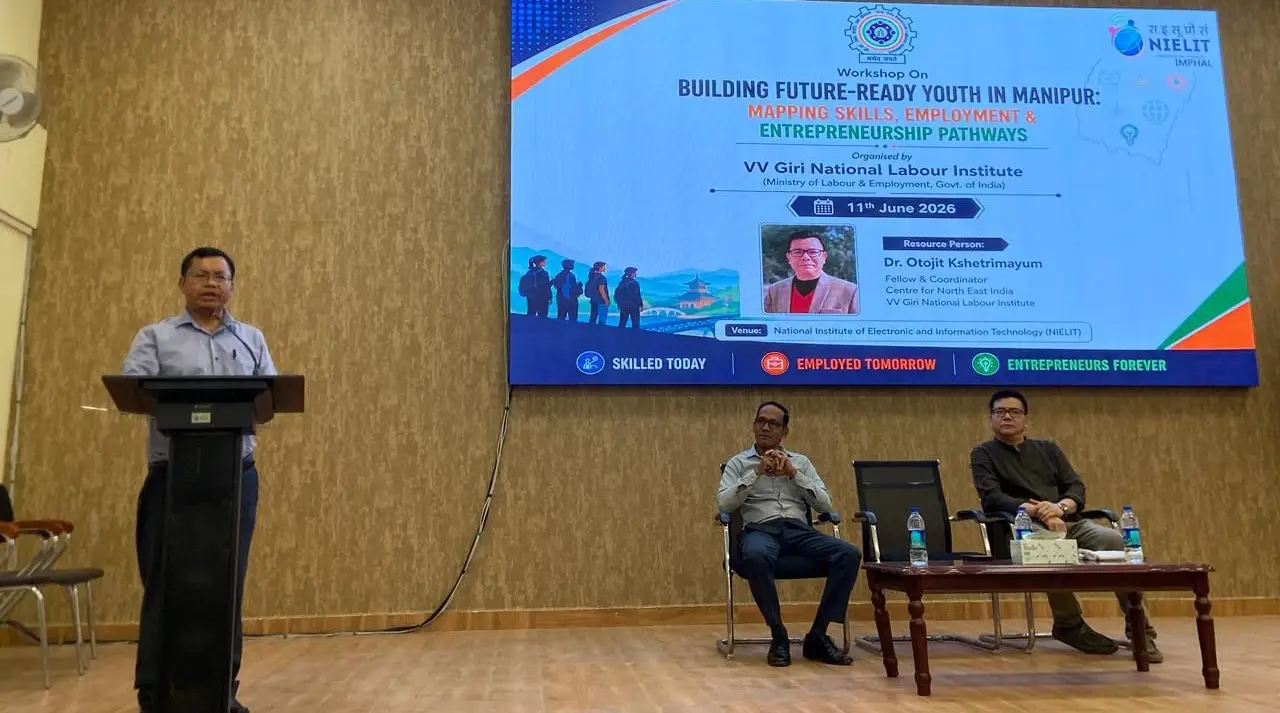
Imphal, June 11: A one-day workshop on “Building Future-Ready Youth in Manipur: Mapping Skills, Employment & Entrepreneurship Pathways” was held at the National Institute of Electronics and Information Technology (NIELIT), Imphal on Thursday, bringing together students, trainees, faculty members and officials to discuss emerging opportunities in employment, skill development and entrepreneurship.
The programme was organised by the VV Giri National Labour Institute (VVGNLI) under the Ministry of Labour and Employment, Government of India, with the objective of helping young people better understand evolving labour market trends and the skills required to succeed in a rapidly changing economy.
The workshop was inaugurated by Dr. Y. Jayanta Singh, Executive Director of NIELIT Imphal, and Dr. L. Shyamsundar, Scientist-E, NIELIT Imphal.
Welcoming the participants, Dr. Jayanta highlighted the importance of equipping youth with industry-relevant skills, digital competencies and entrepreneurial abilities to meet the demands of the modern workforce. Delivering the keynote address, he stressed the need for continuous learning and innovation, while also emphasizing stronger linkages between education and employment.
He noted that as technology continues to transform workplaces, young people must be prepared to adapt to new opportunities and challenges. According to him, skill development and practical exposure are essential for enhancing employability and ensuring sustainable career growth.
The technical session was conducted by Dr. Otojit Kshetrimayum, Fellow and Coordinator of the Centre for North East India at VV Giri National Labour Institute, Noida.
During an interactive presentation on youth employability and workforce readiness, Dr. Otojit outlined the objectives of the National Youth Policy and discussed provisions of the Child Labour (Prohibition and Regulation) Act. He underscored the importance of active youth participation in nation-building and socio-economic development.
Dr. Otojit also examined the relationship between educational qualifications, employability skills and labour market expectations. He explained that many young job seekers continue to face challenges in securing meaningful employment due to skill gaps, limited industry exposure, lack of career guidance and insufficient awareness about available opportunities.
The session also explored emerging employment trends in India and abroad, particularly in technology-driven industries and the growing digital economy. Participants were briefed on sectors expected to generate significant employment opportunities in the coming years and the competencies required to remain competitive.
An awareness programme on the National Career Service (NCS) Portal formed another important component of the workshop. Participants were introduced to the services available through the portal, including job search facilities, career counselling, skill development resources and employer connectivity. Students were encouraged to register and make effective use of the platform to improve their career prospects.
One of the key highlights of the workshop was an immersive student activity session focused on regional development and future workforce planning. Working in groups, participants prepared actionable blueprints identifying potential growth sectors for Manipur. Through descriptive charts and presentations, the teams highlighted opportunities in artificial intelligence, renewable energy, human-machine collaboration and the creative economy.
The presentations emphasized the need for adaptability, communication skills and advanced digital competencies among young professionals. Participants also recommended modernised skill-based curricula and stronger public-private partnerships to better align education with industry requirements.
The discussions ultimately converged on the idea that building a future-ready workforce in Manipur will require sustained support for entrepreneurship, innovation and digital empowerment.
The workshop concluded with active participation from students and trainees, who engaged in discussions on employment prospects, entrepreneurship opportunities and strategies for preparing themselves for an increasingly technology-driven future.