The 2026 rankings continue to underscore the formidable presence of traditional public Central universities from the Northeast, with eight premier institutions from the region successfully featuring in the national top 50 list.
IMPHAL, JUNE 4: The International Institutional Ranking Framework (IIRF) has officially released its highly anticipated 'IIRF India Rankings 2026', covering more than 2,500 institutions across the country. Designed to provide a comprehensive assessment of academic excellence, research performance, employability, and institutional impact, the 2026 ranking framework highlights a powerful, synchronized leap for the higher education landscape of Northeast India.
Evaluating campuses based on nine meticulously defined parameters—including academic reputation, graduate outcome and employability, research output, demand ratio, and international outlook—the latest edition showcases the region's public and private institutions holding their ground firmly against the nation’s absolute academic elite.
Central Universities: Northeast Retains Massive Top 50 Footprint Despite National Squeeze
The 2026 rankings continue to underscore the formidable presence of traditional public Central universities from the Northeast, with eight premier institutions from the region successfully featuring in the national top 50 list. However, the regional data also reflects an increasingly aggressive competitive landscape, with a marginal "score squeeze" causing minor slips in ranks across several frontier campuses.
At the top of the regional hierarchy, Rajiv Gandhi University (RGU) in Arunachal Pradesh remains the highest-ranked university from the Northeast, securing the 14th position nationally, dropping just a single place from 13th in 2025. Conversely, the North Eastern Hill University (NEHU) in Shillong registered a positive upward trajectory, climbing one spot to occupy the national 28th rank.
The state of Manipur saw its two flagship Central universities safely retain their places among India's top 50, although both recorded slight declines. The Central Agricultural University (CAU), Imphal, slipped three places to the 29th rank from 26th in 2025, finishing with an overall index score of 933.68. Despite the minor drop, CAU remains the highest-ranked higher educational institution in the state of Manipur. Meanwhile, Manipur University (MU) in Canchipur faced a steeper multi-year trajectory, sliding to the 43rd position from last year's 40th, following a prior ranking of 35th in 2024. MU's overall index score locked at 903.47, placing it just behind Nagaland University.
The complete breakdown of the eight northeastern Central universities featured in the national Top 50 includes:
To put these standings into perspective, the national benchmark for the Central University category continues to be led by Jawaharlal Nehru University (JNU) at No. 1, followed sequentially by the University of Delhi (DU), Jamia Millia Islamia (JMI), University of Hyderabad (UoH), and Banaras Hindu University (BHU).
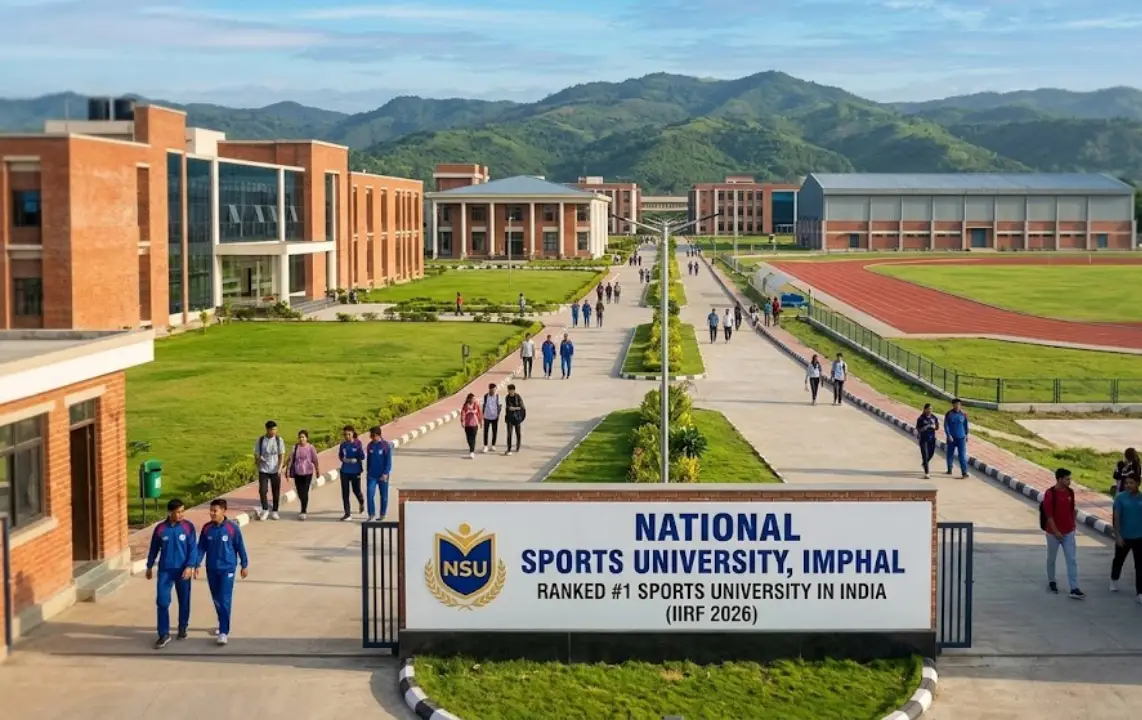
Technical and Specialized Learning: IIT Guwahati and National Sports University Lead the Nation
In highly specialized educational sectors, the Northeast region has registered some of its most historic and outstanding achievements, driven by elite public institutions.
Government Engineering Framework
As detailed in the IIRF India Engineering Rankings 2026_ Top Engineering.pdf, premier engineering and technological campuses across the frontier states have stamped a massive authority on the national stage:
Specialized Technical, Allied, and Sports Classes
Private Sector Expansion: Homegrown Private Networks Stop Regional Brain Drain
A major highlight of the IIRF India University Rankings 2026_ New Age Private Universities.pdf is the rapid emergence of high-performing private institutions within the northeastern states. Historically, the region suffered a massive flight of local student talent to alternative metros; however, homegrown private networks are now offering world-class local education:
Navigating the Score Squeeze in a Progressive Frontier
When evaluating the 2026 data directly against previous editions, a wider systemic pattern comes to light. The marginal drops recorded by campuses like CAU Imphal, Manipur University, and Rajiv Gandhi University do not indicate an absolute decline in localized institutional quality. Instead, they reflect a hyper-competitive national landscape where parameters are evaluated with severe rigor by the IIRF framework.
As traditional institutions across mainland India aggressively ramp up their research funding pipelines, scale up faculty publications, and upgrade baseline student-to-faculty ratios, northeastern universities are experiencing a competitive "score squeeze." For instance, while Tripura University successfully defended its top 50 framework over successive terms (settling at AIR 47), its baseline parameters face constant pressure.
The clear structural takeaway is that survival and elevation in the national rankings require relentless momentum. The fact that Northeast India now commands a nationwide AIR 1 in sports education, an AIR 5 in elite IT education, an AIR 7 in government engineering, and an unbroken wall of top 50 Central universities proves that the region has transitioned from an educational outlier into a highly integrated, formidable powerhouse of specialized higher learning. To maintain this trajectory, regional administrators must continue to prioritize research visibility, institutional funding, and graduate placement outcomes in the upcoming academic cycles.
For the complete, unchecked performance spreadsheets and to see how specific campuses stack up nationally, explore the official data dashboards at www.iirfranking.com.