Union Minister Sarbananda Sonowal says Northeast India has emerged as a major economic growth hub through investments in infrastructure, connectivity and industry.
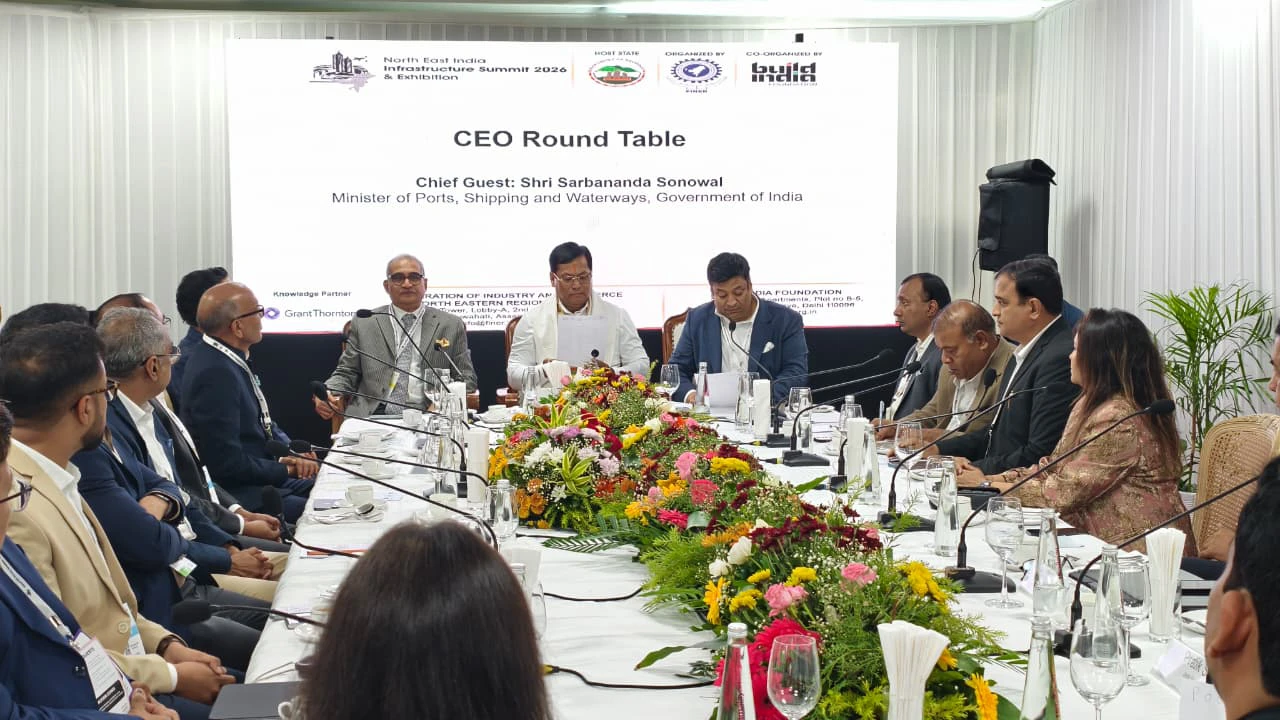
Shillong, June 15: Union Minister for Ports, Shipping and Waterways Sarbananda Sonowal on Monday said the transformation of Northeast India from a region associated with infrastructure deficits and limited investment into a major economic growth hub represents one of the country's most significant development achievements of the past decade under Prime Minister Narendra Modi.
Addressing the North-East India Infrastructure Summit and Exhibition 2026 in Shillong, Sonowal said the region has emerged as a strategic growth engine of the Indian economy, driven by investments in connectivity, digital infrastructure, logistics, energy and industry.
“From a frontier region to an economic growth hub, Prime Minister Narendra Modi has led the Northeast’s transformation and it is one of India’s biggest success stories. The region has moved from the margins of national policymaking to the centre of India’s development agenda,” he said.
Sonowal said the Northeast, once viewed mainly through the lens of geographical remoteness and infrastructure challenges, is now increasingly recognised as India’s gateway to Southeast Asia and a key pillar of the country’s Act East Policy.
Highlighting public investment in the region, the Union Minister said budgetary support for the Northeast has increased from around Rs 20,000 crore in 2014 to over Rs 1.08 lakh crore in 2025-26. He added that cumulative expenditure in the region has crossed Rs 7.3 lakh crore over the past decade. The budget allocation for the Ministry of Development of North Eastern Region (DoNER) has also increased from Rs 2,000 crore in 2014 to Rs 6,812 crore in the current Budget.
“These investments are not merely creating infrastructure; they are creating opportunities. They are connecting farmers to markets, entrepreneurs to capital, students to education, and the region itself to national and global value chains,” Sonowal said.
The minister noted that nearly 10,000 kilometres of national highways have been constructed in the Northeast since 2014 at an investment exceeding Rs 1.07 lakh crore. More than 46,000 kilometres of rural roads have also been built, improving connectivity in remote areas.
Railway investment in the region has increased nearly fivefold compared to the pre-2014 period, with projects worth approximately Rs 77,000 crore currently under implementation. Sonowal cited major projects such as the Bogibeel Bridge, the first passenger rail connectivity to Mizoram and the ongoing Dhubri-Phulbari Bridge as key contributors to regional integration.
He further said air connectivity has expanded significantly, with the number of operational airports in the Northeast increasing from nine in 2014 to 16 at present. Arunachal Pradesh and Sikkim have also been connected to regular commercial air services for the first time.
Describing digital infrastructure as one of the defining achievements of the past decade, Sonowal said nearly 96 per cent of villages in the region are now connected through mobile networks, while more than 40,000 villages have access to 4G services.
“Broadband has become economic infrastructure. Digital connectivity is empowering entrepreneurs, enabling digital commerce, expanding access to education and healthcare, and integrating the Northeast into the knowledge economy,” he said.
Focusing on Meghalaya, Sonowal said the state has emerged as an example of how improved connectivity, tourism, digital infrastructure and governance reforms can accelerate economic growth. He said Meghalaya has leveraged its natural strengths and strategic location to attract investments in tourism, information technology, logistics, agriculture and renewable energy.
The minister also highlighted Meghalaya’s performance in ease of doing business reforms, noting that the state secured third place nationally in Compliance Reduction and Deregulation 1.0 after completing all 23 priority reform areas.
Sonowal pointed to the changing industrial profile of the Northeast, citing the Rs 27,000-crore Tata Semiconductor Assembly and Test Facility at Jagiroad in Assam and the production of the first Made-in-India semiconductor chip in the state.
“A region once associated with connectivity deficits is now participating in one of the world’s most advanced manufacturing sectors. This represents the new Northeast that is emerging before us,” he said.
As Union Minister for Ports, Shipping and Waterways, Sonowal also highlighted the growing role of inland waterways in regional development. He said projects worth more than Rs 750 crore have been completed on inland waterways infrastructure in Assam, while projects exceeding Rs 1,170 crore are currently under implementation.
According to him, the Jogighopa Inland Waterways Terminal and Bogibeel Inland Water Transport Terminal are helping build a multimodal logistics network that will strengthen trade links with Bangladesh, Bhutan and Southeast Asia.
“The Northeast is no longer a landlocked region. It is increasingly becoming a logistics, trade and connectivity corridor linking South Asia with Southeast Asia,” Sonowal said.
He also pointed to exports of products such as Tripura’s Queen pineapple and Assam’s lychees to international markets as examples of how improved infrastructure is benefiting farmers and producers.
“The Northeast is not India’s last frontier. It is India’s gateway to Southeast Asia, the Indo-Pacific and the opportunities of the twenty-first century. The Ashtalakshmi story is no longer an aspiration—it is unfolding before our eyes,” the minister said.