NVIDIA has released Nemotron 3.5 ASR, a multilingual speech recognition model supporting 40 language locales. Here's how it works, how developers can use it, and what it means for low-resource languages such as Manipuri.
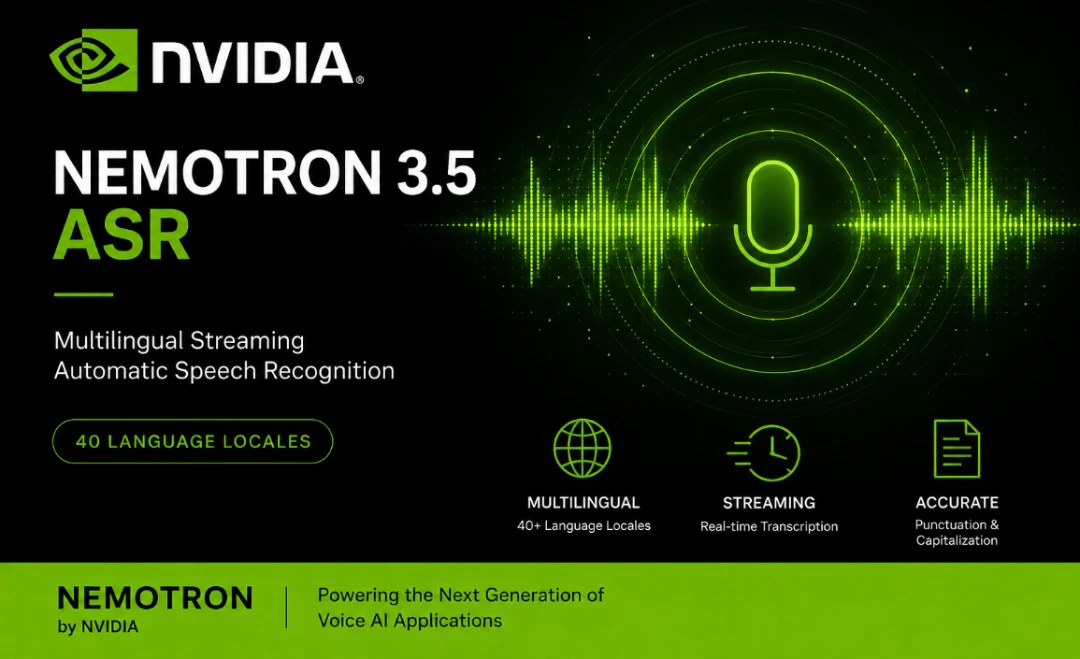
Imphal, June 8: NVIDIA has entered the increasingly competitive speech AI market with the release of Nemotron 3.5 ASR, a multilingual automatic speech recognition (ASR) model designed for real-time and batch transcription workloads.
Released publicly in early June through NVIDIA's AI software ecosystem and Hugging Face repositories, the model is positioned as a high-performance speech-to-text system capable of transcribing speech across approximately 40 language locales from a single checkpoint. The launch comes at a time when voice AI is rapidly becoming a core component of digital assistants, customer support systems, media transcription services, and accessibility technologies.
While the announcement may not have received the same attention as the latest large language models, industry observers view the release as significant because speech recognition remains one of the most challenging and commercially important areas of artificial intelligence.
For countries such as India, where hundreds of languages and dialects coexist, advances in multilingual ASR could eventually play a key role in expanding access to digital services.
What Is Nemotron 3.5 ASR?
Automatic Speech Recognition (ASR) refers to technology that converts spoken language into written text.
Examples include:
Voice typing on smartphones
YouTube subtitle generation
Meeting transcription tools
Voice assistants such as Siri and Alexa
Call center analytics systems
Nemotron 3.5 ASR is NVIDIA's latest multilingual speech recognition model built using the company's NeMo framework.
Unlike traditional ASR systems that often require separate models for different languages, Nemotron 3.5 aims to support multiple languages through a unified architecture.
The model released publicly is a 600-million-parameter streaming ASR model, meaning it can process speech while a person is still speaking rather than waiting for the entire audio recording to finish.
This capability is important for applications requiring low latency, including:
Live captioning
Real-time translation pipelines
Virtual assistants
Customer support agents
Broadcast transcription
How the Technology Works
Speech recognition systems generally operate through several stages:
1. Audio Processing
The model first converts raw speech into machine-readable acoustic features.
2. Neural Network Analysis
Deep neural networks identify patterns corresponding to phonemes, syllables, and words.
3. Language Understanding
A language model helps predict the most likely word sequences.
4. Text Generation
The system produces readable text complete with punctuation and capitalization.
Nemotron 3.5 performs these tasks in a streaming environment, enabling transcription with minimal delay.
NVIDIA says developers can configure various chunk sizes depending on whether they prioritize speed or transcription accuracy.
How Developers Can Use It
The model is available through NVIDIA's NeMo ecosystem and Hugging Face.
A developer typically needs:
Hardware
NVIDIA GPU recommended
CUDA-compatible environment
Linux server or cloud instance
Software
Python
NVIDIA NeMo toolkit
PyTorch
Basic Workflow
1. Install NeMo.
2. Download the pretrained model.
3. Load the model into a Python environment.
4. Provide an audio file or streaming audio source.
5. Receive transcribed text output.
The release also includes documentation for fine-tuning the model on custom datasets.
This means organizations can adapt the system for:
Regional accents
Industry-specific terminology
Healthcare transcription
Legal documentation
Educational applications
Why This Matters
Speech AI is increasingly becoming a gateway technology. Many people around the world interact with technology primarily through voice rather than keyboards.
According to industry estimates, billions of voice interactions occur daily through smartphones, smart speakers, vehicles, and enterprise communication systems.
For businesses, accurate speech recognition reduces operational costs by automating transcription and customer interactions.
For governments, it can improve accessibility and multilingual service delivery.
For media organizations, it can dramatically accelerate newsroom workflows by converting interviews and press conferences into searchable text.
The India Opportunity
India presents one of the largest opportunities for multilingual speech technology.
The country has:
22 scheduled languages
Hundreds of regional languages
Significant dialect variation
Growing smartphone penetration
While speech AI performs well for globally dominant languages such as English, Spanish, and Mandarin, many Indian languages remain underrepresented in AI training datasets. This creates both a challenge and an opportunity.
Models such as Nemotron 3.5 demonstrate how major AI companies are moving toward broader multilingual coverage, but the success of such systems ultimately depends on the availability of quality language data.
What About Manipuri (Meeteilon)?
For Northeast India, one of the most important questions is whether the model supports Manipuri, also known as Meeteilon.
Based on currently available documentation, Manipuri does not appear among the officially listed supported languages. This means users should not expect reliable transcription performance out of the box.
However, the release may still be relevant for the region because NVIDIA has provided pathways for fine-tuning the model on new languages.
If researchers, universities, startups, or government agencies can assemble large datasets of Manipuri speech and transcripts, Nemotron 3.5 could potentially be adapted to support the language.
Such a project would require:
Thousands of hours of speech recordings
Accurate transcripts
Computing infrastructure
Model training expertise
The challenge is substantial, but the potential impact could be transformative.
A reliable Manipuri ASR system could support:
Newsroom transcription
Court proceedings
Educational content
Digital governance
Cultural preservation
Accessibility tools
Competition Is Intensifying
NVIDIA is not entering an empty market. The speech AI landscape already includes several major players:
OpenAI's Whisper
Google's Speech-to-Text systems
Microsoft's Azure Speech Services
Meta's SeamlessM4T
Various open-source research projects
Whisper, in particular, has gained popularity among independent developers because of its broad multilingual capabilities and open-source availability.
Nemotron 3.5's challenge will be demonstrating advantages in speed, scalability, deployment flexibility, and multilingual performance.
The Bigger Picture
The release of Nemotron 3.5 reflects a broader shift in artificial intelligence.
For several years, public attention has focused largely on chatbots and large language models. Yet voice remains one of the most natural forms of human communication.
The next phase of AI development is likely to involve systems that seamlessly combine speech recognition, language understanding, translation, and speech generation.
In that environment, speech recognition models become foundational infrastructure rather than standalone products.
For regions such as Northeast India, the emergence of increasingly capable multilingual ASR systems could eventually lower the barrier to creating digital tools in local languages.
Whether Nemotron 3.5 becomes a major platform for that transformation remains uncertain. But its release signals that competition in speech AI is accelerating, and the race to bring more languages into the digital ecosystem is far from over.