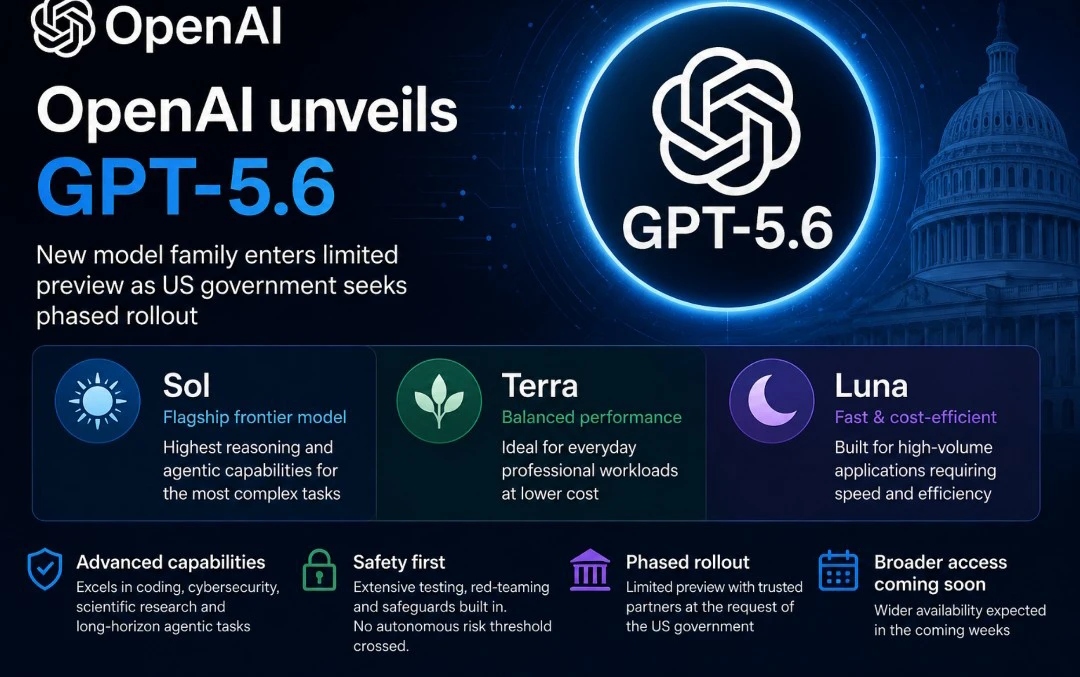
OpenAI has unveiled GPT-5.6 Sol, Terra and Luna in a limited preview, delaying a wider rollout as the US government reviews frontier AI under a new security framework.
IMPHAL, June 27: OpenAI on Friday unveiled GPT-5.6, its newest generation of large language models, but the company stopped short of making the technology immediately available to the public. Instead, access has been restricted to a small group of trusted partners following a request from the United States government, marking one of the clearest signs yet of Washington's growing involvement in the deployment of frontier artificial intelligence systems.
The new release introduces a family of three models—GPT-5.6 Sol, the flagship frontier model; GPT-5.6 Terra, designed to balance performance with operating costs for enterprise workloads; and GPT-5.6 Luna, a faster and more affordable model intended for high-volume applications. Together, they represent OpenAI's latest effort to improve reasoning, coding, scientific analysis and long-running autonomous AI tasks while keeping deployment costs lower than previous flagship systems.
Unlike previous model launches that were rolled out directly to developers and ChatGPT users, GPT-5.6 is beginning with what OpenAI describes as a "limited preview". The company said it shared the capabilities of the new models with the US government before launch and agreed to initially provide access only to selected organisations whose participation had been communicated to federal authorities.
The decision follows a recent policy shift in Washington aimed at increasing oversight of highly capable AI systems. Earlier this month, US President Donald Trump signed an executive order establishing a voluntary framework that allows frontier AI developers to provide the government with early access to powerful models before they are released more broadly. The objective is to give security agencies time to evaluate potential national security risks, including cyberattacks, military misuse and other emerging threats.
OpenAI said the current restrictions are temporary and are intended to support the development of a broader framework for future AI releases. At the same time, the company cautioned that lengthy government reviews should not become the norm, arguing that researchers, developers, businesses and cybersecurity professionals benefit from timely access to advanced AI capabilities.
Among the three new models, GPT-5.6 Sol is positioned as OpenAI's most capable system to date. According to the company, it has been optimised for software engineering, cybersecurity, scientific research, biology and complex reasoning that may require sustained attention over extended periods.
OpenAI has also introduced two specialised operating modes for Sol. A "Max" mode is designed for deeper reasoning on difficult problems, while an "Ultra" mode enables orchestration of multiple sub-agents for long and sophisticated workflows. These additions reflect the industry's growing emphasis on AI agents capable of completing multi-step tasks with minimal human supervision.
The company said Terra is aimed at organisations seeking a balance between capability and efficiency for everyday professional work, while Luna is intended for applications requiring lower operating costs and high throughput without sacrificing reliability.
OpenAI claims GPT-5.6 performs particularly well in areas where previous models have already found widespread adoption. These include writing and debugging software, analysing large datasets, conducting scientific research, solving complex reasoning problems and supporting long-horizon agentic workflows.
The company also said the new models remain focused during extended tasks, reducing the likelihood of losing context or drifting away from user instructions—a challenge that has affected earlier generations of AI assistants.
Safety remains a central theme of the GPT-5.6 launch.
OpenAI said it devoted more than 700,000 GPU hours to automated evaluations and combined those tests with external assessments and extensive red-team exercises before making the models available, even in limited preview. According to the company, GPT-5.6 does not cross the thresholds defined in its Preparedness Framework for dangerous autonomous cyber capabilities, although it acknowledged that frontier AI systems require continued monitoring as their capabilities improve.
The emphasis on cybersecurity reflects increasing concern among governments that advanced AI systems could eventually assist malicious actors in identifying software vulnerabilities, automating cyberattacks or accelerating sensitive scientific research. These concerns have become a significant factor shaping AI regulation in the United States.
The launch of GPT-5.6 comes at a time when frontier AI has become an important national security issue rather than merely a commercial technology.
Washington has intensified its engagement with leading AI developers over the past year as model capabilities have advanced rapidly. Officials are increasingly examining how highly capable AI systems should be evaluated before public deployment, particularly those with sophisticated cybersecurity and autonomous reasoning abilities.
Industry observers note that OpenAI's decision to limit the initial release of GPT-5.6 represents a new phase in relations between AI companies and governments, where national security reviews may become a routine part of launching next-generation models.
Although only selected organisations have access for now, OpenAI said GPT-5.6 will become available more broadly in the coming weeks after the current review process is completed. The company has not announced a specific public release date for ChatGPT users or API developers.
The introduction of GPT-5.6 also highlights the increasingly competitive race among major AI developers to build more capable systems while addressing mounting demands for safety, transparency and regulatory oversight. As governments seek a greater role in supervising frontier AI, companies are likely to face closer scrutiny over how powerful new models are tested and deployed before reaching the public.