A Parliamentary Committee has urged targeted support for displaced women and children in Manipur, while the Ministry of Women and Child Development maintains that existing schemes can address their needs.
Imphal, June 16: A Parliamentary Standing Committee has urged the Ministry of Women and Child Development to consider targeted interventions for internally displaced women and children in Manipur, highlighting the scale of the ongoing humanitarian crisis, even as the Ministry defended its reliance on existing schemes and ruled out the need for a separate mechanism.
The observations were made in the Department-Related Parliamentary Standing Committee on Education, Women, Children, Youth and Sports’ Action Taken Report (Report No. 379) on the Demands for Grants (2025–26) of the Ministry of Women and Child Development (MWCD).
The committee described the situation in Manipur as a crisis of an “extraordinary and humanitarian nature,” noting that the state has been grappling with unrest for nearly two years. According to the report, hundreds of lives have been lost and between 50,000 and 60,000 people have been internally displaced since the outbreak of violence.
The committee said a large proportion of those displaced are women and children who continue to live in relief camps after losing their homes and livelihoods. It noted that displacement has disrupted access to education, nutrition and healthcare while exposing vulnerable groups to severe psychological and social consequences.
Children, pregnant women, lactating mothers and elderly women were identified as among the worst affected sections of the population.
The report referred to findings of the National Commission for Women (NCW), which conducted enquiry visits and consultations with local women’s groups and student organisations in Manipur.
According to the committee, the NCW reported that many participants expressed a “loss of faith and confidence in the system” while discussing the challenges faced by women during the ongoing conflict.
The report further noted that women have borne a disproportionate burden of the violence and displacement. It also highlighted concerns that many incidents of violence against women remain unreported because of fear, stigma and social pressures.
In view of these findings, the committee recommended that the NCW remain actively engaged with developments in Manipur and take proactive steps to ensure that complaints and concerns raised by women are brought to the attention of relevant authorities and acted upon promptly.
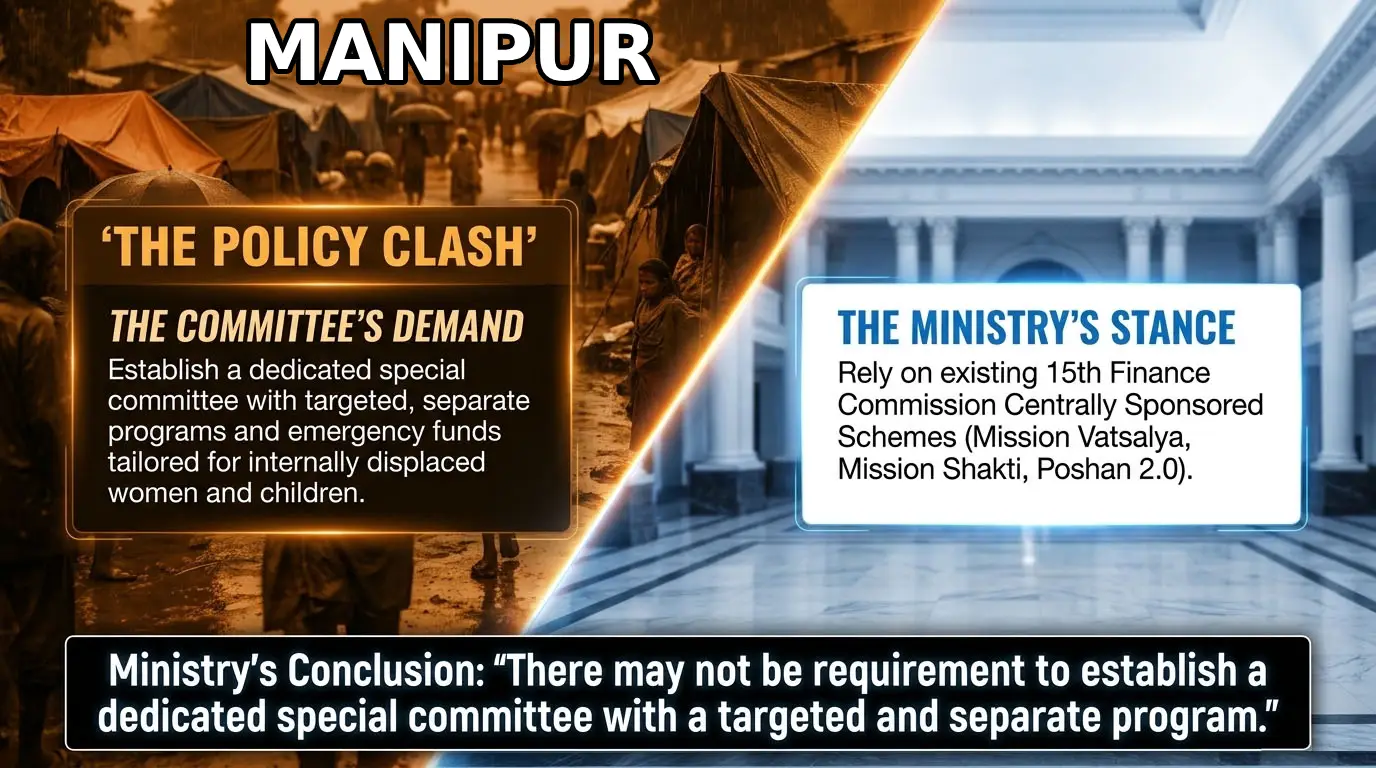
One of the key recommendations made by the committee is the creation of a dedicated mechanism to specifically address the needs of internally displaced women and children.
The committee expressed concern that routine administrative responses may not be sufficient to deal with the scale and complexity of the crisis. It therefore urged the Ministry of Women and Child Development to establish a dedicated special committee along with a targeted programme, policy or scheme focused exclusively on displaced women and children in Manipur.
According to the report, such a mechanism would enable direct monitoring of relief efforts and ensure transparent delivery of assistance while reducing the possibility of misuse of resources.
The committee also outlined a series of immediate priorities that require attention in relief camps.
These include ensuring uninterrupted education for displaced children, healthcare services for pregnant and lactating mothers, livelihood opportunities for affected women and stronger safeguards against sexual violence and exploitation.
The report stressed that women and children living in relief camps require additional support beyond routine welfare measures due to the prolonged nature of the displacement.
The committee highlighted the need for better living conditions in relief camps and called for additional financial support to maintain essential services until normalcy returns.
It specifically recommended enhanced provision of nutritious food, breakfast, adequate accommodation facilities and healthcare services for displaced women and children.
The committee observed that long-term displacement has placed enormous pressure on relief infrastructure and that targeted interventions are necessary to prevent further deterioration in living conditions.
Responding to the committee’s recommendations, the Ministry of Women and Child Development maintained that its existing schemes are capable of addressing the needs of affected populations in Manipur.
The ministry stated that there may not be a requirement to establish a separate committee or dedicated scheme because multiple centrally sponsored programmes are already operational in the state.
Among them is Mission Vatsalya, which focuses on child protection and rehabilitation. Under the programme, 78 Child Care Institutions (CCIs) have been approved for Manipur. These institutions provide education, healthcare, vocational training and rehabilitation support for children in difficult circumstances.
The ministry also noted that financial assistance of Rs 4,000 per child is available under various non-institutional care measures, including sponsorship, foster care and after-care support.
Under Mission Shakti, which focuses on women’s safety and empowerment, Manipur currently has 16 operational One Stop Centres that have assisted 2,059 women. The Women Helpline (181) has reportedly received 37,882 calls and provided direct assistance to 1,415 women.
The state also has 43 Shakti Sadans and 18 Sakhi Niwas facilities with a combined capacity of 1,140 beds for women in distress and working women.
The ministry further pointed to Mission Saksham Anganwadi and Poshan 2.0, which aims to improve nutrition and healthcare services for children, pregnant women and lactating mothers.
Despite the ministry’s assurances, the Parliamentary Committee concluded that existing arrangements may not be sufficient to address the unique challenges posed by the conflict in Manipur.
The report stated that reliance solely on existing schemes may not adequately meet urgent requirements relating to nutrition, safe accommodation, healthcare and psycho-social support.
The committee reiterated that temporary and targeted financial assistance remains essential to ensure that displaced women and children are not deprived of basic necessities while residing in relief camps.
It recommended that the ministry conduct a focused assessment of conditions in relief camps and consider earmarking additional funds or providing greater flexibility within existing schemes to respond to emerging needs.
The report also highlighted initiatives undertaken by the National Commission for Women in the state.
According to the report, the NCW is implementing two projects aimed at supporting the livelihoods of internally displaced women in Kakching and Bishnupur districts through collaboration with non-governmental organisations. These projects are expected to run for six months.
The commission has also conducted gender sensitisation programmes for police personnel and capacity-building initiatives for elected women representatives.
In addition, the report noted that an Empowered Committee has appraised a proposal for the construction of Working Women Hostels in Imphal West, Imphal East and Thoubal districts under the Nirbhaya Fund. The project has an approved cost of Rs 23.28 crore.
The committee concluded that the humanitarian situation in Manipur requires a more coordinated and focused response than what is currently being provided through routine administrative mechanisms.
It urged the Ministry of Women and Child Development to work closely with other ministries and agencies to assess the full impact of the crisis and strengthen support systems for displaced women and children.
The report underlined that restoring dignity, security and access to essential services for thousands of displaced families remains a critical challenge, and called for sustained humanitarian intervention until lasting peace and normalcy are restored in the state.