PAPPM has held the Indian State responsible for the killing of six Liangmai Naga men and demanded the scrapping of the SoO agreement with Kuki militant groups.
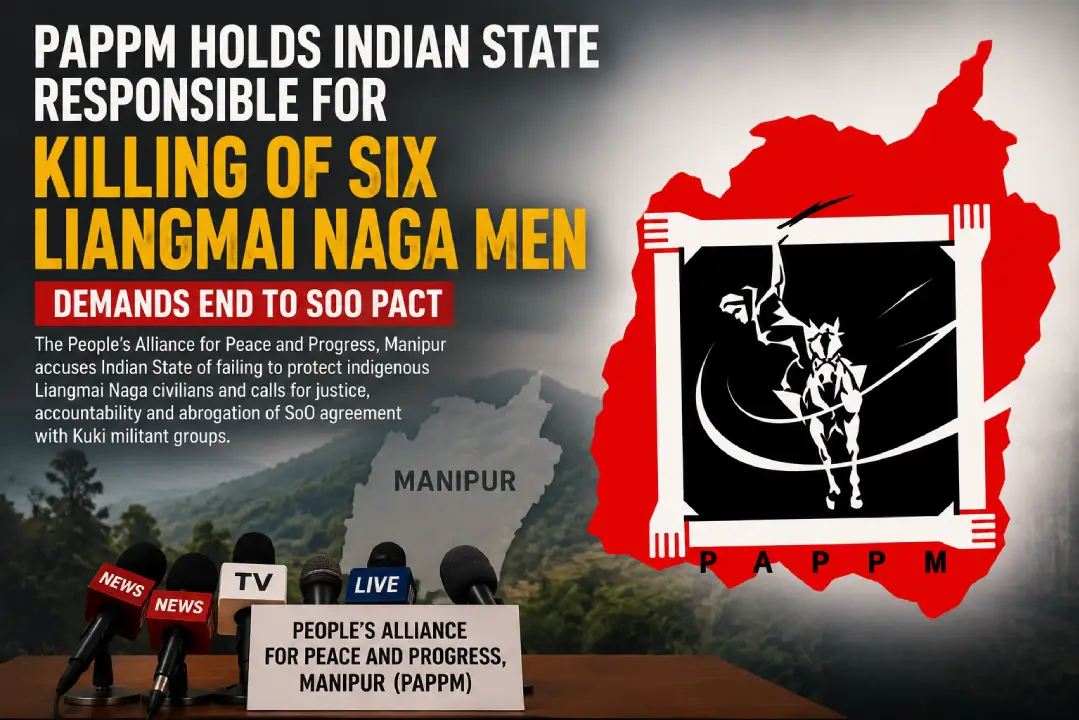
Imphal, June 13: The People's Alliance for Peace and Progress, Manipur (PAPPM) has accused the Indian State of bearing full responsibility for the abduction and killing of six Liangmai Naga civilians whose bodies were recovered in Kangpokpi district earlier this month, and has demanded the immediate abrogation of the Suspension of Operations (SoO) agreement with Kuki militant groups.
In a strongly worded press statement issued on Saturday, PAPPM alleged that the killings were a direct consequence of what it described as the failure of the SoO framework, under which several Kuki insurgent groups operate under a ceasefire arrangement with the Government of India.
The organisation identified the six victims as Kenpibou Chawang, Manu Thiumai, Phenrongwibo Thiumai, Dilip Thiumai, Kaliwangbou Abonmai and Ch. Phenrilung. According to PAPPM, all six were indigenous Liangmai Naga residents of the Koubru range who were abducted on May 13, 2026.
The bodies of the six men were recovered on June 10 near Leilon Vaiphei village in Kangpokpi district after nearly a month of uncertainty over their whereabouts.
PAPPM alleged that the victims had been kidnapped by cadres of the Kuki National Front (President), or KNF-P, which is among the groups operating under the SoO agreement. The organisation claimed that the victims were killed in a brutal manner and said the condition of the bodies had made identification difficult.
Describing the incident as a grave humanitarian and security failure, PAPPM argued that responsibility extends beyond the perpetrators and reaches the institutions overseeing the SoO mechanism.
“The Suspension of Operations regime is an instrument of the Indian State, and the Indian State alone bears the moral, legal and political accountability for this atrocity,” the statement said.
The organisation maintained that the Liangmai Nagas are indigenous inhabitants of the Koubru range and asserted that the killings occurred within their ancestral homeland. It alleged that the current security framework has enabled armed groups to exercise influence in areas where indigenous communities reside.
PAPPM further argued that the SoO arrangement has created an imbalance in which armed groups continue to retain organisational and military structures while local communities remain vulnerable.
According to the statement, the organisation believes that the killings were not an isolated incident but part of a broader pattern of tensions and violence that have affected parts of Manipur in recent years.
The group also criticised the implementation of the SoO agreement, contending that the framework has failed to prevent violence despite provisions intended to restrain armed groups from engaging in unlawful activities.
PAPPM specifically referred to KNF-P leader Semtinthang Kipgen and highlighted that he is the husband of Manipur Deputy Chief Minister Nemcha Kipgen. The organisation alleged that this relationship creates a serious conflict of interest and called for her removal from office pending investigation.
The statement further accused authorities of failing to adequately enforce the ground rules of the SoO agreement and questioned why stronger action had not been taken against groups accused of involvement in violent incidents.
PAPPM also cited earlier incidents, including the alleged vandalism of Naga memorial stones in Ireng village and an attack on villagers repairing a water supply line in Konsakhul. It claimed these incidents had been reported to authorities but did not result in effective intervention.
The organisation warned that unless there is a fundamental review of existing policies, similar incidents could occur again.
Among its principal demands, PAPPM called for the immediate termination of the SoO agreement with all Kuki militant organisations. It argued that the arrangement has failed to protect civilian lives and has instead contributed to insecurity in affected areas.
The organisation also demanded that KNF-P be declared a terrorist organisation and sought a transparent, time-bound judicial investigation into the abduction and killing of the six Liangmai Naga men.
In addition, PAPPM urged the government to provide compensation of Rs 1 crore to each bereaved family and deploy central security forces, excluding the Assam Rifles, in vulnerable villages of the Koubru range.
It further sought administrative changes that would place the Koubru range under the jurisdiction of the Superintendent of Police, Imphal West, and called for greater security measures to safeguard indigenous settlements.
The organisation also demanded what it termed a public acknowledgment of the shortcomings of the SoO framework and insisted that accountability must extend beyond criminal investigations into the broader policy structure governing relations between the State and armed groups.
Concluding its statement, PAPPM said that merely transferring the case to investigative agencies would not address deeper concerns raised by the killings. It urged the Government of India to undertake comprehensive corrective measures and ensure justice for the victims and their families.
The statement ended with a tribute to the six deceased men and reiterated the organisation’s demand for accountability, security reforms and justice.