Prime Minister Narendra Modi commissioned INS Dunagiri, INS Sanshodhak and INS Agray in Kolkata, highlighting India's growing maritime strength and defence self-reliance.
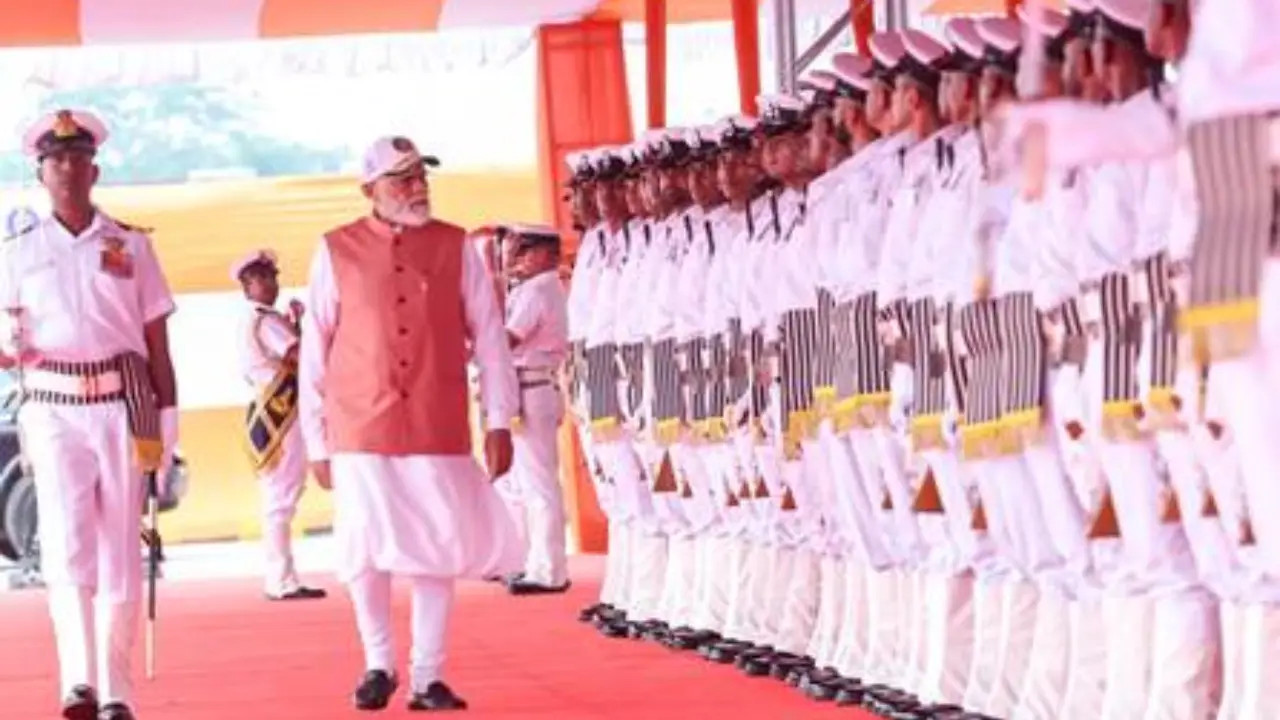
Kolkata, June 21: Prime Minister Narendra Modi on Sunday commissioned three frontline naval platforms — INS Dunagiri, INS Sanshodhak and INS Agray — into the Indian Navy, describing the induction as a significant milestone in India's pursuit of maritime security, self-reliance and strategic capability.
The commissioning ceremony, held in Kolkata, marked the addition of an advanced stealth frigate, a hydrographic survey vessel and an anti-submarine warfare shallow water craft to the Navy's operational fleet. The vessels have been designed and built in India and are expected to strengthen maritime surveillance, domain awareness, anti-submarine operations and overall naval preparedness.
Addressing the gathering, the Prime Minister said maritime strength has become a critical factor in determining a nation's economic and strategic influence.
"No nation can emerge as a major power without strong maritime capabilities. Development, security and prosperity are closely linked to the oceans," he said, noting that global trade routes, underwater communication networks, critical minerals and future energy resources are increasingly connected to the maritime domain.
The Prime Minister pointed out that June 21 is observed globally as World Hydrography Day and noted the significance of commissioning INS Sanshodhak, India's latest hydrographic survey vessel, on the same day.
He described the induction of the three naval platforms as evidence of India's growing technological capabilities and indigenous defence manufacturing strength.
"The journey from INS Vikrant to today is not merely the journey of new warships, it is the journey of India's growing self-reliance," Modi said.
According to the Prime Minister, all three platforms represent India's commitment to indigenous design, innovation and manufacturing. He said the vessels showcase the capabilities of Indian industries, engineers and workers while reflecting the country's determination to reduce dependence on foreign defence suppliers.
The Prime Minister stressed that India aims to emerge not only as a buyer of defence equipment but also as a producer and manufacturer capable of contributing to the global defence industry.
Highlighting recent progress in naval modernisation, he said more than 40 indigenously built warships and submarines have been inducted into the Indian Navy in recent years, while another 45 major naval platforms are currently under construction.
He added that these developments demonstrate the country's expanding industrial capacity and long-term defence ambitions.
INS Dunagiri, an advanced stealth frigate, is designed to enhance the Navy's combat capabilities and operational reach. The warship incorporates modern technologies aimed at improving survivability and mission effectiveness in diverse maritime environments.
INS Sanshodhak, classified as a Survey Vessel (Large), will undertake hydrographic surveys and support navigation safety. The vessel is expected to strengthen India's maritime domain awareness and provide critical data for naval operations and maritime infrastructure development.
INS Agray, an Anti-Submarine Warfare Shallow Water Craft, has been developed to detect, track and neutralise underwater threats in coastal and shallow-water regions. The vessel is expected to play an important role in safeguarding India's coastline and strategic maritime assets.
Defence Minister Rajnath Singh described the induction of the three vessels as a reflection of India's growing defence manufacturing ecosystem and the success of the Aatmanirbhar Bharat initiative.
He said the platforms stand ready to protect national interests and contribute to a secure and stable Indian Ocean Region.
During his address, the Prime Minister also highlighted the economic potential of the maritime sector, describing it as a major driver of employment and industrial growth.
He noted that shipbuilding requires extensive supply chains involving steel, electronics, machinery and thousands of specialised components. According to him, more than 200 micro, small and medium enterprises contributed to the construction of the three vessels.
The Prime Minister said the government is pursuing a broader vision for maritime development through policy reforms and investment initiatives aimed at expanding India's shipbuilding capacity.
Referring to the government's incentive package for the shipping sector, he said the allocation of 70,000 crore is intended to strengthen India's maritime future and industrial capabilities.
He also highlighted initiatives such as Sagarmala, which seek to improve port connectivity, reduce logistics costs and stimulate economic activity in coastal regions.
Modi said India's defence manufacturing sector has undergone significant transformation over the past decade.
He noted that India's annual defence production, which stood at around 40,000 crore in 2014, has increased to nearly 1.8 lakh crore. The growth, he said, reflects the impact of policy reforms and efforts to promote indigenous production, research and exports.
According to the Prime Minister, the expansion of domestic defence manufacturing has opened new opportunities for innovation, employment and technological advancement while strengthening national security.
Reiterating India's approach to maritime affairs, the Prime Minister said the country has traditionally viewed the oceans as a medium of cooperation, connectivity and shared prosperity.
At the same time, he stressed that strength remains essential to preserving peace and protecting national interests.
He said INS Dunagiri, INS Sanshodhak and INS Agray symbolise a confident and self-reliant India that is strengthening its maritime capabilities while contributing to regional stability and security.
The commissioning ceremony was attended by senior naval officers, defence officials, scientists, engineers, shipyard workers and representatives of the defence manufacturing sector.
The induction of the three indigenous platforms is expected to further strengthen the Indian Navy's operational readiness as India continues to expand its maritime presence and strategic reach in the Indian Ocean region.