The duty of journalism is to report the truth accurately and fairly. Citizens must engage with information responsibly, while governments must respond to legitimate problems it reveals. When each fulfills its role, public trust grows and democratic accountability becomes possible.
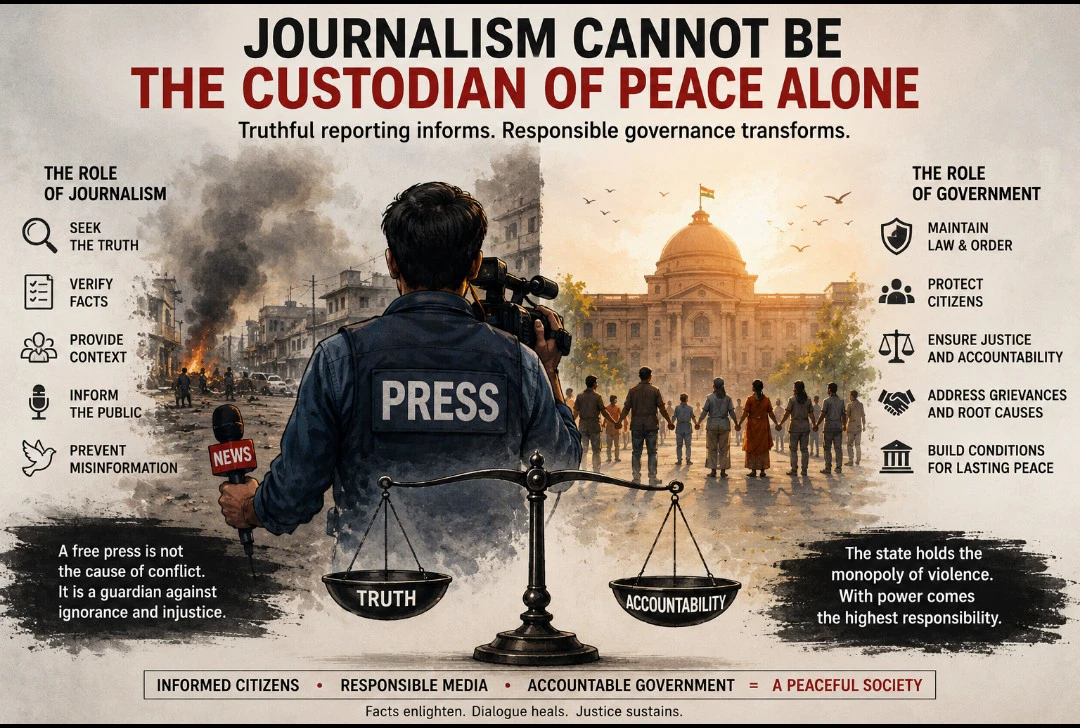
Remarks made by Manipur Home Minister Govindas Konthoujam during a function marking World Environment Day and the ninth foundation day of the All Bishnupur District Working Journalists' Union have sparked discussion beyond the event itself. Addressing journalists, the minister stressed the role of the media in maintaining peace and stability amid Manipur's continuing crisis. Some of his observations were difficult to disagree with. Others raise important questions about responsibility, accountability, and the role of a free press in a democracy.
No serious journalist would dispute that media reporting carries consequences, particularly in a conflict-affected society. Rumours can spread rapidly. Unverified claims can inflame tensions. Irresponsible reporting can deepen mistrust between communities. In such circumstances, calls for verification, accuracy, restraint, and professional responsibility are not only reasonable but necessary.
When the Home Minister urged journalists to thoroughly screen information before publication and avoid content that could unnecessarily destabilize society, he was expressing a principle that sits at the heart of ethical journalism. Every newsroom should aspire to that standard.
The concern arises elsewhere.
Among the minister's remarks, the most striking was the assertion that whether unrest is controlled or whether "the fire burns again" depends entirely on journalists. Even if intended as an appeal to responsibility, the statement places an extraordinary burden on the media while inadvertently raising questions about the role of other institutions, particularly the government itself.
Violence does not emerge from newspaper reports or television broadcasts. Conflicts arise from political disputes, social grievances, failures of governance, security challenges, economic conditions, and the actions of individuals and organised groups. Journalists report on these realities; they do not create them.
In modern states, governments possess what political theorists describe as the legitimate monopoly over the use of force. Through police, security agencies, laws, and administrative institutions, the state carries the primary responsibility for maintaining public order and protecting citizens. When violence occurs, citizens naturally expect explanations and corrective measures from those institutions.
To suggest that peace or unrest depends entirely on journalists risks shifting attention away from that fundamental responsibility.
This is not to diminish the influence of the media. Journalism undoubtedly shapes public understanding. A false report can cause harm. A reckless headline can inflame passions. But influence should not be confused with responsibility for the underlying causes of conflict. The distinction matters.
Another remark likely to draw debate was the observation that "bad news are always good news for media persons." It is true that tragedies, crimes, and conflicts often receive greater public attention than routine developments. This is not unique to Manipur; it is a characteristic of news consumption worldwide.m
However, there is a danger in assuming that journalists cover unpleasant events because they are attracted to negativity. Most reporters would argue the opposite. Violence, corruption, displacement, administrative failures, and public grievances are covered because they affect people's lives and therefore carry public significance.
A journalist reporting on a killing is not promoting violence. A journalist reporting on corruption is not encouraging corruption. A journalist reporting on institutional failures is not responsible for those failures.
The role of journalism is not to manufacture optimism or pessimism. It is to document reality as accurately as possible.
That reality includes positive developments. Development projects, environmental initiatives, successful public programmes, educational achievements, and community reconciliation efforts deserve meaningful coverage. Newsrooms should make greater efforts to tell such stories.
Yet development reporting cannot become a substitute for accountability reporting.
A society does not become more peaceful because uncomfortable facts remain unreported. In many cases, the opposite is true. Problems ignored often become problems intensified. Public awareness allows citizens, institutions, and governments to identify shortcomings and respond to them. This principle lies at the heart of democratic journalism.
The broader idea behind factual reporting is simple. Citizens are not passive recipients of information. They are social beings capable of judgment, reflection, and moral choice. Journalism provides verified information. Citizens evaluate it. Governments analyse it. Institutions respond to it. Corrective measures follow where necessary.
In this model, the press functions neither as an arm of the state nor as an instrument of social control. It functions as a public service that enables society to see itself clearly. That clarity is not always comfortable.
The press has often been described as a mirror. A mirror does not create scars, flaws, achievements, or successes. It merely reflects them. Blaming the mirror for what it reveals rarely addresses the underlying condition.
Manipur's path toward lasting peace will require efforts from many actors: government institutions, security agencies, civil society organisations, community leaders, political representatives, and ordinary citizens. Journalists have an important role within that process, but they cannot carry it alone.
Responsible journalism is essential to peace. So too are responsible governance, accountability, justice, and public trust.
The challenge before Manipur is not to decide whether journalists should report difficult truths. The challenge is to ensure that those truths, once revealed, lead to meaningful action rather than misplaced responsibility.