RBI’s latest statistics handbook shows Sikkim leading Northeast India in income, Manipur excelling in health outcomes, while Assam and Meghalaya face employment and structural economic challenges.
Imphal, June 1: The Reserve Bank of India’s latest Handbook of Statistics on Indian States presents a detailed and sharply contrasting picture of Northeast India, showing a region that has made major gains in education, healthcare and connectivity, but continues to face deep structural challenges in employment generation, financial reinvestment and balanced economic growth.
The 10th edition of the handbook, released on December 11, 2025, covers all eight Northeastern states — Arunachal Pradesh, Assam, Manipur, Meghalaya, Mizoram, Nagaland, Sikkim and Tripura — and reflects a notable shift in national policy thinking.
For the first time, the RBI has integrated “External Sector” and “Environment” as major statistical pillars in the report, signalling that the Northeast is increasingly being viewed not merely as a frontier region requiring infrastructure support, but as a strategic economic gateway and ecological asset within India’s “Viksit Bharat 2047” framework and the broader “Act East” policy.
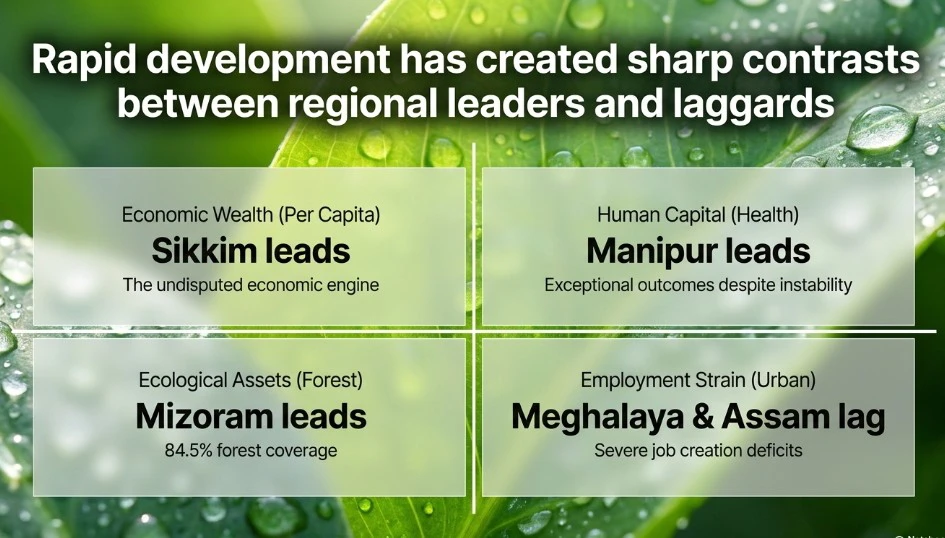
The data shows Sikkim emerging as the Northeast’s strongest economic performer, while Manipur has recorded some of India’s best health outcomes. At the same time, Assam and Meghalaya continue to face major pressures related to urban unemployment, lower income levels and uneven financial development.
Sikkim Emerges as Northeast’s Wealthiest State
Among all Northeastern states, Sikkim recorded the highest Per Capita Net State Domestic Product (NSDP) for 2024-25 at current prices, estimated at around Rs. 5.8 lakh — more than three times the national average of Rs. 1.85 lakh.
The figure places Sikkim among India’s top-performing states economically and far ahead of the rest of the Northeast.
The report attributes the state’s performance to a combination of tourism, pharmaceutical manufacturing, organic agriculture and a growing services economy. Sikkim also recorded one of the region’s strongest Sustainable Development Goal (SDG) scores at 75.
The Himalayan state additionally maintained strong social indicators. Its Infant Mortality Rate (IMR) dropped from 32 in 2004 to just 6 in 2023, placing it among the country’s best-performing states in healthcare outcomes.
Mizoram and Arunachal Pradesh followed Sikkim economically with per capita NSDP figures of around Rs. 2.45 lakh and Rs. 2.2 lakh respectively.
Mizoram also emerged as one of the region’s strongest overall performers. The state recorded high educational indicators, one of the country’s highest forest cover ratios at 84.5 percent, and tele-density of 128.5 — significantly above the national average of 85.7.
The services sector now contributes more than 62 percent of Mizoram’s Net State Value Added (NSVA), driven by public administration and tourism-linked activities.
Manipur Records Exceptional Health and Social Indicators
While Manipur remains economically below the national average with per capita NSDP estimated at Rs. 1.15 lakh, the state emerged as one of the Northeast’s strongest performers in health and human development indicators.
According to RBI data, Manipur recorded an Infant Mortality Rate of just 3 in 2023, among the lowest in India and dramatically lower than the national average of 25.
The state also maintained strong educational outcomes. Its Gross Enrolment Ratio (GER) at the foundational level stood at 91.9, while secondary GER reached 68.7, marginally above the national benchmark.
The report further noted that Manipur’s Total Fertility Rate (TFR) has fallen to 1.5, below replacement level, indicating an ongoing demographic transition toward population stabilization.
At the same time, multidimensional poverty data showed major improvement. Manipur’s poverty headcount ratio dropped from 16.96 percent under NFHS-4 to 8.10 percent under NFHS-5, suggesting substantial expansion of welfare access and social support systems.
The findings present a complex picture of Manipur — a state facing prolonged political and security instability in recent years, yet continuing to record strong social development indicators compared to many larger states.
Assam’s Growth Story Remains Uneven
Assam, the Northeast’s largest economy and biggest export contributor, recorded mixed outcomes across sectors.
The state achieved major improvements in healthcare over the past two decades. Its Infant Mortality Rate declined from 66 in 2004 to 30 in 2023, while Maternal Mortality Ratio dropped sharply from 480 during 2004-06 to 110 during 2021-23.
Assam also recorded the region’s largest reduction in multidimensional poverty, with the poverty headcount ratio falling from 32.65 percent to 19.35 percent between NFHS-4 and NFHS-5.
However, despite being the region’s economic centre and export leader, Assam continues to remain below the national average in per capita income, with per capita NSDP estimated at around Rs. 1.2 lakh.
Urban unemployment in the state stood at 74 per 1000 persons during 2023-24, significantly above the national average of 51.
The report points to a structural contradiction within Assam’s economy — despite improvements in infrastructure, exports and welfare indicators, job creation in urban and industrial sectors has not kept pace with the growing educated workforce.
Assam’s economy also remains more dependent on agriculture than many other Northeastern states. Agriculture contributes nearly 26 percent to Net State Value Added, making the economy more vulnerable to floods, climate shocks and seasonal disruptions.
At the same time, Assam remained the Northeast’s largest export hub in 2024-25, recording exports valued at around Rs. 22,500 crore, largely driven by tea and petroleum products.
Meghalaya and Arunachal Face Urban Employment Stress
The report identified Meghalaya and Arunachal Pradesh as two of the region’s most stressed states in terms of urban employment.
Meghalaya recorded the highest urban unemployment rate in the Northeast at 140 per 1000 persons, while Arunachal Pradesh followed closely at 128. Both figures were far above the national average of 51.
Nagaland also recorded severe urban employment pressure with unemployment of 113 per 1000 persons.
The data suggests that while educational access has improved across much of the Northeast, the expansion of formal urban industries and service-sector employment has lagged significantly behind.
Meghalaya, for instance, recorded the region’s highest foundational Gross Enrolment Ratio at 125.3, indicating strong school participation at the entry level. However, secondary-level progression and labour absorption remain weak.
Arunachal Pradesh showed a similar pattern. The state recorded relatively strong foundational education indicators but continued to struggle with labour market transition and low banking reinvestment.
Nagaland Shows Deep Secondary Education Gap
Among the major structural concerns highlighted in the report is what analysts describe as the Northeast’s “secondary lag” — a situation where foundational enrolment rates remain high, but secondary-level retention weakens sharply.
Nagaland illustrated this challenge most clearly. While the state recorded a foundational GER of 80.9, its secondary GER fell to 50.5, significantly below the national average of 68.5.
The report suggests this gap may eventually affect workforce quality, skill formation and higher education participation if not addressed through targeted interventions.
Tripura Maintains Relative Stability
Compared to several other Northeastern states, Tripura emerged as a relatively stable middle performer across multiple indicators.
The state recorded comparatively lower urban unemployment at 32 per 1000 persons, below the national average.
Tripura also maintained fiscal discipline, with Gross Fiscal Deficit estimated at 2.9 percent of Gross State Domestic Product for 2024-25 Budget Estimates.
Its Credit-Deposit ratio stood at 43.1 percent, indicating moderate reinvestment of local deposits within the state economy.
While not among the region’s highest-income states, Tripura’s relatively balanced performance across employment, fiscal management and banking indicators distinguished it from more volatile regional patterns.
Banking and Credit Gaps Reveal Structural Weaknesses
The RBI handbook also highlighted serious concerns regarding banking penetration and capital reinvestment across the Northeast.
The Credit-Deposit (CD) ratio — which measures how much local deposits are converted into local lending — remained weak in several states.
Sikkim recorded the strongest CD ratio in the region at 52.9 percent, followed by Manipur at 47.9 percent and Assam at 45.6 percent.
However, Meghalaya recorded a CD ratio of only 27.6 percent, while Arunachal Pradesh stood at 30 percent.
Economists often interpret such low ratios as indicators of capital outflow, weak private-sector investment ecosystems, low industrial activity or a shortage of bankable projects.
The data suggests that despite increasing financial inclusion and deposit growth, much of the region still struggles to retain capital for local economic expansion.
This has also reinforced dependence on government expenditure and central transfers in several states.
Connectivity Expansion Strengthens “Act East” Push
Infrastructure development remains central to the Northeast’s economic transformation. The report noted significant expansion of National Highway networks in Assam and Arunachal Pradesh, both viewed as critical corridors under India’s “Act East” strategy.
Improved road infrastructure is expected to support border trade, logistics, tourism and regional market integration with Southeast Asia.
Digital infrastructure has also expanded rapidly. Mizoram and Sikkim both recorded tele-density figures above 100, indicating multiple telecom connections per individual on average.
The report noted that stronger digital penetration could support digital banking, online education, remote healthcare and service-sector growth in geographically isolated areas.
Northeast’s Ecological Importance Gains National Attention
The new environmental indicators in the handbook also underline the Northeast’s increasing strategic importance in India’s climate and sustainability framework.
Mizoram recorded forest cover of 84.5 percent, while Arunachal Pradesh stood at 79.3 percent — both far above the national target of 33 percent.
The Northeast is increasingly being viewed as one of India’s largest carbon sinks and biodiversity zones, with growing significance in future climate policy and ecological conservation planning.
The inclusion of environmental and export indicators in the RBI handbook reflects a broader policy transition in how the region is being assessed — not only through welfare and infrastructure metrics, but also through sustainability, trade integration and long-term strategic value.
Overall, the RBI report presents a Northeast that is advancing unevenly but steadily. States such as Sikkim, Mizoram and Manipur have emerged as strong performers in specific sectors, while Assam, Meghalaya, Arunachal Pradesh and Nagaland continue to face structural pressures related to employment, economic diversification and financial reinvestment.
The data suggests that the next phase of the region’s development will depend not only on welfare gains and connectivity projects, but also on whether the Northeast can generate sustainable urban employment, strengthen private investment ecosystems and convert its strategic location into long-term economic growth.