Temporary restrictions have been imposed on Telegram ahead of the NEET-UG 2026 re-examination, with NTA citing the platform's alleged misuse by fraud networks and misinformation campaigns.
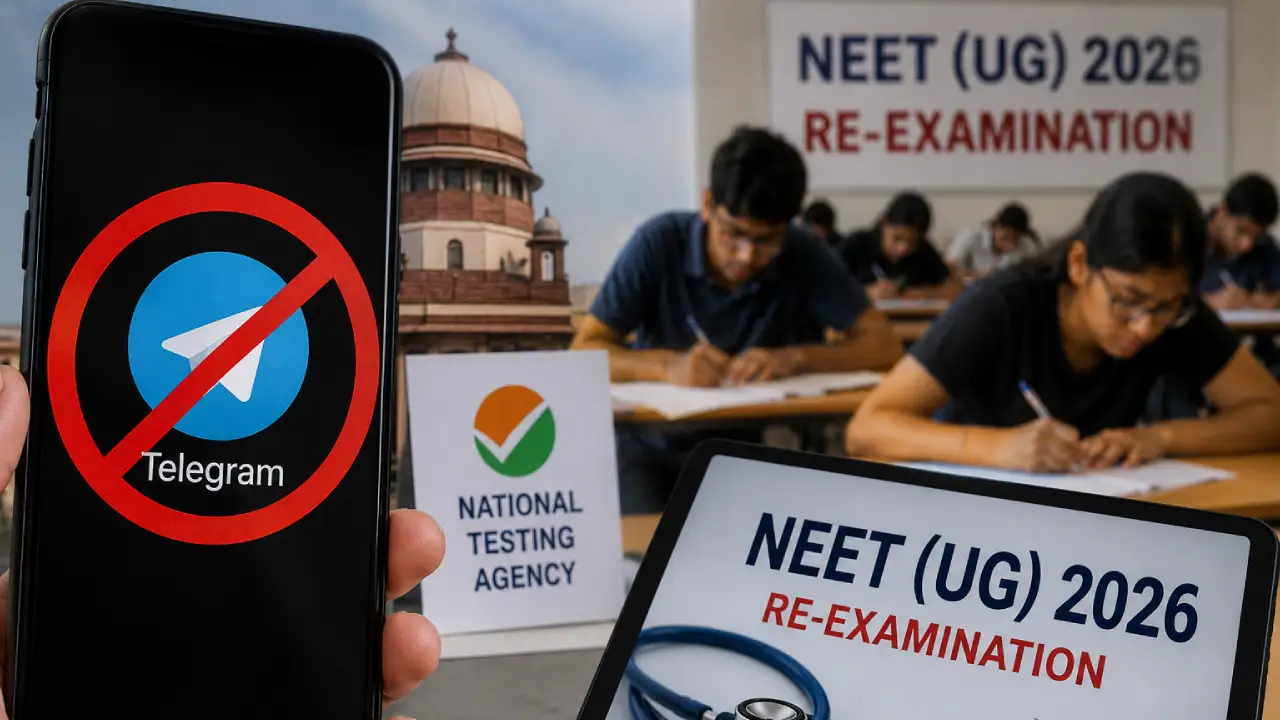
New Delhi, June 16: The National Testing Agency (NTA) on Tuesday said access to the Telegram messaging platform has been temporarily restricted in India ahead of the NEET (UG) 2026 re-examination, as authorities seek to curb online fraud, misinformation and alleged attempts to exploit candidates through fake paper leak claims.
The agency said the restrictions were issued by the Ministry of Electronics and Information Technology (MeitY) following recommendations from the NTA and the Department of Higher Education. According to the agency, the action is aimed at preventing organised cheating networks from using the platform to target candidates appearing for the medical entrance examination re-test scheduled on June 21.
Under the directions issued by MeitY, access to Telegram in India will remain restricted until June 22, covering the examination day and its immediate aftermath. In addition, the platform has been directed to disable the editing of previously posted messages in India until June 30.
The NTA said both measures are temporary and have been designed to address specific concerns identified during the run-up to the examination.
According to the agency, Telegram channels and groups have been used in recent weeks by fraudsters claiming to possess leaked NEET question papers and answer keys. These channels allegedly demanded payments ranging from a few thousand rupees to several lakh rupees from students and parents in exchange for purported access to examination material.
The agency reiterated that no question paper is available outside the secured examination chain and warned candidates against believing claims made by individuals or groups offering advance access to examination papers.
"The promise of any such material is, in every instance, a fraud," the NTA said.
The NTA said the latest restrictions were introduced after authorities concluded that action against individual channels and groups was insufficient to tackle the scale of the problem.
Over the past several weeks, the Indian Cyber Crime Coordination Centre (I4C) under the Ministry of Home Affairs has been coordinating efforts to identify and remove channels, groups and automated bots allegedly involved in fraudulent activities linked to the examination.
According to the agency, the operation involved intelligence inputs from state law-enforcement agencies, including police forces in Bihar, Gujarat and Rajasthan, along with continuous cyber monitoring by central agencies.
The NTA said a substantial number of channels and groups promoting fake paper leaks had already been taken down. However, authorities believed a broader response was required to address recurring misuse of the platform before the re-examination.
The agency described the latest measures as a "last resort" adopted after intermediate remedies had failed to secure adequate compliance at the platform level.
A key aspect of the government's action concerns Telegram's message-editing functionality, which the NTA said has allegedly been exploited to create fabricated evidence of examination paper leaks.
According to the agency, Telegram allows administrators of channels to edit previously posted messages while retaining the original timestamp. The feature can also permit the replacement of attached documents, including PDF files.
The NTA alleged that this capability has been used in several recent examinations to create misleading screenshots suggesting that examination papers had been circulated before the test.
Officials explained that after an examination concludes, an administrator can allegedly edit an older message and insert the actual question paper while preserving the original posting time. Screenshots of the edited message can then be circulated as supposed proof that the paper had been leaked in advance.
The agency said the temporary suspension of the editing feature is intended to prevent the creation of such post-examination artefacts during the critical period following the NEET re-test.
The NTA's statement also cited enforcement actions taken by state agencies against online examination fraud.
The Bihar Police Economic Offences Unit issued a public advisory on June 9 warning students and parents against individuals claiming to offer access to NEET question papers through Telegram and other online platforms.
Meanwhile, the Ahmedabad City Cyber Crime Branch arrested members of an alleged inter-state cyber fraud network that authorities said was operating eight Telegram channels using a similar modus operandi.
According to the NTA, investigators found evidence of transactions amounting to approximately Rs 21.5 crore routed through fraudulent bank accounts. The agency also said nearly 1,000 mobile phone users had allegedly been contacted by the network within a single month.
Investigations into similar activities are reportedly underway in multiple states.
While supporting the restrictions, the NTA acknowledged that the move would affect many legitimate users who rely on Telegram for educational, professional and personal communication.
The agency expressed regret over the inconvenience caused and noted that the access restriction has been limited to a short period ending on June 22.
The message-editing restriction, which will remain in place until June 30, does not prevent users from sending or receiving new messages through the platform, according to the statement.
The NTA said the measures were calibrated to address examination-related concerns while minimising disruption to ordinary users.
The agency said the NEET (UG) 2026 re-examination will proceed as scheduled on June 21 and stressed that the security of the examination remains unaffected.
Officials said the purpose of the restrictions is to strengthen public confidence in the examination process and prevent students from being targeted by fraudulent operators during the final days before the test.
Candidates have been advised to rely only on information available through the official NEET website and verified NTA communication channels.
The NTA also urged students and parents to report suspicious offers, claims of leaked question papers or requests for money to the National Cyber Crime Helpline at 1930 or through the National Cyber Crime Reporting Portal.
The agency thanked the Ministry of Electronics and Information Technology, the Ministry of Home Affairs, the Indian Cyber Crime Coordination Centre, the Central Bureau of Investigation and state police agencies for their role in combating examination-related cybercrime and misinformation.
With the re-examination less than a week away, the NTA said all agencies involved are working to ensure a fair, secure and credible test for candidates across the country.