Thadou Inpi Manipur has questioned a recent meeting between Kuki leaders and the Manipur Chief Minister, alleging attempts to influence public perception and investigations amid scrutiny over recent killings.
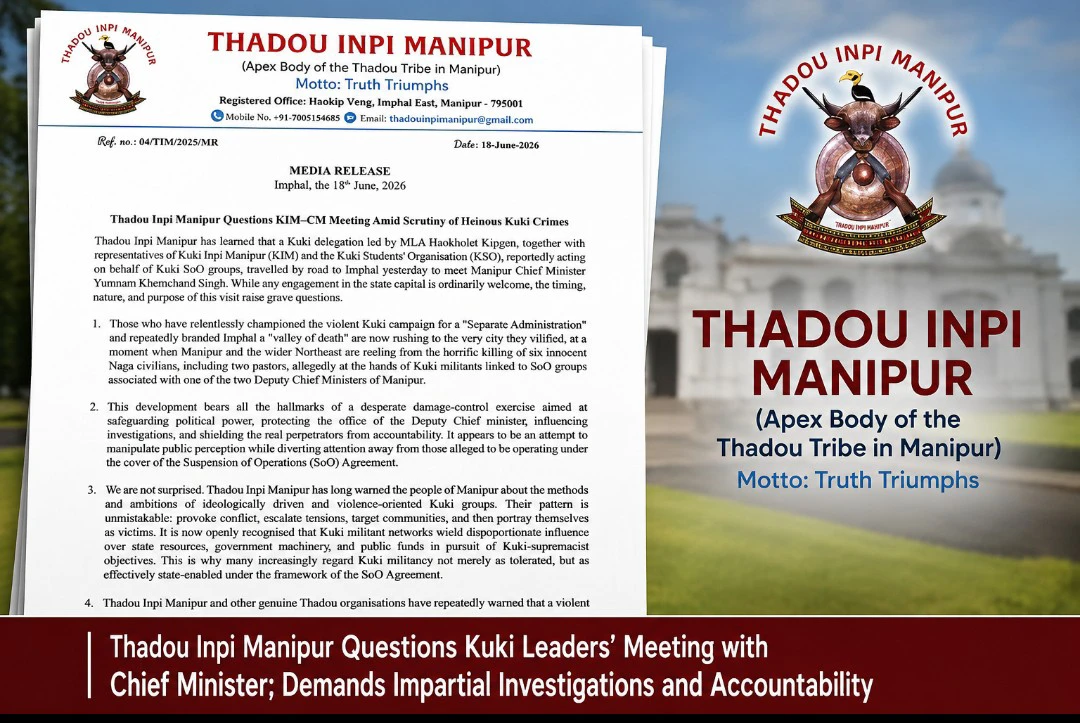
Imphal, June 18: Thadou Inpi Manipur (TIM), the apex body representing the Thadou tribe in Manipur, has raised concerns over a recent meeting between representatives of Kuki organisations and Chief Minister N Biren Singh, questioning the timing and purpose of the engagement amid ongoing scrutiny surrounding a series of violent incidents in the state.
In a media release issued on Thursday, TIM said a delegation led by MLA Haokholet Kipgen, accompanied by representatives of Kuki Inpi Manipur (KIM) and the Kuki Students' Organisation (KSO), reportedly travelled to Imphal to meet the Chief Minister. While acknowledging that meetings with government authorities are a normal part of democratic engagement, the organisation said the circumstances surrounding the visit warranted public scrutiny.
The statement comes at a time when tensions remain high following the recovery of six Naga civilians who were allegedly abducted and killed in the hill districts, as well as ongoing investigations into other recent incidents of violence.
According to TIM, the visit occurred at a sensitive moment when public attention remains focused on the killing of six Naga civilians and allegations linking armed groups operating under the Suspension of Operations (SoO) agreement to the incident.
The organisation alleged that groups which had previously advocated for a separate administrative arrangement and criticised Imphal were now engaging directly with the state government at a time when demands for accountability were intensifying.
TIM claimed the meeting appeared to be part of a broader effort to manage political fallout and shape public perception as investigations into recent incidents continue.
The organisation alleged that there were attempts to divert attention from those responsible for acts of violence and warned against any effort that could undermine public confidence in the investigative process.
A significant portion of the statement focused on criticism of armed groups operating under the Suspension of Operations agreement.
TIM alleged that certain militant networks had acquired disproportionate influence over political and administrative structures in pursuit of what it described as "Kuki-supremacist objectives."
The organisation further claimed that many people increasingly view militancy linked to SoO groups not as a temporary security arrangement but as a system that has enabled armed actors to continue exercising influence within the state.
These allegations were not accompanied by evidence in the statement, and the organisations named by TIM have not publicly responded to the claims.
The statement also argued that a strategy based on ethnic mobilisation and confrontation had ultimately isolated its proponents from neighbouring communities.
According to TIM, the continuing conflict involving different communities in Manipur demonstrates the failure of approaches rooted in ethnic exclusivity and political confrontation.
The organisation also directed criticism toward what it described as the Government of India's long-standing approach to the Kuki issue.
TIM alleged that policies aimed at accommodating Kuki demands had contributed to divisions within the state and weakened public confidence in institutions.
It further argued that the state's social and political realities are often oversimplified through frameworks that do not adequately reflect Manipur's ethnic diversity.
According to the organisation, lasting peace can only be achieved through policies that recognise the state's complex demographic composition and ensure equal treatment of all communities.
The statement asserted that governance decisions influenced by communal considerations have contributed to mistrust and instability over the years.
TIM also expressed concern over what it described as slow progress in investigations into several recent violent incidents.
The organisation noted that no arrests had been reported in connection with the killing of three Thadou pastors between Kotlen and Kotzim villages on May 13.
It further referred to the killing of six Naga civilians whose bodies were recovered earlier this month, alleging that despite widespread public discussion and identification of suspects by various groups, decisive action had yet to be taken.
The organisation also cited the killing of a Thadou individual, Nehkam Jomhao, in Assam in August 2025, claiming that similarities could be observed between that incident and more recent acts of violence.
Several of the allegations made by TIM regarding the circumstances of the killings remain unverified and are currently subjects of public debate and ongoing investigations.
Among the more significant assertions in the statement was the suggestion that recent killings involving Thadou and Naga victims may have been connected.
TIM said there was growing suspicion that those responsible for the killing of three Thadou pastors and the six Naga civilians could be linked, pointing to the fact that both incidents occurred within the same broad geographical area and within a similar timeframe.
The organisation stated that increasing scrutiny of militant activities may have prompted efforts to evade accountability and preserve particular narratives regarding the conflict.
However, no official investigation findings have been released to support such claims, and authorities have not publicly indicated any connection between the two cases.
While strongly criticising both militant groups and government policies, TIM concluded its statement by calling for transparent investigations and equal application of the law.
The organisation urged the Chief Minister, government authorities and the public to remain vigilant against any attempts to influence investigations or distort public discourse.
It argued that confidence could only be restored through impartial governance, transparent investigations and accountability for those responsible for acts of violence.
"Only by resisting political pressure, ensuring accountability, and upholding justice without fear or favour can Manipur reclaim its legacy of peace, communal harmony, justice, and coexistence," the statement said.
The statement concluded by reiterating a position adopted during the Thadou Convention in 2024, which maintains that the Thadou community constitutes a distinct ethnic group separate from the broader Kuki identity.
TIM stated that any organisation claiming to represent Thadou interests while simultaneously portraying Thadou as part of the Kuki community does not represent the position adopted by the convention.
The latest statement reflects continuing tensions over both the security situation in Manipur and the evolving political debates surrounding identity, representation and accountability amid the state's prolonged ethnic conflict.