As study rooms and learning pods emerge across urban Manipur, this article explores whether they are a passing trend or a practical response to domestic distractions, changing study habits, and the growing need for focused learning environments.
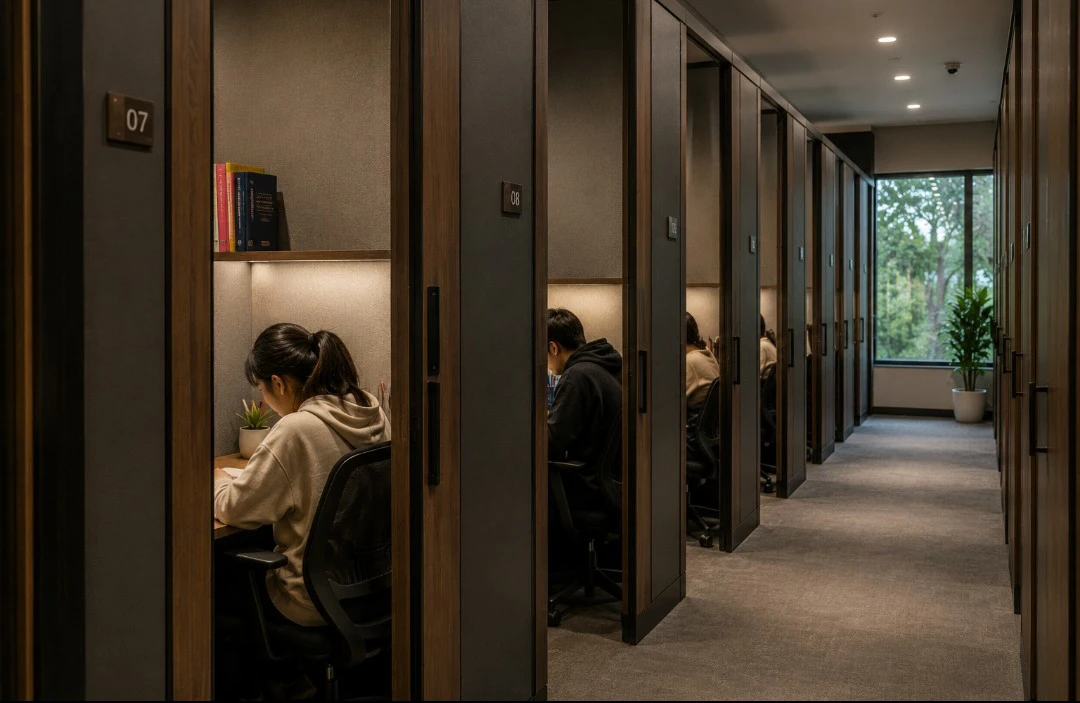
Not long ago, the idea of paying for a place merely to sit and study would have sounded unusual. For generations, students studied at home, in school libraries, on verandas, or wherever a quiet corner could be found. In our school days we even studied in a clearing near a bamboo groove or under a tree near the pond. Today, however, a new kind of educational business is quietly emerging in many towns and cities across India, including parts of Manipur. These are study rooms, study cafés, learning pods, and shared study spaces designed specifically for students who need an environment conducive to focused learning.
At first glance, the concept appears simple. A student pays a fee and gains access to a desk, chair, electricity, Wi-Fi, and a quiet atmosphere. Yet the growing popularity of such spaces raises an important question: are they merely a passing trend influenced by urban lifestyles, or are they responding to a genuine educational need?
The answer may reveal much about how learning itself is changing.
For many students, the greatest obstacle to studying is not a lack of intelligence or motivation. It is the environment. Educational discussions often focus on textbooks, teachers, examinations, or digital tools. Much less attention is given to the physical space where learning actually takes place.
In theory, home should be an ideal place for study. In reality, many students struggle with distractions. Some live in crowded households where multiple family members share limited space. Others deal with frequent visitors, television noise, household responsibilities, or the constant interruptions of mobile phones and social media.
As a former teacher, I often noticed that students who claimed they had studied for several hours sometimes struggled to explain even basic concepts from a lesson. The problem was not always effort. Many were attempting to study in environments that constantly fragmented their attention. Reading a chapter while family conversations unfold nearby is very different from studying in a quiet and dedicated learning space.
Research increasingly supports the importance of environment in learning. A study published in the Australasian Journal of Educational Technology found that students strongly valued learning spaces that were free from distractions and specifically designed for focused work. The research highlighted how dedicated learning environments contribute to engagement, concentration, and a sense of academic purpose.
This helps explain why study rooms are finding customers.
Across urban centres, study cafés and learning pods are being designed to offer exactly what many students lack at home: silence, structure, and separation from daily distractions. Unlike traditional cafés where conversation and socialising are expected, these spaces are intentionally built around concentration. Individual desks, charging points, ergonomic seating, air conditioning, stable internet connectivity, and quiet rules create an atmosphere that encourages sustained attention.
The attraction is not limited to competitive examination aspirants. School students, college learners, freelancers, online learners, and even working professionals preparing for government examinations increasingly use such facilities.
Interestingly, the demand for study spaces reflects a broader shift in our understanding of productivity. Many students have realised that learning is not only about willpower. It is also about reducing unnecessary friction.
Psychologists have long observed that environment influences behaviour. When distractions are constantly present, the brain must repeatedly expend energy resisting them. Over time, this creates mental fatigue. A well-designed study environment reduces the number of competing stimuli, allowing cognitive resources to be directed toward learning rather than self-control.
Studies on learning environments consistently show that noise, clutter, and interruptions negatively affect concentration and information retention. Students working in organised and distraction-free environments generally demonstrate better focus and sustained attention than those studying in chaotic surroundings.
This reality is particularly relevant in contemporary Manipur.
Many parents place great importance on education. Tuition classes are common. Students often spend significant amounts on coaching, textbooks, and digital resources. Yet relatively little investment is directed toward the learning environment itself.
At the same time, urban lifestyles are changing. Houses are becoming more compact. Families are increasingly connected through televisions, smartphones, and social media. In some neighbourhoods, uninterrupted silence has become surprisingly difficult to find.
The emergence of study room businesses can therefore be viewed not simply as a commercial opportunity but as a response to a genuine gap in educational infrastructure.
There is also an interesting entrepreneurial dimension to this trend.
When people think about educational businesses, they often imagine schools, coaching centres, or ed-tech platforms. Study spaces represent a different category altogether. Rather than teaching students directly, they support learning indirectly by providing the conditions under which learning becomes easier.
In many ways, this resembles the evolution of coworking spaces in the professional world. Just as entrepreneurs and remote workers began seeking environments that promoted productivity, students are increasingly searching for spaces that support focused study.
For young entrepreneurs in Manipur, this presents an intriguing opportunity. A well-designed study room does not necessarily require massive investment. An accessible location, reliable electricity, comfortable seating, good lighting, clean facilities, and thoughtful management may be enough to create value.
Some operators are already experimenting with additional services such as lockers, discussion rooms, digital resources, mentorship sessions, or group learning zones. The future may see study spaces evolving into broader learning communities rather than simply rows of desks.
However, it is important to recognise that study rooms are not a universal solution.
A student who lacks curiosity, discipline, or effective study habits will not automatically become successful simply by renting a desk. Learning ultimately depends on engagement with ideas, deliberate practice, and consistent effort.
There is also a risk of assuming that every educational challenge can be solved through commercial services. Many families cannot afford recurring study room fees. Public libraries, community learning centres, and school-based study facilities remain essential components of an equitable educational ecosystem.
In fact, the growing popularity of study rooms should perhaps encourage policymakers and educational institutions to ask a broader question: why are students seeking these spaces in the first place?
If schools, colleges, and public libraries can provide accessible, well-maintained, and student-friendly learning environments, the benefits would extend far beyond those who can afford private study facilities.
The deeper lesson is that learning does not happen in isolation from its surroundings. Educational success is shaped not only by curriculum and instruction but also by the environments in which students think, read, question, and reflect.
The rise of study room businesses may appear at first to be a small urban trend. Yet it reflects a larger reality of modern education. In an age filled with distractions, attention has become a valuable resource. Students are increasingly willing to invest in environments that help them protect it.
Whether these study spaces become a permanent feature of Manipur's educational landscape remains to be seen. But their popularity sends a clear message: many students are not simply looking for a place to sit. They are looking for a place where learning can truly happen.
And in today's increasingly noisy world, that may be less of a luxury than we imagine.
(Keithellakpam Manikanta Meetei is a seasoned journalist and a former educator. He also writes under his pen name Keicha Chingthou Mangang instead of his actual name. You can contact him at chingthouheiya@gmail.com)