An insightful look at how peer discussions, group study, and supportive family environments strengthen curiosity, critical thinking, and long-term learning habits, while helping students move beyond rote memorization toward collaborative, emotionally healthy, and future-ready education.
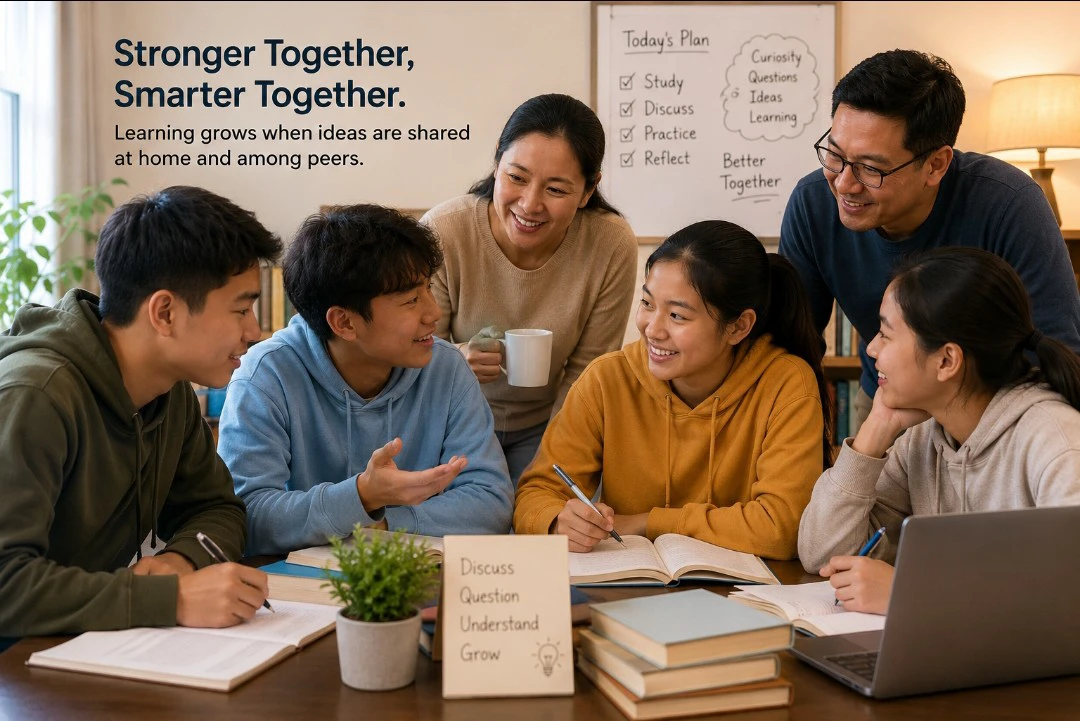
The quietest classrooms are not always the most effective ones. In many homes and tuition centres, silence is still treated as a sign of discipline. Students sitting alone for hours, memorising notes under dim lights, often appear “serious” about studies. Yet when examinations demand interpretation, application, or analytical thinking, many of these students struggle. They have consumed information, but they have not truly interacted with it.
Learning, at its core, is deeply social. Human beings understand ideas more clearly when they explain them, debate them, question them, and connect them with lived experiences. This is why some of the most meaningful learning does not happen during lectures, but during conversations after class, discussions among friends, or simple exchanges at the dining table.
Over the past few years, educational researchers across the world have increasingly highlighted the importance of peer-led learning and family-centered learning ecosystems. In a rapidly changing world where adaptability matters as much as information itself, learning can no longer remain confined to textbooks and examination halls alone.
A 2023 OECD report on future-ready education emphasized that collaborative learning environments significantly improve problem-solving abilities, communication skills, and long-term retention. Similarly, educational psychologist Lev Vygotsky’s long-standing theory of social learning continues to remain highly relevant today. His concept of the “Zone of Proximal Development” suggests that students often learn better when supported by peers or slightly more knowledgeable individuals rather than through isolated memorization. This becomes visible even in ordinary classrooms.
As a former teacher, I often noticed that some students who remained silent during lectures became unexpectedly expressive when discussing lessons with classmates. A student who could not answer directly in front of a teacher would suddenly explain the same concept fluently to a friend sitting beside him. Sometimes the language of peers feels less intimidating. The fear of failure reduces. Questions emerge more naturally.
I used to occasionally encourage students to explain grammar rules or computer concepts to one another in small groups before I intervened with corrections. The transformation was noticeable. Students who taught others often remembered concepts longer. Those who listened to classmates sometimes understood explanations more easily than formal lectures. In hindsight, the process itself was strengthening comprehension.
Modern neuroscience supports this observation. Research published in the journal Nature Reviews Neuroscience has shown that active retrieval, discussion, and explanation strengthen neural pathways more effectively than passive rereading. In simple terms, the brain learns better when it works with information rather than merely storing it temporarily.
Unfortunately, many students still study in isolation not because it is effective, but because our educational culture often equates collaboration with distraction.
Certainly, uncontrolled group study sessions can become unproductive social gatherings. But structured peer learning is entirely different. When done properly, peer discussions improve clarity, reveal knowledge gaps, and expose students to different ways of thinking.
In Manipur, where examination pressure remains intense and tuition culture dominates academic life, students often move mechanically from school to coaching centres and then to late-night self-study routines. In such environments, learning can slowly become transactional. Marks become the only visible goal. Curiosity weakens.
This is where peer-led learning can restore some humanity to education.
A small study group discussing science concepts, debating historical events, solving mathematics problems together, or even sharing different methods of approaching the same question can transform learning from burden into engagement. Students begin to see knowledge as something living rather than something to be memorised line by line.
At home too, learning ecosystems matter more than many parents realise. Family-centered learning does not mean parents constantly supervising homework or forcing children into rigid study schedules. In fact, excessive monitoring often damages independent thinking. A healthy learning environment is usually quieter and subtler. It is reflected in ordinary habits.
Children observe whether adults themselves read books, ask questions, discuss ideas, manage time wisely, or remain curious about the world. A home where conversations revolve only around marks, ranks, and comparisons gradually creates anxiety-driven learning. But a home where ideas are discussed freely creates intellectual confidence.
Sometimes the smallest family interactions shape learning habits more deeply than formal instruction.
A parent discussing a news report at dinner. A child being encouraged to ask “why". A family debating whether artificial intelligence will change future jobs. A conversation about how music affects concentration. These moments quietly train children to think critically.
I have personally experienced this while guiding my son’s learning journey. Rather than focusing only on examination preparation, I often try to discuss broader connections behind what he studies. When learning databases, for example, we sometimes talk about how modern apps organise information. While learning Python, discussions occasionally shift toward AI systems, automation, or future careers. The goal is not to overload him with advanced concepts, but to help him see learning as connected to real life.
This shift matters because motivation grows stronger when knowledge feels meaningful.
Research by Stanford psychologist Carol Dweck has repeatedly shown that students perform better when they develop a growth mindset — the belief that abilities can improve through effort, strategy, and learning rather than fixed intelligence. Family environments strongly influence whether children develop this mindset or become fearful of failure.
Unfortunately, many homes unintentionally create fear-based academic environments.
Comparisons with toppers, constant reminders about competition, and emotional pressure surrounding marks may produce short-term compliance, but they often weaken intrinsic motivation over time. Students begin studying to avoid criticism rather than to understand.
In several households today, especially in urban areas, another emerging challenge is fragmented attention. Television noise, constant phone usage, chaotic routines, and overstimulation make sustained concentration increasingly difficult. This partly explains the growing popularity of study rooms and library-style spaces among students in Manipur. Many students are not merely searching for silence; they are searching for structure.
Yet even the best study room cannot replace an emotionally supportive home atmosphere.
Children learn better when they feel psychologically safe enough to make mistakes, ask “foolish” questions, and admit confusion. Harvard education researcher Todd Rose has argued extensively against standardized assumptions about learning, emphasizing that individuals learn differently and progress differently. This insight becomes extremely important inside families. Some children thrive through visual learning, some through discussion, some through repetition, and others through hands-on experimentation.
Parents do not need to become expert teachers. But they can become facilitators of curiosity.
Simple practices can make a remarkable difference:
Encouraging children to explain what they learned instead of merely asking marks.
Creating fixed reading or discussion times at home.
Allowing students to occasionally teach younger siblings.
Supporting collaborative study with responsible peers.
Discussing current events, technology, science, or ethics casually at home.
Respecting individual learning styles instead of imposing identical routines.
One important aspect often overlooked is emotional modelling. Children closely observe how adults respond to stress, setbacks, and uncertainty. A parent who handles problems calmly teaches resilience more effectively than motivational lectures ever can.
Peer learning also teaches something formal education frequently neglects: intellectual humility.
When students collaborate, they realise that others may solve problems differently. They learn patience, communication, negotiation, and the ability to listen. These are not secondary skills. In the future workplace shaped by AI, automation, and interdisciplinary collaboration, such human abilities may become more valuable than rote memorization itself.
The World Economic Forum has repeatedly identified collaboration, critical thinking, adaptability, and emotional intelligence among the most essential future skills. Ironically, many of these skills emerge naturally through healthy peer interaction and supportive family learning environments.
Education, therefore, cannot remain an isolated individual struggle.
A child learning alone under pressure may score marks. But a child growing inside a culture of discussion, curiosity, emotional support, and collaborative thinking is more likely to become an adaptable lifelong learner. That difference may matter far beyond examinations.
In the end, learning ecosystems are not built through expensive infrastructure alone. They are built through conversations, habits, emotional safety, shared curiosity, and the simple willingness to learn together.
(Keithellakpam Manikanta Meetei is a seasoned journalist and a former educator. He also writes under his pen name Keicha Chingthou Mangang instead of his actual name. You can contact him at chingthouheiya@gmail.com)