Two new AI research papers examine whether next-generation video world models truly understand causality or merely predict visual patterns, raising deeper questions about the future of artificial intelligence.
Imphal, June 1: The race to build AI systems that can understand and simulate the physical world has entered a new phase. Over the past year, technology companies and research labs have increasingly promoted “world models” as the next frontier after large language models, arguing that machines capable of predicting how environments evolve could eventually power robotics, autonomous systems, scientific discovery and advanced digital agents.
Two newly published research papers are now drawing attention to a critical question behind that ambition: do these systems genuinely understand causality, or are they simply becoming better at predicting patterns?
The debate comes at a time when video generation models are improving at a remarkable pace. Systems that once produced short, unstable clips can now generate coherent scenes with realistic motion, object interactions and temporal consistency. This progress has encouraged many researchers to describe modern video models as early forms of world simulators.
However, emerging evidence suggests that visual realism and causal understanding may not be the same thing.
The Rise of Video World Models
One of the papers, “minWM: A Full-Stack Open-Source Framework for Real-Time Interactive Video World Models” (arXiv:2605.30263), focuses on building practical world models capable of generating and responding to dynamic environments in real time. According to references surrounding the paper, the framework is designed as an open-source system aimed at interactive video-based simulation and environment modeling.
The significance of such work extends beyond entertainment or visual content generation.
Researchers increasingly view world models as a potential foundation for AI agents that can reason about future events before taking actions. Instead of learning solely from text, these systems attempt to model how objects move, interact and change over time.
In theory, a sufficiently advanced world model could allow an AI system to mentally simulate outcomes before acting, much like humans imagine consequences before making decisions.
This concept has become particularly influential in robotics and autonomous AI research. If machines can accurately predict the evolution of physical environments, they may require fewer real-world experiments and could learn more efficiently through simulation.
Yet the second paper suggests there is still a substantial gap between realistic video generation and genuine understanding.
The Causality Problem
The study “YoCausal: How Far is Video Generation from World Model? A Causality Perspective” (arxiv: 2605.30346) examines whether state-of-the-art video diffusion models truly grasp causal relationships. Its central argument is straightforward but important.
Humans do not merely observe sequences of events. They infer causes behind those events. When a glass falls and shatters, people naturally understand that impact caused the breakage. This ability to connect events through cause-and-effect relationships is a core component of intelligence.
Modern video models, by contrast, are trained primarily to predict visual sequences. The researchers argue that such systems may learn temporal patterns without developing deeper causal understanding.
To investigate this, the team introduced a benchmark called YoCausal, inspired by the “Violation of Expectation” framework used in cognitive science to study human reasoning.
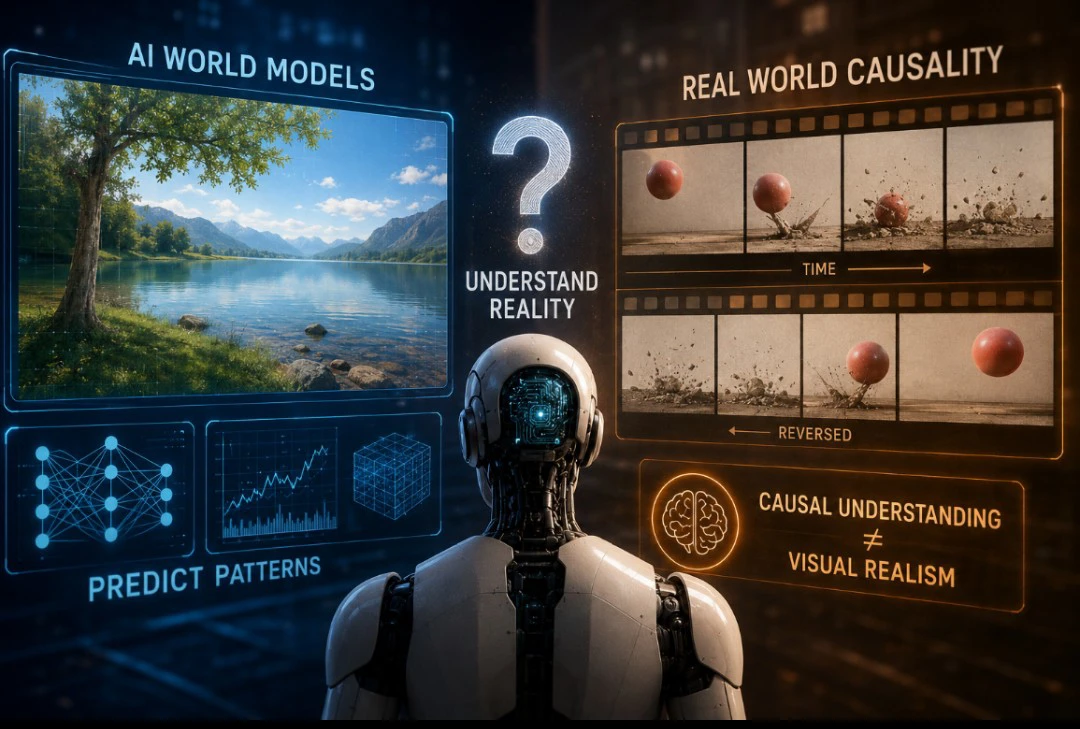
Their method employs a surprisingly simple idea: reverse real-world videos.
Humans can often immediately recognize when a video is being played backwards because the sequence violates intuitive expectations about gravity, motion, physical interactions and everyday causality.
The researchers used these reversed videos as natural counterfactual examples and evaluated whether video generation models could distinguish meaningful causal direction from mere temporal structure.
What the Researchers Found
The findings suggest that current video models possess a limited form of temporal awareness but fall short of true causal reasoning.
The paper introduces two evaluation metrics. The first, called the Reverse Surprise Index (RSI), measures whether a model can detect the natural direction of time. The second, the Causality Cognition Index (CCI), attempts to separate genuine causal reasoning from simple temporal bias.
After evaluating 13 state-of-the-art video diffusion models, the researchers concluded that recognizing the arrow of time does not necessarily imply understanding causality. A significant gap remains between current AI systems and human-level causal cognition. This distinction is crucial.
An AI model may learn that broken glasses usually appear after falling glasses. Yet that does not mean it understands why the glass broke.
The difference resembles the distinction between memorizing patterns and understanding mechanisms.
For many AI researchers, this has become one of the defining challenges of the next generation of machine intelligence.
Why This Matters Beyond Video Generation
The implications extend well beyond visual AI. Large language models, multimodal systems and autonomous agents increasingly depend on internal representations of the world. If those representations are based primarily on statistical correlations rather than causal relationships, their reasoning abilities may face fundamental limitations.
This issue becomes especially important in areas such as robotics, autonomous driving, healthcare decision-making and scientific research, where understanding causal structure can be more important than recognizing patterns.
A robot operating in a physical environment, for example, must understand not only what usually happens but why it happens.
Similarly, an AI scientist attempting to generate hypotheses must distinguish between coincidence and causation.
The YoCausal study therefore contributes to a growing body of research arguing that the next breakthroughs in AI may require advances in causal reasoning rather than simply larger datasets and more computational power.
The Next Stage of AI Development
Taken together, the two papers highlight a broader transition underway in artificial intelligence.
Researchers are no longer focused solely on making models generate convincing outputs. Increasing attention is being directed toward evaluating whether these systems possess deeper forms of understanding.
The emergence of world models reflects an ambition to build machines capable of simulating reality itself. But the causality findings suggest that realism alone may not be enough.
For now, video generation systems continue to improve rapidly, producing increasingly coherent representations of the world. Yet the evidence indicates that reproducing the appearance of reality is still different from comprehending the logic that governs it.
As AI development moves beyond language and into simulation, perception and autonomous action, that distinction may become one of the most important questions shaping the field.