How study environments shape learning outcomes — and why students need more than curriculum reform. A case for rethinking home learning spaces in the age of digital distraction and fractured attention.
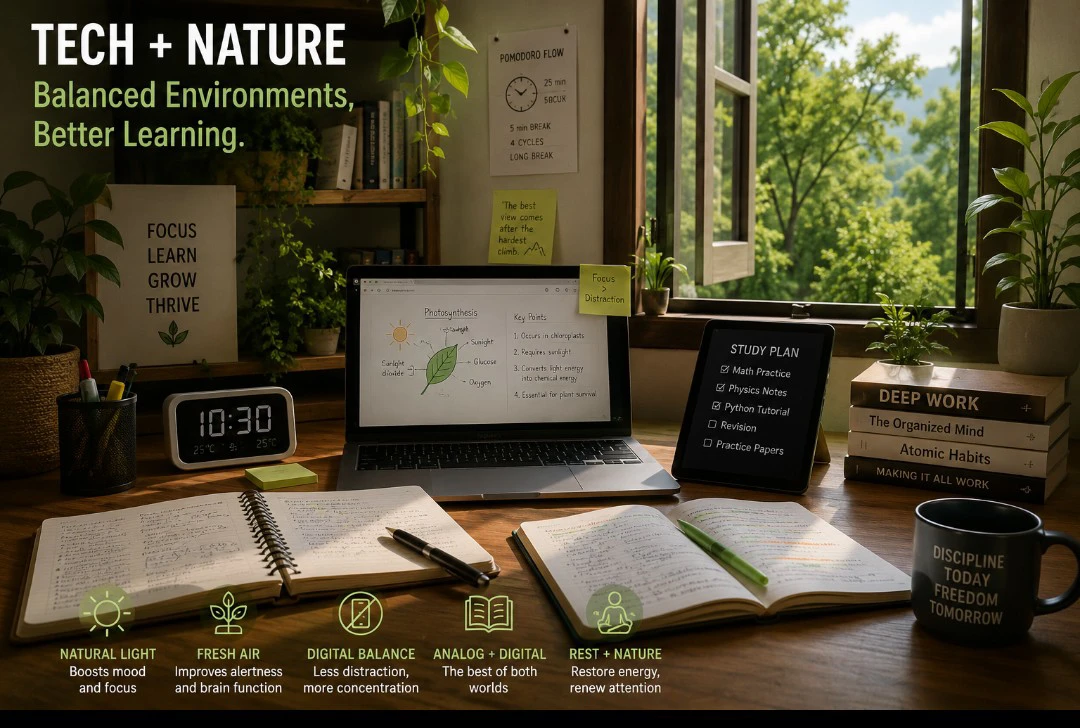
Across Manipur and the broader Northeast, a quiet crisis plays out every evening. Students return from school — or tuition classes that stretch well into the night — and settle into whatever corner of a shared home they can find. A television murmurs nearby. Household activity continues around them. A smartphone lights up with a notification. And somewhere in that noise, a student tries to learn.
We have invested enormous energy in reforming what happens inside classrooms. We debate curriculum, teacher training, examination patterns, and digital infrastructure. But we have paid far less attention to the environments in which students actually do the bulk of their learning — the hours after school, inside homes that were never designed with study in mind. That neglect has consequences.
The Environment Is Part of the Education
The OECD's landmark report The Nature of Learning made an argument that educators have been slow to fully absorb: effective learning depends not only on curriculum and teaching, but on the conditions that support attention, motivation, and cognitive engagement. Environment is not a backdrop to education. It is a variable within it.
This matters acutely in a region like Northeast India, where home learning conditions vary enormously and are rarely factored into conversations about academic performance. A student struggling to concentrate in a cramped, noisy household is not failing due to lack of effort or intelligence. They may simply be working against an environment that was never structured to support them.
The physical basics are more consequential than they appear. Natural light helps regulate the body's internal clock, supports alertness, and reduces eye strain — yet many students in towns and cities across Manipur study under artificial lighting in poorly ventilated rooms. Fresh air matters too. Poor ventilation produces a kind of low-grade fatigue that students often cannot name or explain, only feel. Opening windows, repositioning a desk toward natural light, clearing a cluttered surface — these are small adjustments, but they are not trivial ones. They are conditions that directly shape the quality of thought.
Nature as Infrastructure
Educational psychologists Stephen and Rachel Kaplan developed what is known as Attention Restoration Theory — the idea that exposure to natural environments helps restore mental focus after periods of sustained concentration. Looking at greenery, trees, or open sky allows the brain to recover from what researchers call directed attention fatigue. A 2022 systematic review in Educational Psychology Review found that contact with nature can improve attention, working memory, classroom engagement, and learning outcomes among children and adolescents.
During my years in teaching, I observed something that aligned with this research before I had the language for it. Students who struggled to maintain concentration indoors often returned noticeably more settled after a short walk outside. The break was not wasted time. It was the brain doing necessary maintenance.
In the Northeast Indian context, this finding carries particular relevance. Many students live within reach of natural environments — hills, open fields, quieter neighbourhoods — that urban students elsewhere do not have. The problem is that academic culture rarely sanctions the use of these spaces as part of the learning process. Rest is treated as a concession to weakness rather than a condition for performance. A student who steps outside for ten minutes is assumed to be avoiding study. In many cases, they are enabling it.
The Digital Overload Problem
Technology has transformed access to education in ways that cannot be overstated. For students in regions where libraries are limited, qualified teachers are unevenly distributed, and exposure to the wider world is constrained, online courses, digital libraries, language platforms, and AI-powered tools have opened opportunities that did not exist a generation ago.
But technology has also introduced a structural problem that neither schools nor families have adequately addressed.
A laptop opened for studying is also a gateway to social media, video platforms, and messaging applications. A 2024 study examining students' experiences with technology found that digital distractions significantly affected academic performance and attention — not merely because devices were present, but because the environment offered no meaningful boundary between learning and entertainment. Students believed they were multitasking effectively. The research suggests otherwise: each shift of attention carries a cognitive cost, concentration becomes shallower, and study sessions grow longer without becoming more productive.
The solution is not to remove technology from the study environment. It is to give it defined limits. Unnecessary browser tabs closed. Smartphones placed out of reach during focused sessions. Notifications disabled. Many students are surprised by how much mental energy returns simply by reducing interruptions — not because the work changed, but because the environment finally stopped working against them.
My son uses digital resources extensively for coding and music. But some of his most focused and productive moments still happen with a notebook and a pencil — music playing softly in the background, screen set aside. The technology provides access. The music, for him, provides the conditions. The quiet the rest of us seek, he finds in sound.
The Policy Gap
Here is what makes this more than a parenting problem: the conditions students study in are shaped by factors that policy can address.
Joint family living arrangements, limited household space, and the absence of designated study areas are structural realities for a significant proportion of families in Manipur. The rise of dedicated study rooms and learning pods in urban centres reflects a genuine demand that homes are not always able to meet. Yet public policy has not caught up — there is no systematic effort to incorporate learning environment standards into educational planning, school counselling, or community infrastructure.
Schools can do more than teach subjects. They can educate students and families about environment design: the value of natural light, ventilation, reducing digital interruptions, and alternating between analog and digital learning methods. Handwritten notes continue to have value — the physical act of writing encourages slower processing and deeper engagement with ideas. Digital tools excel at organisation, retrieval, and access. Neither replaces the other. Both work better when used with intention.
Simple combinations work. Learning concepts through video, then consolidating with handwritten notes. Using digital flashcards for revision alongside a paper planner for weekly goals. These are not nostalgic gestures toward the pre-digital era. They are evidence-informed habits that acknowledge how the brain actually works.
Attention Is the Real Curriculum
A well-designed study environment is not defined by expensive furniture or the latest devices. It is defined by whether it helps a student think clearly, focus deeply, and learn meaningfully.
In Manipur, where students already navigate disruptions that go far beyond the domestic — years of conflict, displacement, interrupted schooling, and a persistent uncertainty about the future — the argument for intentional learning environments is not academic. It is urgent. Young people who have had so much taken from them deserve spaces that give something back: quiet, light, air, and the conditions in which concentration can actually take root.
In an age built around capturing and fragmenting attention, teaching students to protect and sustain their own concentration may be among the most important things education can do — and it begins not in the classroom, but in the spaces we too rarely think to design.
(Keithellakpam Manikanta Meetei is a seasoned journalist and a former educator. He also writes under his pen name Keicha Chingthou Mangang instead of his actual name. You can contact him at chingthouheiya@gmail.com)