The 16th Finance Commission has recommended Rs 1,262 crore for Manipur's panchayats, but Lok Sabha data shows the state left Rs 624 crore unreleased after filing zero audit reports for FY 2024-25.
Imphal, July 28: The 16th Finance Commission has recommended Rs 1,262.00 crore for Manipur's panchayats, the highest amount recommended for the state across any Finance Commission cycle on record, even as central data shows the state has been unable to draw down roughly Rs 624.50 crore of its previous allocation because not a single audit report was filed by any of its 3,823 Panchayati Raj Institutions in FY 2024–25. The information was given by Union Minister of Panchayati Raj Rajiv Ranjan Singh, also known as Lalan Singh, in a written reply in the Lok Sabha on Tuesday.
The funding gap and the reporting lapse are closely linked, according to the data. Central Finance Commission grants are increasingly conditional on elected local bodies and verified audit accounts, and Manipur's Panchayati Raj Institutions have functioned without an elected tier since their tenure expired years ago. The Manipur Cabinet had earlier approved panchayat elections for October 1, 2026, but the audit and funding shortfalls the data points to predate that decision and are described in the ministry's assessment as a structural, not merely electoral, problem.
Later, the Manipur Cabinet, on June 15, decided to defer the 6th general Panchayat election, which was earlier scheduled for October 1, citing the prevailing situation in the state and challenges in the delimitation exercise of newly formed Panchayat Samitis. The Cabinet decided to approach the State Election Commission to fix a fresh date after completion of the delimitation process and assessment of ground realities, including issues related to rehabilitation of internally displaced persons.
The Supreme Court on July 2 declined to interfere with the Manipur High Court’s order extending the deadline for holding the 6th general Panchayat election in the state until October 16, 2026. A Bench of Justices N Kotiswar Singh and N V Anjaria dismissed the appeal challenging the High Court order, observing that there were no grounds to intervene. The High Court had granted additional time to the state government and the State Election Commission citing extraordinary circumstances, including the prevailing law and order situation and challenges arising from the imposition of President’s Rule.
A near-total reporting breakdown
The Ministry of Panchayati Raj's report, titled "Status of Devolution to Panchayats in States – An Indicative Evidence-Based Ranking, 2024," found that none of Manipur's 3,823 Panchayati Raj Institutions — including all 12 Zilla Panchayats and 3,811 Gram Panchayats — generated an audit report through the ministry's AuditOnline platform for FY 2024–25.
Nationally, the compliance rate stood at 90.73 percent, with 2,40,435 of 2,64,998 institutions filing reports. Even states with far larger numbers of panchayats posted high compliance: Uttar Pradesh generated reports for 58,551 of its 58,592 institutions, a rate of 99.9 percent, and Tamil Nadu reported 12,942 of 12,949. Karnataka, with 5,949 reports out of 6,221 institutions, and Maharashtra, with 26,835 out of 28,338, trailed the national average but still reported substantial numbers — underscoring how complete Manipur's reporting gap is by comparison.
The AuditOnline platform was introduced under the Digital India initiative specifically to give the central government a transparent, verifiable record of how Finance Commission funds are being used at the local level. Without that record, officials say, the government has limited means of confirming utilisation of past grants before releasing further instalments.
Releases have fallen for four straight years
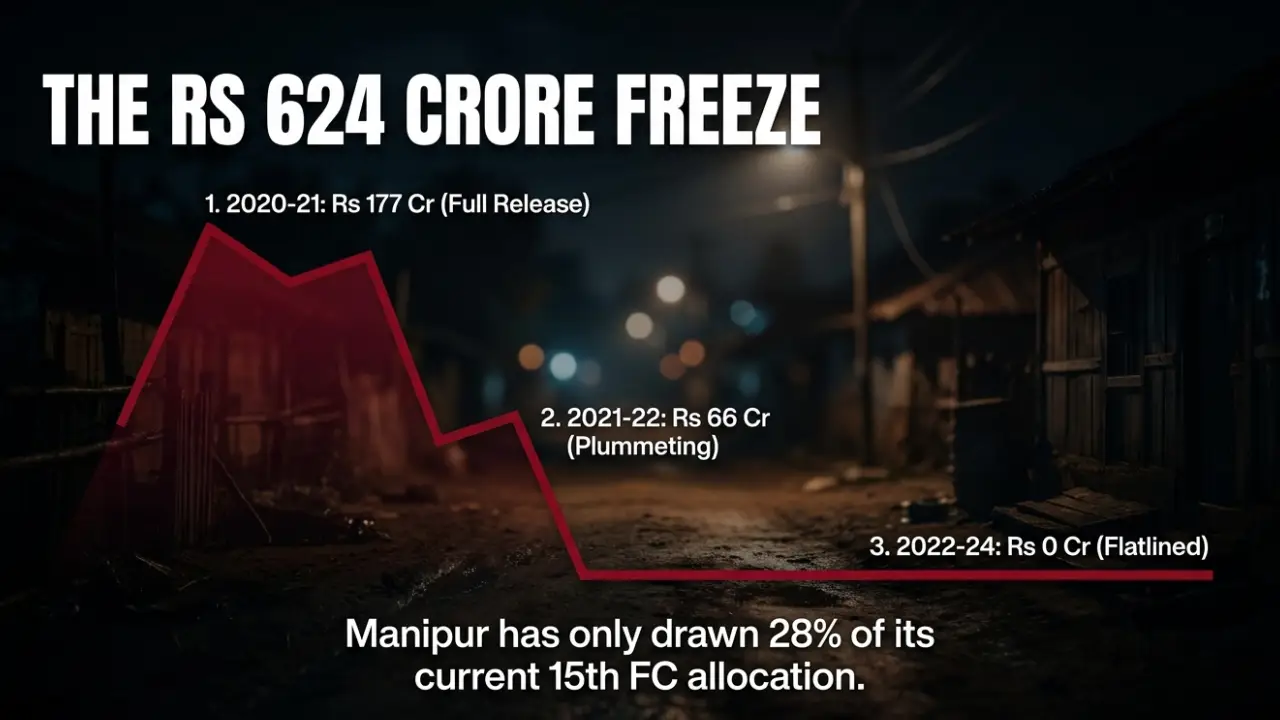
The fiscal impact of the reporting gap shows up clearly in the release data for the 15th Finance Commission period (2020–21 to 2025–26). Manipur's total allocation for the period stands at Rs 867.00 crore, of which only Rs 242.50 crore, or 28 percent, has been released as of July 2026.
A year-by-year breakdown shows the decline was not immediate. In 2020–21, the state received its full allocation of Rs 177 crore. In 2021–22, only Rs 66 crore of an allocated Rs 131 crore was released, a drop to just over 50 percent. The two years that followed saw no releases at all: for 2022–23 and 2023–24, a combined Rs 272 crore was allocated, but the state received nothing in either year, according to the data.
By comparison, the national release rate for 15th Finance Commission funds stood at around 95 percent as of March 2026, with Rs 2,82,632 crore released nationally out of a total allocation of Rs 2,97,555 crore. Manipur's 28 percent release rate places it well outside that national pattern.
A sharper decline than earlier cycles
The current shortfall marks a reversal from Manipur's record in the two preceding Finance Commission periods. The 13th Finance Commission (2010–2015) released Rs 199.82 crore of an allocated Rs 236.77 crore, a rate of 84.4 percent, and the 14th Finance Commission (2015–2020) released Rs 194.05 crore of Rs 206.04 crore, or 94.2 percent. The 12th Finance Commission (2005–2010) had a weaker release rate of 46 percent, with Rs 21.16 crore released against an allocation of Rs 46.00 crore.
Set against that history, the 15th Finance Commission's 28 percent release rate represents the sharpest decline in the state's recent record, according to the ministry's data.
Performance grants dropped, then reinstated at higher stakes
The 14th Finance Commission had tied part of its funding to specific performance criteria, including the timely submission of audited accounts and growth in a panchayat's Own Sources of Revenue. Manipur accessed a modest share of that component, receiving Rs 4.04 crore in 2016–17 and Rs 4.57 crore in 2017–18.
The 15th Finance Commission removed the performance grant component altogether for its award period, structuring its funding purely around tied and untied grants. The 16th Finance Commission has now reintroduced performance-linked funding at a larger scale. Nationally, the commission has recommended Rs 87,048 crore in performance grants alongside Rs 1,74,094 crore each in tied and untied grants. For Manipur specifically, the Rs 1,262.00 crore recommendation breaks down into Rs 504.50 crore in tied grants, Rs 504.50 crore in untied grants and Rs 253.00 crore in performance grants.
The performance component alone accounts for about a fifth of that total, meaning the state's ability to resolve its audit and reporting gaps will have a direct bearing on how much of the recommended sum it is ultimately able to claim.
Capacity-building funds have also been uneven
The Union government's Revamped Rashtriya Gram Swaraj Abhiyan, a centrally sponsored scheme launched in 2022–23 to fund training for panchayat representatives and staff, has shown a similarly uneven pattern in Manipur. Releases rose from Rs 2.98 crore in 2021–22 to Rs 8.63 crore in 2022–23 and Rs 9.56 crore in 2023–24, before falling to zero in 2024–25 and recovering only to Rs 1.48 crore in 2025–26, according to the data.
The state's panchayat framework was itself restructured through the 8th Amendment Act, 2023, notified on February 22, 2023, which introduced a Panchayat Samiti, or Block Panchayat, tier that had not previously existed in Manipur's structure. Since "Local Government" is a State subject under the Seventh Schedule, responsibility for devolving powers to these institutions rests with the state government under Article 243G of the Constitution.
Manipur's last panchayat elections were held in October 2017, and the next cycle, due in October 2022, was delayed for close to four years before the state Cabinet deferred the election after initially approving a fresh election date of October 1, 2026. The data suggests that restoring elected representatives is a necessary but not sufficient step: the ministry's assessment frames the audit and reporting failure as a separate administrative problem tied to staffing and capacity, one that will need to be addressed alongside the return of elected bodies if the state is to access its full Finance Commission entitlement.
Manipur is one of several states and Union Territories where local body elections have lapsed for extended periods, including Karnataka, Jammu and Kashmir, Lakshadweep and Puducherry, though the ministry's data indicates Manipur's audit reporting gap is more complete than in most other cases.
Path ahead
The ministry has pointed to digital platforms including SAMARTH, for digitising local tax collection, eGramSwaraj, for real-time payments, and an Own Source Revenue training module developed with the Indian Institute of Management, Ahmedabad, which had trained 2,75,893 participants nationally as of July 2026, as tools available to help panchayats meet reporting requirements. For Manipur, officials say closing the audit gap and building administrative capacity at the panchayat level will be central to whether the state is able to secure the Rs 1,262 crore recommended for the 16th Finance Commission period, on top of restoring elected local governance.