Alibaba has launched Qwen-Image 3.0, a third-generation AI image model designed for practical workflows, introducing long-context prompts, advanced text rendering and multilingual image generation.
Imphal, July 22: Alibaba has introduced Qwen-Image 3.0, the latest image generation model in its Qwen artificial intelligence ecosystem, marking a notable shift in the industry's focus from creating visually appealing AI artwork to producing images that can be directly used in professional and commercial workflows.
Released on July 21, Qwen-Image 3.0 is the third-generation model in the Qwen-Image series. Rather than positioning the update primarily as an improvement in visual quality, Alibaba has centred the release around a single concept, "Real", referring to the model's ability to generate images that closely match practical, real-world requirements.
The announcement comes at a time when competition among AI developers has increasingly moved beyond photorealistic image generation. Companies are now attempting to solve long-standing limitations in AI-generated visuals, particularly the inability to accurately render text, maintain complex layouts and generate content suitable for publishing, education and enterprise applications.
Moving beyond "beautiful pictures"
For the past two years, most AI image models have been judged largely on artistic quality, photorealism and stylistic diversity. However, these systems often struggled when users requested newspaper pages, academic papers, presentation slides, business dashboards or diagrams containing hundreds of words and mathematical symbols.
Alibaba argues that this gap has prevented AI-generated images from becoming reliable productivity tools.
According to the company, Qwen-Image 3.0 is designed to bridge that gap by focusing on three areas: Rich Content, Authentic Details and Deep Knowledge.
Unlike earlier models that typically handled relatively short prompts, the new model accepts instructions of up to 4,500 tokens, enabling users to describe significantly more complex scenes, layouts and design requirements in a single request.
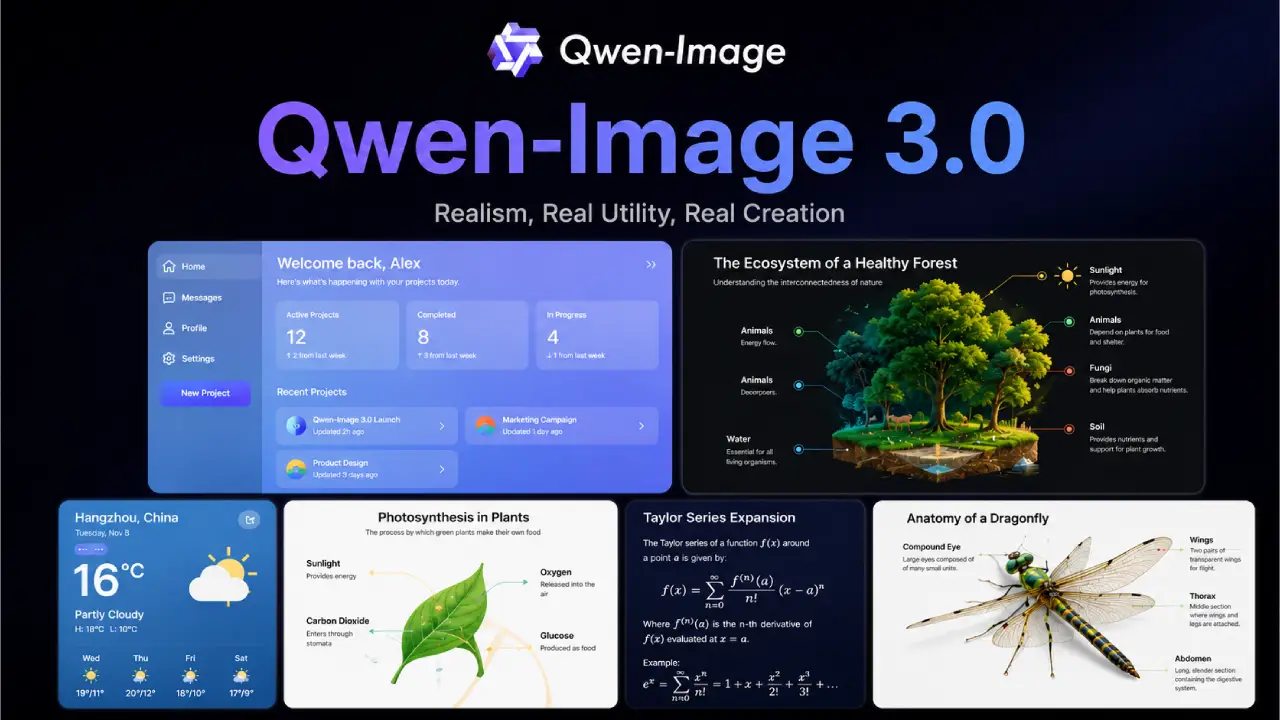
Alibaba demonstrated this capability by generating an entire 3×3 grid of educational and scientific graphics in one image, rather than stitching together multiple AI-generated outputs.
The company said the extended context window enables users to create newspaper layouts, examination papers, comic storyboards, interface mockups and large infographics through a single prompt.
Solving one of AI's biggest weaknesses
One of the most significant improvements claimed by Alibaba is the model's ability to render small, readable text, an area where AI image generators have traditionally performed poorly.
Text rendering has long been considered a major technical challenge because diffusion-based image models often distort letters, merge words or generate meaningless characters.
Qwen-Image 3.0 claims to accurately reproduce text as small as 10 pixels, while maintaining proper spacing, mathematical notation and multilingual typography. According to Alibaba, the model can generate academic papers containing LaTeX equations, educational diagrams and information-rich posters with considerably higher fidelity than previous versions.
The company also said the model supports native rendering in 12 languages and more than 20 font styles, making it suitable for multilingual publishing and international marketing materials.
Designed for knowledge-heavy tasks
Beyond visual realism, Alibaba has expanded the model's ability to generate knowledge-intensive graphics.
Examples released alongside the announcement include research illustrations, biology charts, mathematical derivations, taxonomy diagrams and annotated scientific figures.
In one demonstration, the model transformed a photograph of an insect into a publication-style scientific illustration by adding taxonomic labels, morphological annotations, magnified sections and measurement scales while preserving the original image.
The company also showcased the model generating weather forecast graphics based on current online information, indicating that the system can integrate internet-based knowledge when connected to external data sources.
Better image editing and interface generation
Alibaba has also positioned Qwen-Image 3.0 as more than a text-to-image model.
According to the company, it can generate realistic user interfaces resembling websites, mobile applications, games and livestream dashboards. This expands its potential use in software design, advertising and digital product development.
The model is also capable of instruction-based image editing, allowing users to modify existing visuals while preserving the original subject. Alibaba demonstrated this through examples involving restoration of historical artwork and enhancement of scientific photographs.
Part of Alibaba's broader AI strategy
The launch forms part of Alibaba's rapidly expanding Qwen ecosystem, which now includes large language models, coding assistants, reasoning models, vision-language systems and image generation technologies.
Unlike previous years, when AI companies competed mainly on benchmark scores or artistic quality, recent releases have increasingly focused on practical deployment in enterprise environments. Qwen-Image 3.0 reflects this trend by targeting industries such as publishing, education, e-commerce, research, software development and content creation.
Industry observers note that the ability to generate accurate layouts, readable typography and structured information could make AI image models more useful for businesses than improvements in photorealism alone.
A changing competitive landscape
The release also adds pressure to competitors including OpenAI, Google, Midjourney, Black Forest Labs' FLUX and Stability AI, all of which have introduced increasingly capable image-generation systems over the past year.
While most leading models now produce highly realistic photographs, the next stage of competition is increasingly centred on handling complex instructions, maintaining consistency across intricate compositions and generating publication-ready visual documents.
Alibaba's latest release suggests that future AI image models may be evaluated less on how artistic they appear and more on whether they can replace parts of existing creative workflows.
Whether Qwen-Image 3.0 can consistently deliver on those ambitions will ultimately depend on real-world adoption by designers, educators, publishers and enterprises. However, the launch signals a broader shift in the AI industry, from creating impressive demonstrations to building tools intended for everyday professional use.