Anthropic has launched Claude Science, a research workbench built on existing Claude models rather than a new biology-tuned system, entering a three-way contest with OpenAI and Google DeepMind over how AI reshapes drug discovery and lab research.
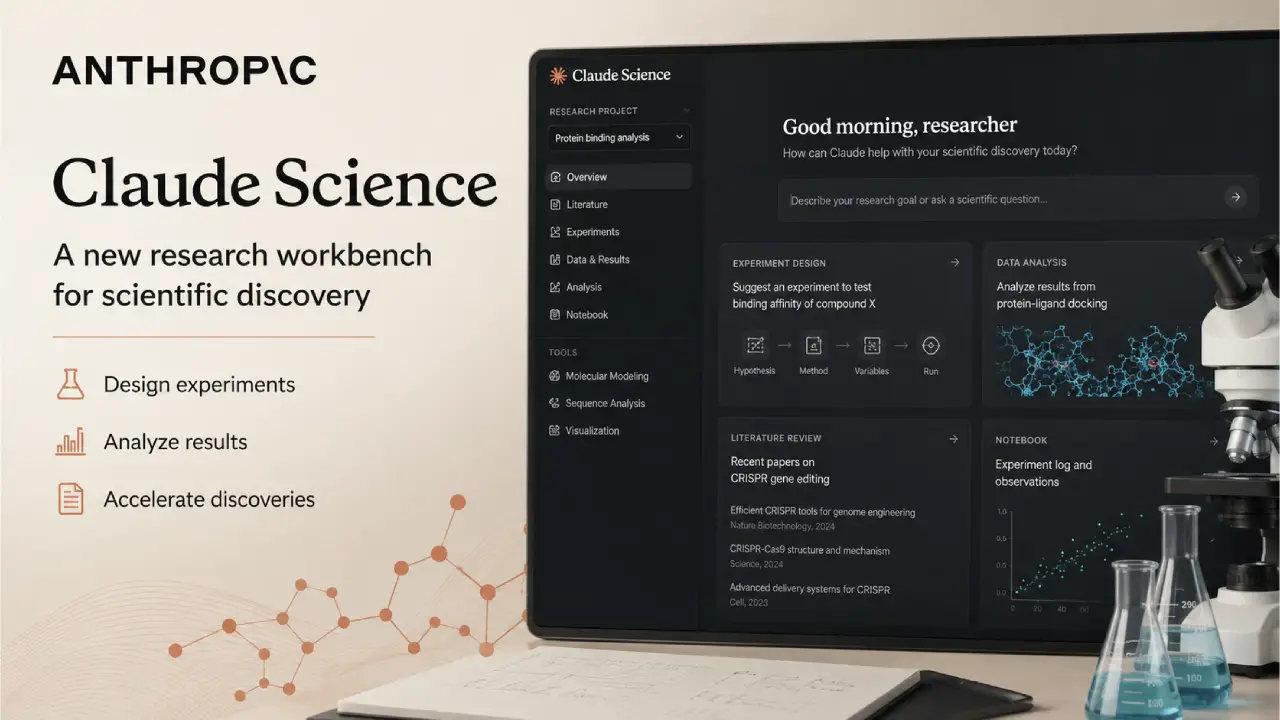
Imphal, July 7: Anthropic introduced Claude Science on June 30, positioning the product not as a new artificial intelligence model but as a workbench meant to pull scientific research out of its scattered tools and into a single environment. The move puts the company squarely in competition with OpenAI and Google DeepMind for a market both are already courting with rival products of their own.
The launch, unveiled at an event for pharmaceutical executives, biotech founders and researchers, extends work Anthropic began last October under the banner "Claude for Life Sciences," which connected the chatbot to scientific databases through plug-ins. Claude Science goes further, bundling literature analysis, coding, figure generation, manuscript drafting and access to computing clusters into one interface that researchers can run locally on macOS or Linux, over SSH, or on a remote high-performance computing login node.
Central to Anthropic's pitch is a claim that runs against the industry's usual instinct to tout new models: Claude Science, the company says, introduces no new intelligence at all. It runs on Claude models already available to subscribers, including Opus 4.8, without any special or gated access. The bet, instead, is that scientists are held back less by model capability than by the drudgery of moving between platforms such as PubMed for literature, Jupyter and R for analysis, and cluster terminals for heavier computation.
Introducing Claude Science, a new app designed with every stage of research in mind.
— Claude (@claudeai) June 30, 2026
Artifacts traced to their code, environments managed on demand, and 60+ optional scientific databases that you can connect.
Available now in beta. pic.twitter.com/HKhLknxLJO
WHAT THE PRODUCT DOES
A generalist coordinating agent sits at the center of the workbench, with access to more than 60 curated skills and connectors spanning genomics, single-cell analysis, proteomics, structural biology and cheminformatics. That agent can spin up specialist agents of its own or hand off to ones researchers have built themselves. A separate reviewer agent checks citations and calculations, addressing one of the more persistent criticisms of AI-assisted research: fabricated or misattributed sources.
The workbench also renders scientific outputs natively rather than as static text, displaying three-dimensional protein structures, genome browser tracks and chemical structures directly. Every figure it produces carries the code and computing environment that generated it, along with a plain-language explanation and the full message history behind it, an approach Anthropic frames as necessary for reproducibility rather than a convenience feature.
“It represents how important this is to our mission that this is right up there with Claude Code and Claude Cowork.” — Eric Kauderer-Abrams, Anthropic's head of life sciences
Anthropic has also arranged for Claude Science to connect to external repositories including UniProt, the Protein Data Bank, Ensembl, Reactome, ClinVar, ChEMBL and the Gene Expression Omnibus, along with Nvidia's BioNeMo toolkit, which links the workbench to specialized life-science models such as Evo 2, Boltz-2 and OpenFold3. Notably, that same Nvidia toolkit is available to OpenAI as well, meaning the two companies' products can draw on identical underlying science models while competing chiefly on the software layer wrapped around them.
A CROWDED FIELD, THREE DIFFERENT BETS
Claude Science does not arrive into empty space. OpenAI released GPT-Rosalind in April, a model fine-tuned specifically for biological reasoning and gated to enterprise customers who meet the company's qualification criteria. It later introduced Prism, described as an AI-native workspace for scientists. Google, for its part, unveiled Gemini for Science at its I/O conference in May, pairing its own proprietary models, including AlphaFold and AlphaGenome, with more than 30 databases.
The contrast in strategy is deliberate. Where OpenAI and Google DeepMind are leaning on specialized, often gated models, Anthropic is wagering that researchers need a better working environment more than a smarter one, available to any paying subscriber rather than reserved for enterprise deals. The approach echoes how Claude Code built its following among software developers less through raw model superiority than by solving the friction of the workflow around coding.
|
COMPANY |
PRODUCT |
CORE BET |
ACCESS MODEL |
|
Anthropic |
Claude Science |
Workflow layer atop existing models |
Open to any paid subscriber |
|
OpenAI |
GPT-Rosalind / Prism |
Specialized biological reasoning model |
Gated to qualified enterprises |
|
Google DeepMind |
Gemini for Science |
Proprietary science models (AlphaFold, AlphaGenome) |
Bundled with 30+ databases |
Sources: Anthropic, MIT Technology Review, Memeburn
ANTHROPIC BECOMES A DRUG DEVELOPER, TOO
Alongside the software launch, Anthropic disclosed it will use Claude Science to pursue its own drug research, targeting neglected and rare diseases, a decision that places the company in an unusual dual role as both toolmaker and potential competitor to the pharmaceutical and biotech clients it is simultaneously trying to win over. Anthropic has offered few specifics on the scope of that effort so far.
The company has pointed to early demonstrations meant to illustrate the workbench's reach, including one in which Claude reportedly analyzed 100 rare genetic diseases in under an hour and flagged 32 candidates for further computational screening. Early users cited by Anthropic include Manifold Bio, researcher Jerome Lecoq at the Allen Institute, who built a multi-agent review pipeline with the tool, and a University of California, San Francisco team led by Stephen Francis that used it to speed up germline analysis of glioma.
REASONS FOR CAUTION
Outside researchers have urged restraint in reading too much into those early results. Frank von Delft, a professor at the University of Oxford, has noted that AI models remain far from making laboratory experiments unnecessary. Screening claims are not clinical evidence, and the distance between an AI-flagged candidate and a therapy approved by regulators still runs through years of toxicity testing, wet-lab validation and clinical trials that no software layer can shorten.
Anthropic has tried to preempt some data-governance concerns by emphasizing that Claude Science can run on a lab's own infrastructure rather than Anthropic's servers, so that sensitive datasets need not leave an institution's systems, a point likely to matter most to pharmaceutical companies bound by strict compliance requirements. The company has also committed up to $30,000 in computing credits for as many as 50 research projects, aimed chiefly at graduate students and postdoctoral researchers, a move that doubles as both goodwill and a pipeline for institutional adoption.
WHY IT MATTERS
Estimates of the AI-for-science market vary widely depending on scope, with some forecasts placing AI-driven drug discovery alone at roughly $4 billion this year and above $25 billion by 2035, and broader science-focused AI tools reaching into the tens of billions within a decade. Whether that market consolidates around specialized, tightly gated models or around general-purpose workbenches like Claude Science remains an open question that Anthropic, OpenAI and Google DeepMind are each answering differently, and the coming year of independent, peer-reviewed validation — rather than launch-stage demonstrations — is likely to determine which bet was right.