Academic marks matter, but they tell only part of a student's story. Discover why emotional intelligence, creativity, resilience, curiosity, and social skills are becoming equally important for lifelong success in education, careers, and personal growth.
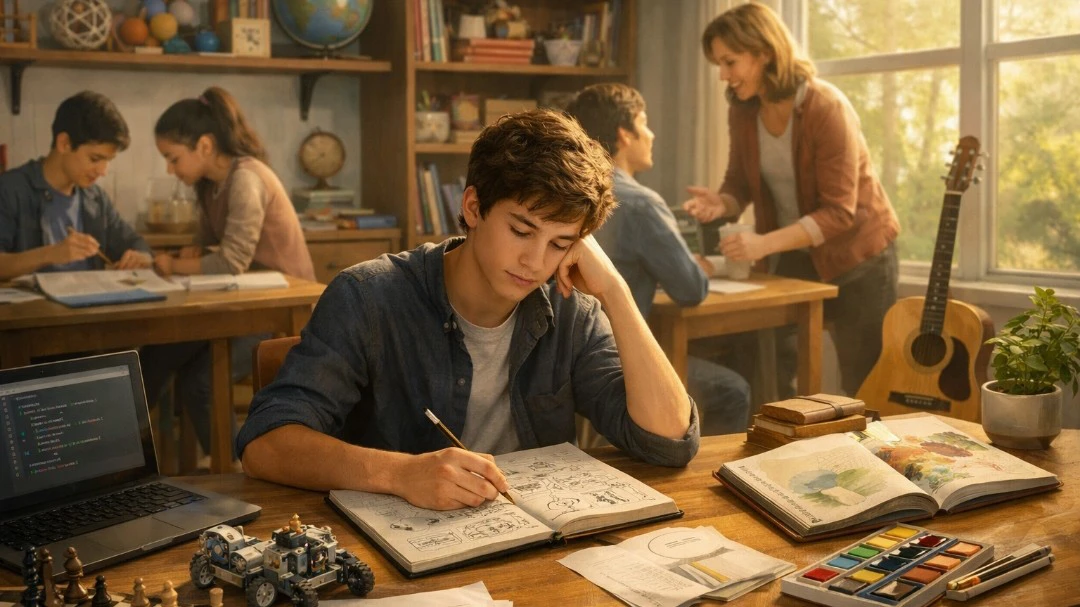
There is a familiar scene that unfolds every time examination results are announced. Families celebrate distinctions, neighbours compare percentages, and social media fills with photographs of smiling toppers. For many students, these moments become defining milestones. Yet quietly, and almost unnoticed, there are countless others whose report cards attract no attention but who possess remarkable qualities — kindness, creativity, leadership, resilience, curiosity, or an extraordinary ability to solve practical problems. These strengths rarely appear on a mark sheet, but they often shape a person's future far more profoundly than a percentage ever can.
Marks are important. They open doors to colleges, scholarships, and employment opportunities, and they provide a measurable indicator of academic performance. Pretending that marks do not matter would be unrealistic. But confusing good marks with complete intelligence is equally misleading. Education should prepare young people not merely to pass examinations but to navigate an increasingly complex world where success depends on far more than remembering textbook answers.
Psychologist Howard Gardner challenged the traditional notion of intelligence through his Theory of Multiple Intelligences, arguing that it extends beyond linguistic and mathematical ability to include interpersonal, intrapersonal, musical, spatial, bodily-kinesthetic, and naturalistic intelligence. While educators continue to debate aspects of his theory, it has undeniably broadened our understanding of human potential. A child who struggles in mathematics may possess exceptional artistic talent or remarkable leadership abilities. Another who finds essay writing difficult may have outstanding practical or entrepreneurial instincts.
The workplace is changing in ways that reinforce this broader understanding. Artificial intelligence is rapidly automating routine tasks, making uniquely human abilities increasingly valuable. Communication, empathy, creativity, ethical judgment, collaboration, and adaptability cannot be easily replicated by machines. The OECD's Trends Shaping Education 2025 highlights that future education systems must cultivate not only academic knowledge but also socio-emotional skills and adaptability to prepare learners for an uncertain future.
As a former teacher, I often noticed that some students who were average performers in written examinations became the most active participants whenever discussions, debates, or group projects were introduced. They asked thoughtful questions, helped classmates understand difficult concepts, and often discovered creative solutions that never appeared in standard answer keys. Those experiences gradually convinced me that examinations capture only a narrow slice of a student's abilities.
Today, as a parent, that conviction has only grown stronger. While I certainly encourage my son to perform well academically, I also encourage him to compose music, learn programming, solve problems independently, and explore ideas beyond the prescribed syllabus. These activities are not distractions from education; they are part of education itself. They cultivate patience, discipline, imagination, and confidence — qualities that no examination can fully measure.
Among the many forms of intelligence, emotional intelligence deserves particular attention. Popularised by psychologist Daniel Goleman, it refers to the ability to recognise, understand, manage, and appropriately respond to one's own emotions as well as those of others. Students with high emotional intelligence often handle examination pressure better, recover more quickly from setbacks, work effectively in teams, and build healthier relationships.
Research increasingly supports the importance of these abilities. The OECD Survey on Social and Emotional Skills found that qualities such as curiosity, persistence, responsibility, empathy, self-control, and emotional regulation are closely associated with academic achievement, well-being, and later life success. Students who participate in extracurricular activities like sports and the arts also tend to demonstrate higher creativity and curiosity.
Creativity is another dimension frequently undervalued in conventional schooling. In many classrooms, students are rewarded for reproducing expected answers rather than generating original ones. Yet every major innovation — from scientific discoveries to technological breakthroughs and artistic masterpieces — began with someone asking a different question or imagining a different possibility.
In Manipur, creativity is already woven into everyday life. Whether it is the precision of traditional handloom weaving, the discipline of classical dance, the artistry of indigenous crafts, or the innovation shown by young musicians and entrepreneurs, our society constantly demonstrates that intelligence is not confined to examination halls. Unfortunately, these talents often receive less recognition than examination scores.
Social intelligence also plays an increasingly significant role. Modern workplaces demand collaboration across cultures, professions, and disciplines. An individual who communicates effectively, resolves conflicts respectfully, and leads diverse teams may achieve far greater success than someone with technical expertise alone. Schools therefore need to create more opportunities for collaborative learning, peer discussion, presentations, and project-based activities rather than relying exclusively on individual written tests.
Another overlooked quality is resilience. Every student will eventually encounter failure — a poor examination result, a rejected application, an unsuccessful interview, or an unexpected career setback. The ability to recover, learn, and keep moving forward may ultimately prove more valuable than consistently scoring high marks. Parents and teachers should therefore treat mistakes as opportunities for growth rather than reasons for shame.
Recent educational research also points toward a more holistic understanding of achievement. A 2026 study on STEM education concluded that learning resources, educational environments, and sustained learning habits contribute significantly to academic performance beyond measured intelligence alone. The findings reinforce the idea that success emerges from a combination of personal effort, supportive environments, and continuous learning — not merely innate ability or examination scores.
This broader perspective is particularly relevant in today's educational climate. In many households across Manipur, parents understandably worry about marks because competition for higher education has become intense. Tuition classes continue to expand, study rooms are becoming common, and students often carry enormous academic pressure. These efforts can certainly improve examination performance, but they should not come at the cost of curiosity, physical health, emotional well-being, or family relationships.
A truly balanced education encourages students to ask questions, read widely, participate in sports, appreciate music, volunteer within their communities, develop practical life skills, and engage with technology responsibly. It allows them to discover not only what they know but also who they are.
Parents can contribute by praising effort rather than only outcomes, encouraging hobbies without treating them as distractions, allowing children to solve age-appropriate problems independently, and discussing failures with understanding rather than disappointment. Teachers can support this by weaving discussion, collaborative projects, reflective writing, peer learning, and creative expression into academic instruction.
Ultimately, marks should remain milestones, not destinations. They are useful indicators, but they are not complete definitions of intelligence or human worth. A report card may record what a student remembered during an examination. It cannot measure compassion, imagination, perseverance, integrity, leadership, or wisdom.
Education succeeds not when every student becomes a topper, but when every student becomes capable of thinking independently, working ethically, adapting confidently, and contributing meaningfully to society. That is the kind of intelligence our schools — and our future — need most.
(Keithellakpam Manikanta Meetei is a seasoned journalist and a former educator. He also writes under his pen name Keicha Chingthou Mangang instead of his actual name. You can contact him at chingthouheiya@gmail.com)