Lok Sabha MP Dr Bimol Akoijam accuses the BJP-led Centre of lacking accountability, criticises Parliament's silence on Manipur, and questions the government's handling of the state's prolonged crisis.
Imphal, July 21: Lok Sabha MP Dr Bimol Akoijam on Monday launched a scathing attack on the BJP-led Government at the Centre, accusing it of fostering a culture devoid of accountability and failing to address the prolonged crisis in Manipur, which he said continues to be ignored by the country's political establishment.
In a strongly worded post on social media platform X, the Inner Manipur MP argued that the absence of accountability extended far beyond recent national controversies and reflected a broader pattern of governance.
"Accountability is a word not found in the Government of India's dictionary under the present BJP leadership," Dr Akoijam wrote.
He asserted that concerns over accountability were not confined to the NEET examination controversy or question paper leaks but encompassed a series of major national issues.
"It's not only about NEET and question leaks but also about numerous issues: electoral bonds, the PM CARES Fund, the tragedy of Demonetisation and the Covid fiasco, including the Covishield vaccine controversy," he stated.
The parliamentarian further alleged that these issues were accompanied by "the general abuse and subversion of institutions, including the basic mechanisms of the legislative oversight function under the parliamentary system."
Drawing attention to the continuing ethnic conflict in Manipur, Dr Akoijam lamented that the state's suffering remained largely invisible in the national discourse despite more than three years of violence.
Accountability is a word not found in the Government of India's dictionary under the present BJP leadership…
— A. Bimol Akoijam (@Bimol_Akoijam) July 20, 2026
It’s not only about NEET and question leaks but also about numerous issues: electoral bonds, the PM CARES Fund, the tragedy of Demonetisation and the Covid fiasco,… pic.twitter.com/8QKT1hyvV7
He compared Manipur's situation to neglected colonial-era territories that remained outside mainstream attention.
"Far from the cosmopolitan gaze, amidst these 'national' issues, like the invisible provincial tragedies of the distant colonies of the European empires of yesteryears, Manipur, my home state, has been reeling under an unprecedented tragedy for more than three years," he wrote.
The MP linked recent scenes of police action against protesters in Delhi with similar incidents witnessed in Manipur since the conflict began.
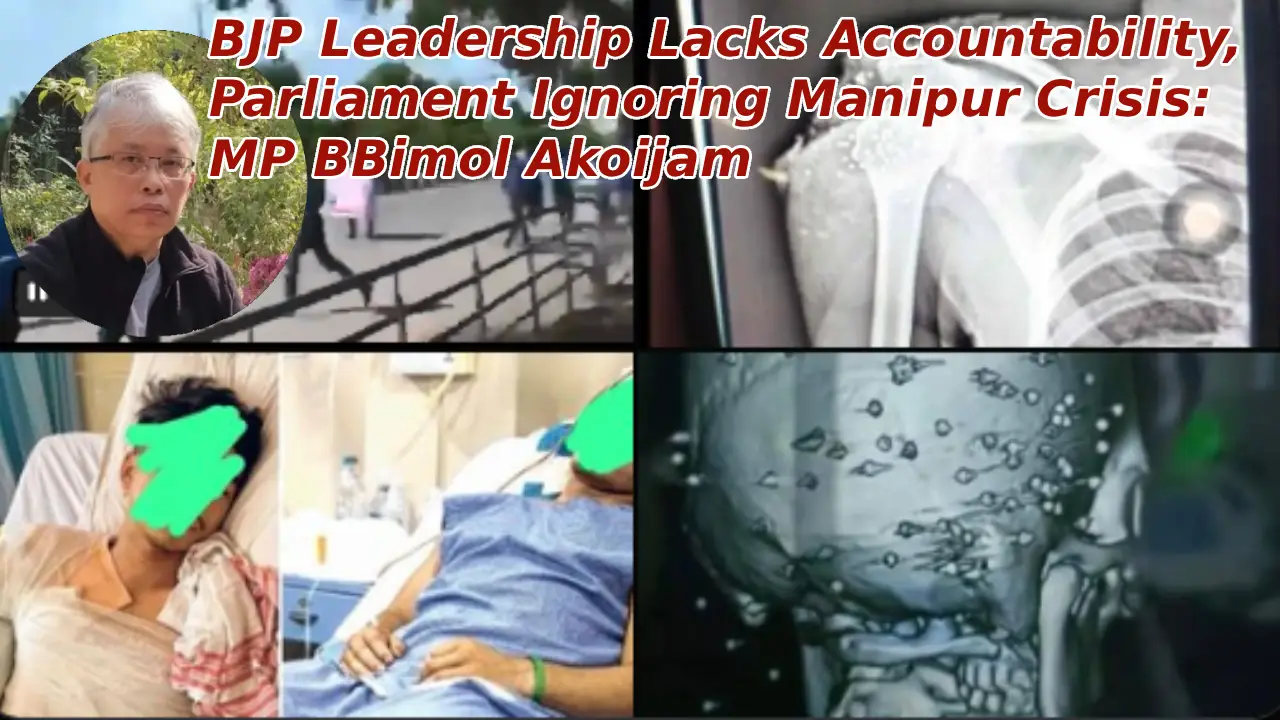
"Today, as I witness the tear gas and lathi charges right in the heart of Delhi, I can't help but think of the blown-off shoulder and pellet-ridden heads of protesting young students as they face tear gas and pellet guns in Imphal during the present crisis in Manipur," he remarked.
Dr Akoijam also referred to the extensive human suffering witnessed during the conflict, including deaths, displacement and destruction of property.
He spoke of "mutilated and bruised bodies, burnt down villages and residential complexes" and criticised the condition of internally displaced persons (IDPs) living in relief camps.
The MP also questioned the functioning of both the political leadership and the security establishment during the conflict.
"There is NO ACCOUNTABILITY for all these criminal acts and negligence," he asserted, alleging failures by the political class and security agencies, including units of the Indian Army, in preventing widespread violence.
Expressing disappointment over the functioning of Parliament, Dr Akoijam alleged that the prolonged crisis in Manipur had not received the attention it deserved despite its constitutional significance.
"The PARLIAMENT of the largest democracy doesn't have time for any discussion on this tragedy," he wrote.
He further argued that even securing recognition of the crisis as a national issue had become difficult.
"To make the tragedy visible itself is a struggle; to recognise it as a tragedy of a 'constituent state' of the UNION, if not a 'national issue'," he stated.
The MP also criticised the continued restrictions affecting the movement of people within Manipur, saying many citizens remain unable to travel freely across the state because of security concerns and community-based divisions.
Calling the situation both "unthinkable, and unconstitutional," he argued that the inability of citizens to safely access national highways undermined constitutional guarantees under Articles 15 and 19.
Dr Akoijam also highlighted what he described as inconsistency in the Centre's approach to regulating airline fares.
He said repeated appeals had been made to the Ministry regarding high airfare to and from Manipur, but authorities maintained that private airlines operated on market principles and that the Government could not impose fare caps.
However, he contrasted this with the Centre's reported intervention following disruptions affecting IndiGo operations elsewhere in the country.
"When the Indigo crisis hit the 'national mainstream', the Government of India imposed a 'fare cap' to stop the airlines from exploiting the situation by manipulating the fare hike," he observed.
Concluding his remarks, the Lok Sabha MP expressed hope that accountability would eventually prevail and that longstanding inequalities in governance would come to an end.
"One day, hopefully, accountability will be heard, and the reality that postcolonial scholars talk about, namely, the continuity of the colonial in the postcolonial, will also finally come to an end," he wrote before ending his post with "Vande Mataram" and "Ima Leipakna Yaiphare."
Dr Akoijam has consistently raised the issue of Manipur's prolonged ethnic conflict both inside and outside Parliament, calling for greater political engagement, accountability, and constitutional safeguards for affected communities.