Cybercrime cases in India more than doubled between 2020 and 2024, prompting the Centre to strengthen cyber policing, fraud prevention systems and digital investigation infrastructure across the country.
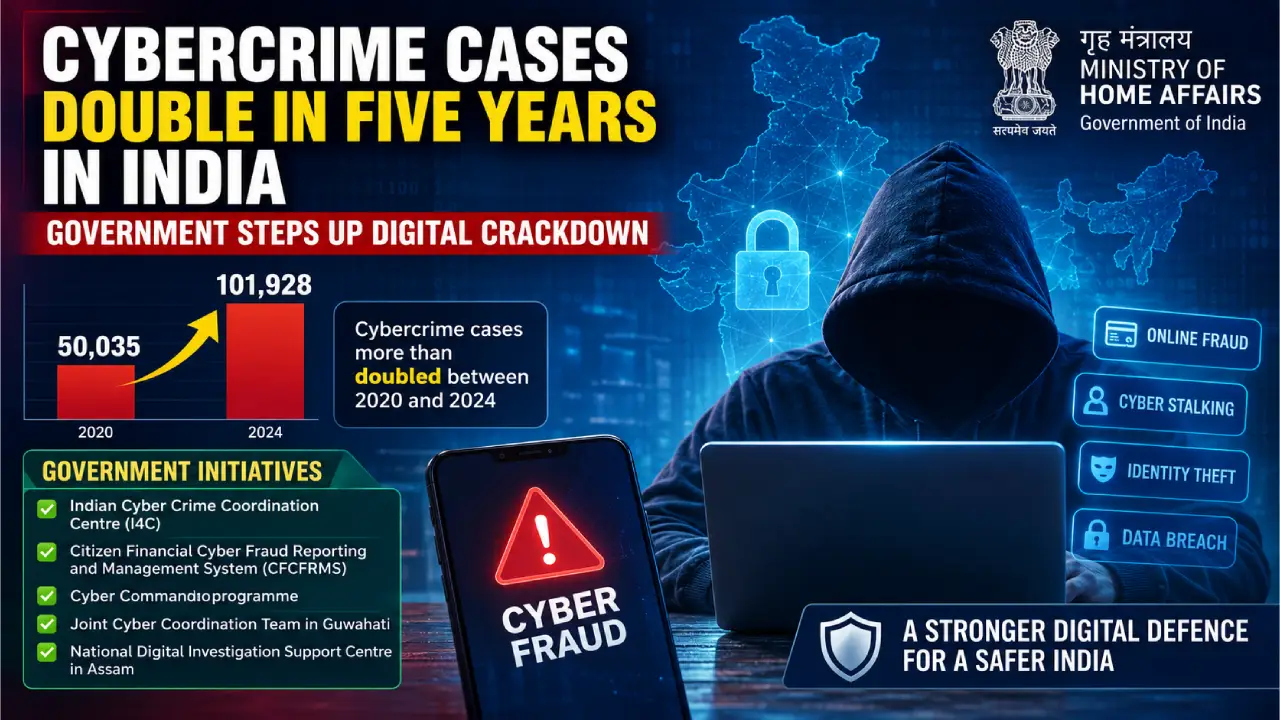
New Delhi, July 21: India is witnessing an unprecedented rise in cybercrime as rapid digital adoption continues to reshape the country's economy and daily life. New data released by the Ministry of Home Affairs (MHA) shows that the number of cybercrime cases registered nationwide has more than doubled over the past five years, prompting the government to expand its cyber policing infrastructure, strengthen financial fraud detection systems and establish specialised investigation centres across the country, including in the Northeast.
According to a written reply tabled in the Lok Sabha on Monday by Minister of State for Home Affairs Bandi Sanjay Kumar, cybercrime cases registered under the National Crime Records Bureau (NCRB) increased from 50,035 in 2020 to 101,928 in 2024. The figures reflect both the growing scale of digital offences and increased reporting through government-operated cybercrime platforms.
The data presents a picture of a threat landscape increasingly dominated by financial fraud, online cheating and technology-enabled offences, while also showing the government's efforts to build a nationwide response through specialised institutions, digital investigation tools and trained cyber investigators.
Among all categories of cybercrime, financial offences recorded the sharpest increase during the five-year period.
Cases of fraud registered under the Indian Penal Code (IPC) and, later, the Bharatiya Nyaya Sanhita (BNS), rose from 10,395 in 2020 to 29,758 in 2024.
Cases involving cheating recorded an even steeper rise, increasing from 4,480 in 2020 to 19,296 in 2024, highlighting how online scams, fraudulent investment schemes, phishing attacks and impersonation have become increasingly common.
Offences registered under the Information Technology Act continued to account for a substantial share of cybercrime.
Computer-related offences increased from 21,926 cases in 2020 to 36,920 in 2024, making them the single largest category under the IT Act.
The NCRB data also showed that offences relating to the publication or transmission of obscene or sexually explicit electronic content remained consistently high throughout the period, with annual cases ranging between around 6,000 and 7,800. In 2024 alone, authorities registered 6,990 such cases.
Cyber stalking and online bullying targeting women and children also continued to be reported across the country, with 1,240 cases registered last year.
The 2024 data additionally introduced new crime classifications under the Bharatiya Nyaya Sanhita, including 60 cases of organised cybercrime and 99 cases involving sexual intercourse by deceitful means committed through digital platforms.
Beyond registered criminal cases, the financial impact of cyber fraud has expanded significantly.
According to the Ministry of Home Affairs, the National Cyber Crime Reporting Portal (NCRP) received more than 65.8 lakh complaints related to financial fraud between 2021 and 2025. The total amount reported to have been lost in these cases exceeded Rs 55,050 crore.
Officials said the figures underline the increasing sophistication of organised cybercriminal networks that exploit digital payment platforms, online banking services, social media applications and communication networks to target victims across the country.
To tackle the growing threat, the ministry has steadily expanded the role of the Indian Cyber Crime Coordination Centre (I4C), which serves as the central agency for coordinating cybercrime prevention and investigation.
One of its key initiatives is the Citizen Financial Cyber Fraud Reporting and Management System (CFCFRMS), launched in 2021 to enable victims to report financial fraud immediately through the national cybercrime helpline, 1930.
The ministry said rapid reporting allows banks and financial institutions to freeze suspicious transactions before money is withdrawn or transferred through multiple accounts.
As of June 30, 2026, authorities said the system had helped prevent the loss of more than Rs 11,158 crore across over 32.8 lakh complaints.
Officials also reported that more than Rs 8,189 crore had been placed under lien while over 1.95 lakh FIRs had been registered based on complaints received through the system.
Recognising the need to improve compensation for victims, the ministry recently introduced a Standard Operating Procedure for returning recovered money.
In April this year, two new digital modules were made operational. The Money Restoration Module has been designed to speed up the return of recovered funds to victims, while a Grievance Redressal Module addresses complaints relating to bank account freezing and lien marking.
The government's cybercrime strategy increasingly relies on technology-driven investigation tools.
Among the most important is the Samanvaya platform, a national management information system that allows investigators to share intelligence and coordinate investigations across jurisdictions.
Integrated into the platform is the Pratibimb module, which maps the physical locations of cybercriminals and the digital infrastructure they use, helping investigators trace criminal networks operating across multiple states.
According to the ministry, intelligence generated through the platform has contributed to the arrest of more than 29,800 accused persons and supported over 2.33 lakh cyber investigation requests from law enforcement agencies.
The ministry has also launched the Sahyog Portal to streamline the issuance of legal notices to social media companies and other IT intermediaries under the Information Technology Act. The portal is intended to accelerate the removal or disabling of online content and digital links associated with unlawful activities.
The latest NCRB data shows considerable variation in cybercrime trends across the northeastern states.
Assam, which recorded one of the highest numbers of cybercrime cases in the region during the early years of the study period, reported a sharp decline in registered cases. The number fell from 3,530 in 2020 after peaking at 4,846 in 2021 to 408 cases in 2024.
Manipur also registered a significant reduction, with cases declining from 79 in 2020 to five in 2024.
While the ministry did not provide reasons for the decline, the figures contrast with the broader national trend of increasing cybercrime. Other northeastern states reported gradual increases over the same period.
Arunachal Pradesh recorded 78 cases in 2024 compared with 30 in 2020. Mizoram saw registered cases rise from 13 to 50, while Sikkim, which reported no cybercrime cases in 2020 and 2021, recorded 15 cases in 2024. Nagaland's cases increased from eight to 14, while Meghalaya reported 97 cases in 2024 after recording 142 in 2020. Tripura's numbers remained largely unchanged, with 33 cases recorded last year compared to 34 in 2020.
To strengthen cyber policing in the region, the ministry has established a Joint Cyber Coordination Team (JCCT) in Guwahati. The specialised unit works with police forces from the northeastern states to coordinate investigations involving multiple jurisdictions and respond to organised cybercrime networks operating across state boundaries.
The ministry has also established a National Digital Investigation Support Centre in Assam, which became operational on August 29, 2025. The centre provides cyber forensic support to investigating officers and functions as a regional counterpart to the national facility in New Delhi.
Alongside technological upgrades, the government has expanded training programmes for police personnel and judicial officers. The CyTrain online learning platform, which offers specialised cybercrime investigation courses, has registered more than 1.63 lakh users from police and judicial services.
According to the ministry, over 1.61 lakh course certificates have been issued covering cyber forensics, digital evidence collection and cyber investigation techniques.
The Home Ministry has also launched the Cyber Commando programme to create a specialised force capable of responding to complex cybersecurity threats. Since its launch in September 2024, 281 officers have completed advanced training at institutions including the Indian Institutes of Technology (IITs), Indian Institutes of Information Technology (IIITs), Rashtriya Raksha University and the National Forensic Sciences University.
The ministry said these officers are expected to strengthen the country's ability to protect critical digital infrastructure and investigate sophisticated cyber attacks.
The Centre has also increased financial assistance to states and Union Territories under the Cyber Crime Prevention against Women and Children (CCPWC) scheme.
According to the ministry, Rs 132.93 crore has been released to establish cyber forensic-cum-training laboratories across 33 states and Union Territories.
These facilities have trained around 24,600 personnel, while seven Central Forensic Science Laboratories and 28 State Forensic Science Laboratories continue to support cybercrime investigations requiring advanced forensic analysis.
Although policing and public order remain subjects under the jurisdiction of state governments, the Centre said it continues to provide policy support, funding, technology platforms and specialised investigative capabilities to strengthen cyber policing nationwide.
The latest figures illustrate both the growing scale of India's cybercrime challenge and the rapid expansion of institutions designed to combat it.
With online banking, digital payments, e-commerce and social media becoming integral to everyday life, officials say cybercrime will remain one of the country's most significant policing challenges. The government's response has increasingly shifted towards real-time fraud prevention, coordinated investigations, advanced digital forensics and specialised training as authorities seek to keep pace with increasingly organised and technology-driven criminal networks.