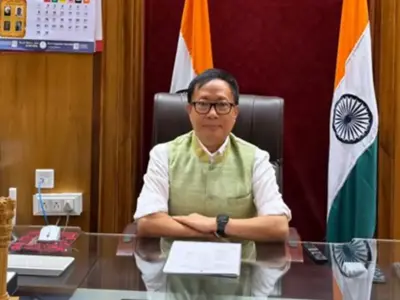
Assam Chief Minister Himanta Biswa Sarma says Manipur's crisis stems from a deep trust deficit, with the Myanmar conflict, demographic anxieties and identity politics driving the violence more than any single trigger.
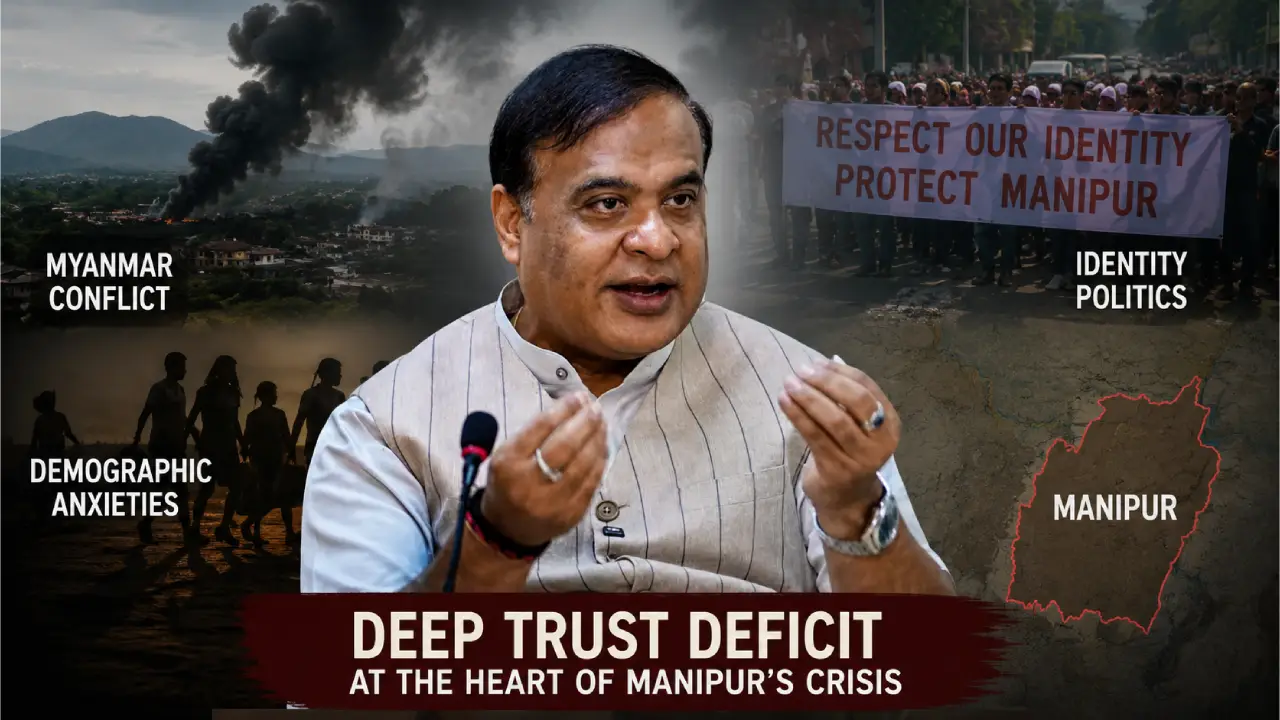
Imphal, July 5: More than three years after ethnic violence erupted in Manipur, Assam Chief Minister Himanta Biswa Sarma has offered one of his most detailed public assessments of the conflict, arguing that the crisis cannot be understood as a conventional law-and-order problem or insurgency but as a collapse of trust between communities that no government can resolve through force alone.
Speaking during an exclusive interaction at The Indian Express Idea Exchange, Sarma said the conflict represents a "big trust deficit" among the Meitei, Kuki and Naga communities, adding that the absence of any formal political charter of demands distinguishes Manipur from many other conflicts in the Northeast.
Unlike insurgencies that revolve around negotiations with armed groups or political organisations, Sarma said the Manipur crisis is essentially an internal social conflict between communities.
"There is no memorandum before the Government of India. There is no charter of demands that can simply be negotiated," he observed, describing the violence as a dispute rooted in identity, history and mutual distrust rather than a conventional political movement.
According to Sarma, while the government can deploy the Army, paramilitary forces and police to prevent further violence, security operations alone cannot repair broken relationships between communities.
"You can restore law and order, but you cannot make two brothers sit together and settle their dispute by evening," he said, arguing that reconciliation cannot be imposed administratively.
The observation marks a significant distinction between maintaining peace and achieving peace. Security forces, he suggested, are capable of containing violence but not rebuilding social trust.
High Court order was the trigger, not the root cause
Sarma rejected the notion that the 2023 Manipur High Court order recommending consideration of Scheduled Tribe (ST) status for the Meitei community was the sole cause of the violence.
Instead, he described it as the immediate trigger that ignited tensions which had been accumulating over several years. In his assessment, the deeper structural factor lay across the international border.
The prolonged civil war in Myanmar, he said, had already altered the demographic and political landscape of Manipur well before violence erupted in May 2023.
According to Sarma, the instability in Myanmar resulted in an influx of Kuki people into Manipur, intensifying anxieties within sections of the Meitei community over demographic change and land ownership.
These concerns, he said, fuelled demands for measures such as a National Register of Citizens (NRC) and stronger legal safeguards for land.
At the same time, he noted, sections of the Kuki community increasingly articulated demands for greater political autonomy, including proposals relating to separate administrative arrangements.
The convergence of these competing aspirations created conditions that made the state increasingly vulnerable to conflict.
"The High Court order was a trigger, but not the major problem," Sarma indicated, suggesting that the underlying fault lines had been widening long before the violence began.
Identity politics rather than negotiable demands
One of the central themes emerging from Sarma's assessment is that Manipur's crisis differs fundamentally from conflicts driven by economic or administrative grievances. Ordinarily, governments negotiate over political demands, development packages or constitutional arrangements.
In Manipur, however, he argued, the dispute revolves around competing perceptions of identity, belonging and demographic security. This, he suggested, makes the conflict inherently more difficult to resolve because there is no single political agreement capable of satisfying all stakeholders.
The issue, in his words, is not what communities want from the government, but how they perceive each other's future within the same geographical and political space.
That distinction explains why successive rounds of security deployment have succeeded in reducing violence without eliminating the underlying tensions.
Lessons from Manipur's history
Sarma also placed the current conflict within a broader historical context. He pointed out that Manipur has experienced similar episodes of ethnic conflict in the past. Those confrontations, he said, were eventually resolved not through administrative intervention but through prolonged dialogue among community leaders.
According to him, previous conflicts took nearly eight to nine years before lasting settlements emerged. That historical experience, he argued, demonstrates why expectations of a quick political solution may be unrealistic.
Instead, rebuilding confidence between communities is likely to require sustained engagement over several years. The observation also reflects a broader understanding within parts of the Northeast that communal reconciliation often progresses more slowly than political negotiations.
Why Sarma stepped back from mediation
Sarma disclosed that he had actively engaged in efforts to ease tensions during the initial phase of the violence. He visited Manipur several times and participated in discussions aimed at reducing hostilities. However, he eventually chose to withdraw from direct involvement.
The reason, he explained, was strategic rather than political.
Assam is home to sizeable Meitei, Kuki and Naga populations that have continued to coexist peacefully. He feared that any perception of bias towards one community could create tensions within Assam itself and potentially spread the conflict beyond Manipur.
According to Sarma, remaining publicly neutral was therefore essential to protecting communal harmony in Assam and elsewhere in the Northeast. His remarks underscore the delicate balancing act faced by neighbouring states that share ethnic linkages with communities involved in the Manipur conflict.
Guwahati's evolving role
Although Sarma withdrew from active mediation, he said Assam continues to play an important facilitating role. Guwahati, he noted, has emerged as a neutral venue where representatives from different communities and officials of the Government of India regularly meet for discussions.
Rather than prescribing solutions, Assam's role is to provide a secure and politically neutral environment in which dialogue can continue.
This approach reflects what may be described as a policy of facilitation rather than intervention. By avoiding overt alignment with any stakeholder, Assam seeks to encourage communication without becoming a party to the dispute.
A lesson from security training
Sarma illustrated his argument with an example involving a Manipur battalion that underwent training in Assam. The unit consisted of approximately 1,200 personnel drawn from the Meitei, Kuki and Naga communities.
According to him, when the recruits first arrived, members of different communities refused to speak to one another because of the violence unfolding in Manipur.
However, after nearly a year of living, training and working together, relationships gradually improved. By the end of the programme, Sarma said, they functioned "like brothers."
The example, while anecdotal, was intended to demonstrate that institutional settings can gradually rebuild trust when neutrality and sustained interaction are maintained.
For Sarma, the experience reinforced his belief that reconciliation is possible but requires time rather than coercion.
Rejecting conspiracy narratives
The Assam Chief Minister also dismissed suggestions that the violence could be attributed to a single political actor or orchestrated conspiracy.
He argued that such explanations oversimplify a conflict rooted in decades of accumulated distrust. In his view, the crisis has evolved beyond the influence of any individual or political organisation.
Instead, the challenge lies in addressing deep social divisions that cannot be explained solely through political rivalries.
This perspective departs from narratives that seek to identify a single architect behind the unrest and instead places greater emphasis on structural and historical factors.
Reading Sarma's strategy
Taken together, Sarma's remarks outline what may be termed a strategy of containment, neutrality and long-term dialogue.
The first pillar is maintaining law and order to prevent renewed violence.
The second is avoiding actions that could internationalise or regionalise the conflict by drawing neighbouring states into ethnic disputes.
The third is creating conditions in which community leaders themselves can negotiate durable settlements.
This approach reflects an acknowledgement of the limits of state power. Security forces can separate hostile groups and prevent immediate violence. Governments can facilitate meetings and provide institutional support.
But rebuilding trust between communities, Sarma argues, remains a task that only the communities themselves can accomplish.
A conflict still searching for political consensus
Sarma concluded by observing that Manipur is relatively more peaceful today than during the height of the violence. However, he cautioned that the absence of widespread violence should not be mistaken for reconciliation.
For peace to become durable, he argued, the trust deficit between communities must be addressed through sustained dialogue rather than short-term political interventions.
His assessment also serves as a reminder that the Manipur conflict cannot be viewed solely through the lens of security operations or electoral politics.
Instead, it represents a deeper contest over identity, territory and coexistence—issues that have historically required patience, community engagement, political will to address real issues, and long-term confidence-building across the Northeast.
Whether that process gathers momentum in the coming years may ultimately determine not only Manipur's future but also the broader stability of India's Northeast.