Manipur inaugurated a CSIR-NEIST bioreactor unit for biofertilizer production as Chief Minister Yumnam Khemchand Singh reaffirmed the state's push towards organic farming.
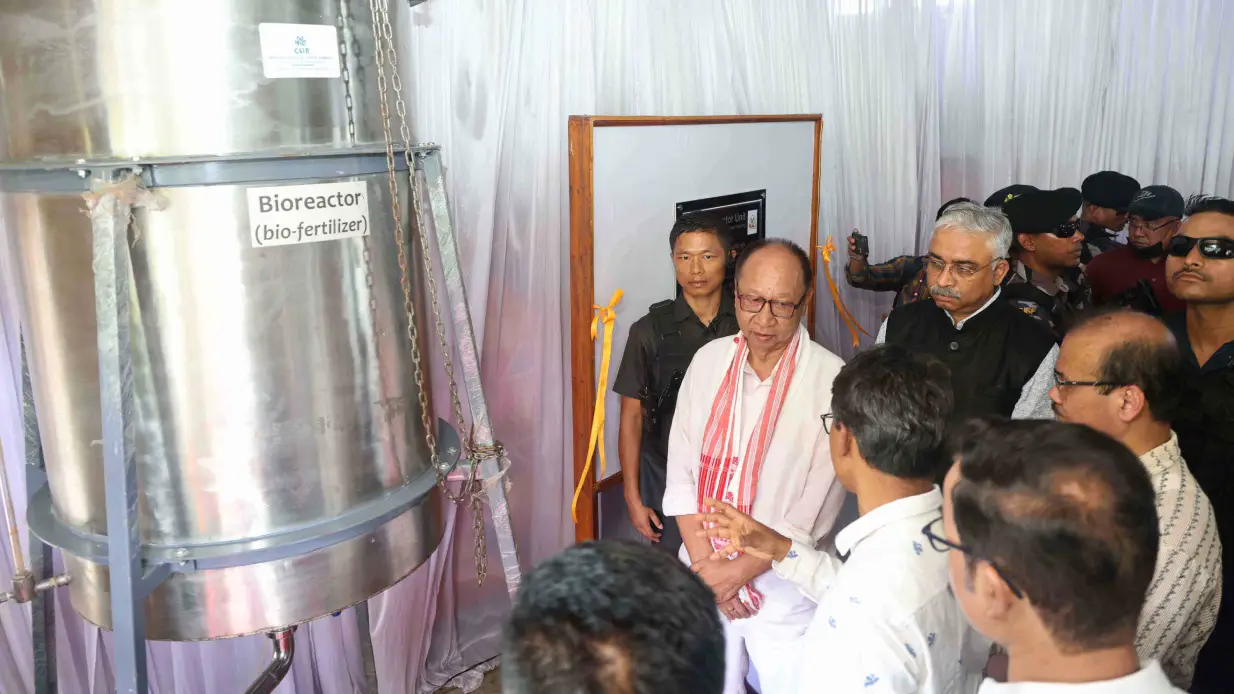
Imphal, July 2: Chief Minister Yumnam Khemchand Singh on Thursday inaugurated a Bioreactor Unit for Biofertilizer Production at the CSIR–North East Institute of Science and Technology (CSIR-NEIST) Branch Laboratory in Lamphelpat, describing the expansion of organic farming as an important component of India's Viksit Bharat@2047 vision.
The new facility is expected to support the production of biofertilisers in Manipur and strengthen ongoing efforts to reduce dependence on chemical fertilisers while promoting sustainable agriculture in the state.
Speaking at the inaugural programme, the Chief Minister said the Government of India has launched several initiatives across different sectors under the leadership of Prime Minister Narendra Modi to realise the vision of a developed India by 2047. Among these, he said, encouraging the use of biofertilisers and expanding organic farming are important steps towards building a healthier nation and protecting the environment.
He noted that the continued use of chemical fertilisers has raised concerns not only over declining soil fertility but also over their potential impact on human health. According to him, biofertilisers offer a sustainable alternative by improving soil quality while reducing reliance on synthetic agricultural inputs.
"The use of biofertilisers will contribute to healthier agricultural practices and support the broader goal of creating a healthier India," he said.
Highlighting the state's progress, Khemchand Singh said Manipur has already brought around 400 hectares of agricultural land under organic cultivation. He added that the Agriculture Department is working to bring another 400 hectares under organic farming as part of its ongoing expansion programme.
The Chief Minister said the long-term objective is to gradually transform Manipur into a fully organic state through coordinated efforts by government agencies, scientific institutions and farmers.
Inaugurated the Bioreactor Unit for Bio-Fertilizer Production & Farmers’ Meet at CSIR-NEIST, Lamphelpat, and participated in the #EkPedMaaKeNaam plantation drive.
— Khemchand Yumnam (@YKhemchandSingh) July 2, 2026
Inspired by Hon’ble PM Shri @narendramodi Ji’s vision of #ViksitBharat2047, this initiative will strengthen organic… pic.twitter.com/cYoFxa3wT3
Referring to the experience of Sikkim, he pointed out that the Himalayan state became India's first fully organic state in 2016 and has continued to maintain that status. He said the achievement demonstrates that sustained policy support and public participation can successfully transform agricultural practices.
Drawing from that example, he expressed confidence that Manipur could also make significant progress in organic farming if farmers, researchers and government departments work together.
The Chief Minister also appealed to beneficiaries receiving bioreactor units to utilise the equipment effectively for producing quality biofertilisers and making them accessible to farmers across the state.
He said the success of such initiatives would depend not only on government support but also on the commitment of beneficiaries to expand production and encourage wider adoption of organic farming practices.
According to him, collective efforts at the grassroots level would be essential in achieving the state's vision of becoming an organic farming hub.
Director of CSIR–North East Institute of Science and Technology (NEIST), Jorhat, Prof. V.M. Tiwari, said the Council of Scientific and Industrial Research has contributed to society for several decades through scientific research and technological innovation.
He said the organisation has also played a significant role in skill development and capacity-building programmes aimed at supporting local communities.
Prof. Tiwari noted that the CSIR Mission has been implemented effectively in Manipur over the past seven to eight years, helping promote scientific interventions in sectors including agriculture, rural livelihoods and entrepreneurship.
He said the inauguration of the new biofertiliser production unit represents another step towards applying scientific research to address practical challenges faced by farmers in the region.
The programme also witnessed the exchange of two Memoranda of Understanding (MoUs) between CSIR-NEIST and local incubate organisations from Manipur.
The agreements were signed with Farmers Based Organization (FBO), represented by its General Secretary Sagolsem Nimaichand Singh, and M/s Global Bio Solutions, represented by Ningombam Arunkumar Singh of Thangal Bazar, Imphal.
The collaborations are expected to facilitate the production, promotion and wider dissemination of biofertilisers while strengthening partnerships between scientific institutions and local enterprises.
As part of the programme, the Chief Minister planted an Avocado (Persea americana Mill.) sapling under the nationwide "Ek Ped Maa Ke Naam" campaign, which encourages tree plantation as a tribute to mothers while promoting environmental conservation.
Scientists, officials and staff of CSIR-NEIST, along with farmers and other stakeholders, attended the inaugural function.
The establishment of the bioreactor unit reflects the growing emphasis on integrating scientific research with sustainable agricultural practices in the Northeast. Biofertilisers are increasingly viewed as an environmentally friendly alternative to conventional chemical fertilisers because they improve soil microbial activity, enhance nutrient availability and reduce long-term ecological degradation.
For Manipur, where agriculture continues to support a significant share of rural livelihoods, expanding access to biofertilisers could help improve farm productivity while lowering input costs and promoting healthier cultivation practices. The state's ongoing efforts to expand organic farming also align with national initiatives aimed at climate-resilient agriculture and sustainable rural development.
If successfully implemented, the collaboration between government agencies, research institutions and local entrepreneurs could strengthen Manipur's transition towards environmentally sustainable farming while creating new opportunities in biofertiliser production and rural enterprise.