Manipur launches VB-G RAM G, increasing guaranteed rural employment from 100 to 125 days and raising daily wages to Rs300 as districts begin implementation.
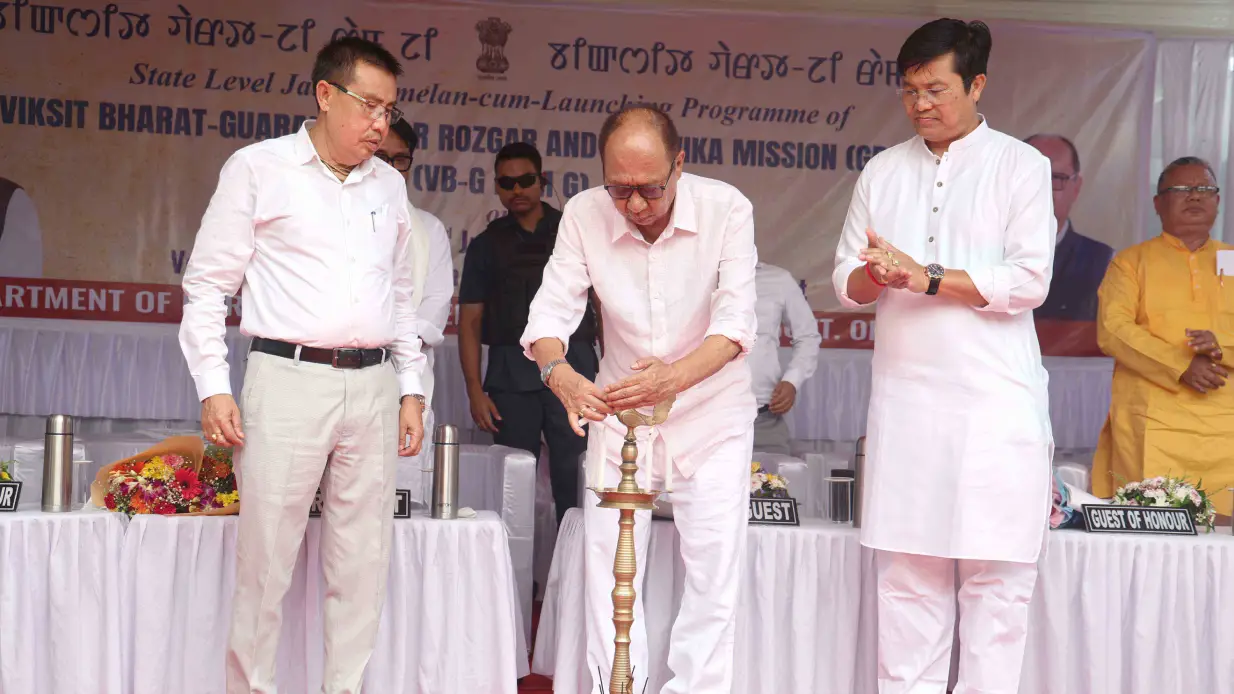
Imphal, July 2: Manipur on Thursday rolled out the Viksit Bharat–Guarantee for Rozgar and Ajeevika Mission (Gramin) (VB-G RAM G) across the state, replacing the Mahatma Gandhi National Rural Employment Guarantee Act (MGNREGA) framework with an expanded rural employment programme that increases guaranteed wage employment from 100 to 125 days annually while raising daily wages to Rs300.
The state-level launch was held at Salam Tharojam Eco Tourism Park in Imphal West, where Chief Minister Yumnam Khemchand Singh announced that eligible job card holders would now receive up to 125 days of guaranteed employment every financial year, compared to the earlier 100-day entitlement under MGNREGA.
The programme, organised by the Department of Rural Development and Panchayati Raj, coincided with the nationwide launch of the scheme led by Union Minister for Rural Development and Agriculture & Farmers' Welfare Shivraj Singh Chouhan from Tirupati in Andhra Pradesh.
Addressing the gathering, the Chief Minister said the revised scheme represents a major expansion of livelihood support for rural households and is intended to strengthen village economies while contributing to the national vision of Viksit Bharat @2047.
He said the enhancement of guaranteed employment would provide additional income security for rural families, while the increase in daily wages from Rs283 to Rs300 would offer greater financial support amid rising living costs.
"The scheme will not only generate employment but also help create productive assets in villages while contributing to the larger vision of building a developed India by 2047," he said.
Besides inaugurating the programme, the Chief Minister joined other dignitaries in a plantation drive organised as part of the launch.
Deputy Chief Minister Nemcha Kipgen, who addressed the programme through video conferencing, said sustainable national development must begin at the village level.
She stressed that the new mission should function as more than an employment programme and serve as a platform for convergence among multiple rural development initiatives.
According to her, the scheme should be linked with agriculture, horticulture, watershed development, soil conservation, the Jal Jeevan Mission, rural water conservation programmes and National Rural Livelihood Mission (NRLM) activities so that villages can build durable, productive and climate-resilient assets.
Such convergence, she said, would improve the long-term impact of public investment while generating sustainable livelihoods instead of focusing solely on wage employment.
Commissioner of Rural Development and Panchayati Raj Sumant Singh outlined the structural changes introduced under the new legislation.
He said the Act was passed by Parliament on December 19, 2025, replacing the earlier MGNREGA framework with a more comprehensive rural development model.
Under the revised system, every Gram Panchayat will prepare its own development plan based on local priorities.
The plans will subsequently be assessed and graded by the State Government under four categories—A, B, C and D—to evaluate implementation and performance.
He further informed that planning, monitoring and execution of projects would be integrated with the PM GatiShakti geospatial portal, enabling digital mapping, improved transparency and better coordination among departments.
The new mission places greater emphasis on creating durable public assets instead of merely generating temporary employment.
Across the state, officials highlighted that priority will be given to projects relating to natural resource management, water conservation, agriculture and allied sectors, rural infrastructure, livelihood promotion and climate resilience.
The programme also envisages greater convergence with flagship rural development schemes to maximise outcomes while promoting technology-enabled governance, geo-tagging of works, digital monitoring and transparent wage payments.
Several district administrations noted that village-level planning through Gram Sabhas would remain central to implementation, allowing communities to identify works based on local needs.
Alongside the state-level function in Imphal, district administrations across Manipur simultaneously organised Jan Sammelan-cum-launch events to mark the beginning of the new programme.
In Kakching, officials distributed Information, Education and Communication (IEC) materials to job card holders, Self-Help Groups and other stakeholders before holding discussions on the provisions of the new Act. Participants also watched the live national launch before district officials explained the objectives and implementation strategy.
In Tamenglong, Deputy Commissioner Dr. L. Angshim Dangshawa highlighted the enhanced employment guarantee and increased wages, describing the revised programme as an important source of livelihood support for rural households. The district also inaugurated the construction of a pucca side drain at Apollo as its first work under the new scheme.
The Senapati district administration described the programme as a renewed commitment towards resilient and self-reliant villages. Officials emphasised that the mission builds upon the achievements of MGNREGA while introducing improvements in livelihood security, natural resource conservation, rural infrastructure and timely wage payments. Beneficiaries from different development blocks also shared success stories from earlier employment works, including water harvesting structures, roads and drainage systems.
At Churachandpur, Deputy Commissioner Krishna Kumar said the scheme prioritises four broad sectors—water security, rural infrastructure, livelihood infrastructure and climate resilience. He added that all projects would be geo-tagged and digitally documented to improve transparency while village authorities would play the primary role in planning and implementation.
The Pherzawl district administration said the revised framework aims to strengthen rural livelihoods by creating durable assets such as water harvesting structures, rural roads, drainage systems and plantations while integrating implementation with programmes including PM GatiShakti and Jal Jeevan Mission. Officials also highlighted provisions allowing temporary pauses during peak agricultural seasons without affecting overall implementation.
In Ukhrul, Deputy Commissioner Uppuluri Chaitanya urged people to actively participate in rural development efforts, saying improved rural infrastructure would contribute towards achieving the objectives of Viksit Bharat 2047. Nearly 500 participants attended the district launch programme.
The Chandel district administration distributed work orders to village chiefs representing five villages while emphasising transparency, community participation and planning around water security, rural infrastructure, livelihoods and climate resilience.
In Kamjong, officials highlighted that the scheme would seek to reduce distress migration by generating employment opportunities within villages. The district also announced the commencement of an approach road improvement project under the new programme and reiterated that at least 30 per cent of job card holders would be women.
The Tengnoupal administration distributed work orders to beneficiaries from Tengnoupal and H. Wajang villages during its launch event and called upon village authorities to prioritise locally relevant projects under the new framework.
Meanwhile, Bishnupur officials emphasised that technology such as biometric authentication, geo-tagging and digital monitoring would improve transparency while ensuring timely wage payments and effective implementation.
While retaining wage employment as its core component, officials said the new legislation broadens the scope of the programme by integrating livelihood generation with long-term village development.
The mission seeks to strengthen rural economies through participatory planning led by Gram Panchayats while creating durable public assets capable of supporting agriculture, conserving natural resources, improving rural infrastructure and enhancing resilience against climate-related challenges.
With simultaneous launches across Manipur's districts, the state has formally begun implementing the new framework that replaces MGNREGA and expands employment guarantees alongside a wider focus on sustainable rural development.