NITI Aayog's Investment Friendliness Index ranks Manipur 33rd of 36 states as fiscal deficits, the 2023 conflict, and stalled Act East infrastructure projects continue to deter private investment.
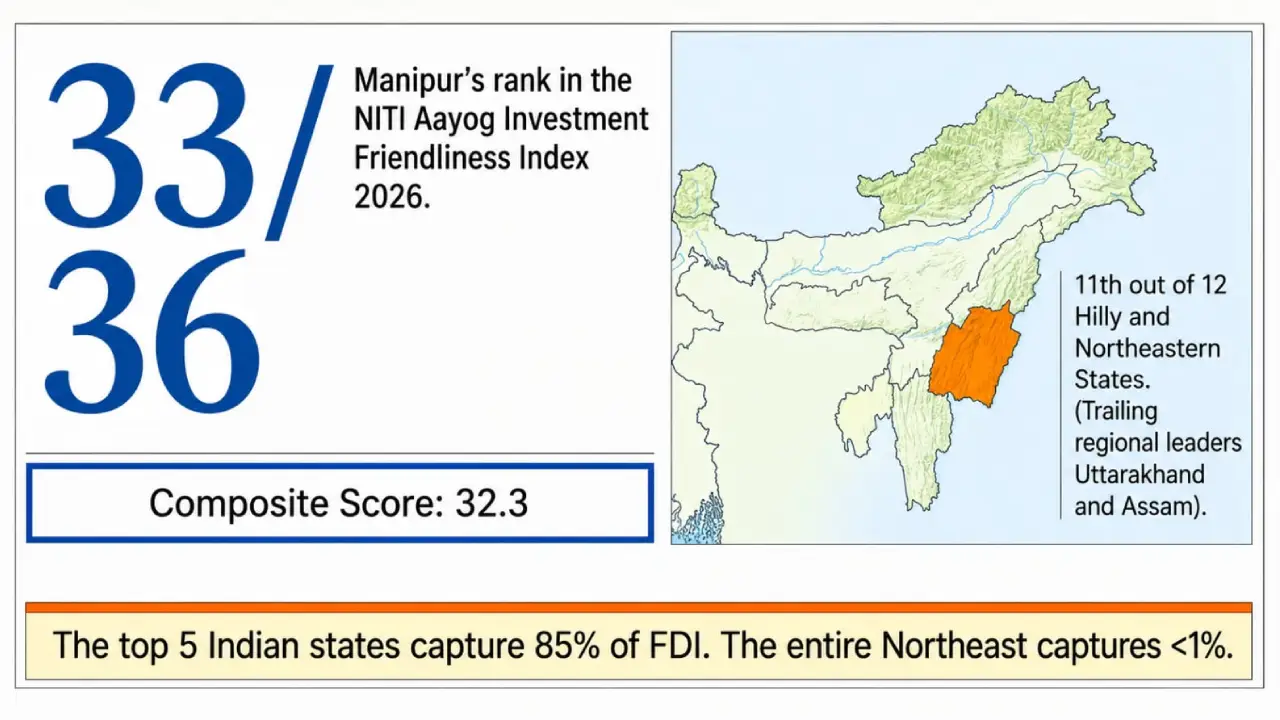
Imphal, July 17: Manipur has been ranked 33rd out of 36 states and union territories in NITI Aayog's newly released Investment Friendliness Index (IFI) 2026, placing it 11th among the 12 states in the Hilly and Northeastern category with a composite score of 32.3. The ranking, alongside a separate risk assessment of the state's economy, points to a widening gap between Manipur's potential and its ability to attract capital, driven by chronic fiscal deficits, the aftermath of the 2023 ethnic conflict, and stalled cross-border infrastructure central to India's Act East Policy.
The findings arrive as India works toward its long-term "Viksit Bharat 2047" development goal, under which state-level competitiveness has become a central factor in attracting investment. The NITI Aayog index, built on 84 indicators across eight pillars and drawing on perception surveys from more than 1,850 ground-level investors, found that the top five states — Maharashtra, Karnataka, Gujarat, Delhi and Tamil Nadu — together account for roughly 85 percent of India's foreign direct investment inflows. The entire Northeastern region, by contrast, receives less than 1 percent. Data on recent FDI inflows into Manipur specifically was not available, according to the index.
Within the Hilly and Northeastern category, Uttarakhand and Assam led with scores of 47.5 and 47.3 respectively. Manipur's score of 32.3 places it well behind both.
A Service-Heavy Economy With Little Industry
Manipur's Gross State Domestic Product per capita stood at Rs 85,414, according to the index — far below leading states such as Goa (Rs 439,596) and Gujarat (Rs 264,232). The state's economy remains heavily tilted toward services, which account for 77 percent of its Gross Value Added, while industry contributes just 11.2 percent. The state's principal industries are non-metallic mineral products and food processing.
The picture is not uniformly weak. The index found Manipur performing above the regional average on several foundational measures. The state's pool of graduates and postgraduates entering the workforce runs 22 percent above the category average, and its vocational training capacity through Industrial Training Institutes was 31 percent above average in 2025. Road density was around 37 percent above the pillar average for fiscal 2024, and average daily power supply, at 22.7 hours, exceeded the regional average of 21.9 hours. Investors also rated Manipur's single-window clearance system 6 points above the category average on satisfaction.
Those strengths were offset by steep weaknesses elsewhere. Manipur's gross fiscal deficit stood at approximately 11.3 percent of GSDP in fiscal 2024 — 4 percentage points above the regional average and 7 points beyond the limit set by the 15th Finance Commission. The state scored just 9 percent on the Government Policy pillar, reflecting low research and development incentives and limited budget allocations for industry, and 23 percent on Business Climate, weighed down by negligible export activity.
Investors consulted for the index identified sociopolitical stability, expanded international air connectivity to Bangladesh, Myanmar and Thailand, better road quality, and more consistent power supply as the priorities for improving the investment climate.
Two Decades of Policy, Little Conversion
A separate risk assessment of Manipur's economy — covering industrial policy, public finances, conflict and connectivity — traces the gap between the state's regulatory ambitions and their outcomes over more than a decade. The Manipur Industrial Investment Policy of 2013 and the Industrial and Investment Promotion Policy of 2017 sought to build a private-sector-led growth model, backed by financing from the Asian Development Bank for road corridors including the Imphal Ring Road and sections of Asian Highway 1, and World Bank funding for power transmission infrastructure.
The Manipur Ease of Doing Business Act of 2016 created a State Single Window Clearance System meant to offer time-bound approvals, followed by the Manipur Industrial Single Window Clearance Bill in 2021. But in the Centre's Business Reforms Action Plan assessments, Manipur has remained in the lowest tier, classified as an "Emerging Business Ecosystem." Under the World Bank-supported digital initiative meant to raise single-window satisfaction to 80 percent, current progress stands at 0 percent, with implementation yet to begin, the assessment found.
Of the 39 memorandums of understanding signed with corporate entities at the North East Business Summit in Imphal in November 2017 — spanning projects such as an oil pipeline from Numaligarh to Imphal and mineral extraction in the hill districts — the assessment found that a significant majority have stalled or been abandoned, citing land disputes in unclassed forest areas, resistance to extractive projects, and armed conflict as key factors.
Fiscal Dependency and Rising Committed Costs
The state's own tax revenue contributes only about 10 percent of its total revenue receipts, with 80 to 90 percent coming from central transfers. The withdrawal of Manipur's Special Category Status in January 2015, following recommendations of the 14th Finance Commission, raised the state's share of development financing costs from 10 to 50 percent. Its share of grants-in-aid under the 15th Finance Commission was further reduced to 1.4 percent, down from 2.0 percent previously.
Between fiscal 2016-17 and 2021-22, the state's total expenditure grew at a compound annual rate of 25 percent against 24 percent growth in receipts, driven substantially by rising salary and pension costs. Capital outlay in the 2026-27 budget is proposed at Rs 4,716 crore, a 10 percent contraction from the previous year's revised estimate. To manage cash flow, the state has relied on Ways and Means Advances from the Reserve Bank of India, with annual transactions projected between Rs 3,000 crore and Rs 5,000 crore.
Conflict's Continuing Economic Toll
The ethnic conflict that broke out on May 3, 2023, between Meitei and Kuki-Zo communities, which resulted in over 260 documented deaths and the displacement of more than 70,000 people, has had lasting economic consequences, according to the assessment. More than 8,000 acres of farmland in hill-valley interface zones have gone out of cultivation due to security risks, resulting in an estimated Rs 120 crore in annual agricultural losses. More than 200 registered business establishments in Imphal and surrounding districts have closed.
Disruptions along National Highway 2 and National Highway 37 — the state's principal supply routes — including blockades and transit taxes imposed by non-state actors, have caused trade losses estimated between Rs 400 crore and Rs 600 crore, contributing to inflation in essential commodities. The World Bank-funded Manipur Infotech eNabled Development Project, a $46 million initiative to improve digital infrastructure, was rated "Moderately Unsatisfactory" in its mid-2025 progress review, with instability preventing stakeholder consultations and field deployment.
Act East Gateway Still Largely Closed
Manipur shares a 398-km border with Myanmar and is positioned as a land gateway under India's Act East Policy, but major connectivity projects remain behind schedule. The Jiribam-Imphal Railway Project, requiring 45 tunnels and the Noney Bridge, has seen cumulative expenditure reach Rs 14,423 crore against an escalated cost of Rs 22,274 crore as of March 2024. Passenger services on commissioned sections have been suspended, and the completion target has been pushed to March 2028.
Moreh Land Port, which opened for trade with Myanmar in August 2018, has seen commercial traffic suspended entirely amid the domestic conflict and Myanmar's military coup. The India-Myanmar-Thailand Trilateral Highway remains stalled in Myanmar's Sagaing Region and Chin State, where sections are under the control of ethnic armed organisations. International commercial flights from Imphal's Bir Tikendrajit International Airport also remain suspended, affecting the state's medical tourism sector, which had previously drawn thousands of patients from western Myanmar to private hospitals such as Shija Hospitals and Research Centre.
Regional Gap With Assam Widens
The assessment also highlights a widening gap between Manipur and Assam in accessing central industrial schemes. Under the North East Industrial Development Scheme 2017, Assam registered 797 of the 976 industrial units recorded across the eight Northeastern states, receiving Rs 895.06 crore in disbursed subsidy compared with Manipur's Rs 18.92 crore across 12 registered units. Under the newer UNNATI 2024 scheme, Manipur had zero recommended applications on the agenda at a Department for Promotion of Industry and Internal Trade committee meeting in October 2025, against 67 for Assam.
Manipur's Micro, Small and Medium Enterprises sector remains dominated by small-scale handloom and agro-processing units, with women accounting for 55 percent of the MSME workforce — the second-highest share in the country after Nagaland.
Educated but Jobless
The state also faces what the assessment terms a "Graduate Paradox." Despite a 2011 Census literacy rate of 76.94 percent, Manipur recorded the highest unemployment rate among Indian states and union territories at 10.1 percent for persons aged 15 and above, according to the Periodic Labour Force Survey for July 2023–June 2024. Unemployment among graduates and postgraduates reached 29.1 percent. The state's Labour Force Participation Rate stood at 32.8 percent in 2021-22, against a national average of 41.3 percent, with 64.3 percent of the workforce in informal self-employment.
The assessment attributes sustained outmigration of educated youth to cities such as Bengaluru, Delhi, Pune and Mumbai to a combination of limited formal employment, security laws, and informal taxation, alongside the pull of higher wages elsewhere.
Both reports point to fiscal stabilisation support, security measures to protect transit corridors, and a services-oriented strategy built around healthcare, tourism and skilled labour as areas requiring coordinated intervention between the state and central governments.