UDISE+ 2025-26 and AISHE 2023-24 reveal Manipur's strengths in teacher availability and higher education growth, alongside major concerns over school infrastructure, digital access and rising student dropouts.
Imphal, July 9: Manipur's education sector presents a picture of both resilience and persistent structural challenges, according to the latest reports released by the Union Ministry of Education. While the state continues to maintain one of the country's best pupil-teacher ratios and has expanded its higher education network over the past five years, serious concerns remain over school infrastructure, access to basic amenities, digital connectivity and the ability to retain students through higher grades.
The Ministry recently released the Unified District Information System for Education Plus (UDISE+) 2025-26 report on school education on July 7, and the All India Survey on Higher Education (AISHE) 2023-24 on July 9, providing a detailed assessment of the state's education sector from primary schooling to university education.
The findings suggest that although Manipur has invested significantly in its human resources, the state's education system continues to face major infrastructural and demographic challenges that could affect learning outcomes if not addressed.
A Large School Network Supported by a Strong Teaching Workforce
According to the UDISE+ report, Manipur has 4,662 recognised schools catering to 6,65,042 students, including 3,39,662 boys and 3,25,380 girls. These schools are supported by 41,742 teachers, resulting in a Pupil-Teacher Ratio (PTR) of 16, considerably lower than the national average of 24.
Education experts generally regard a lower PTR as a positive indicator because it allows teachers to provide greater individual attention to students, improve classroom engagement and strengthen learning outcomes.
The state's school system is primarily driven by government institutions. Of the total schools, 2,934 are managed by the State Government, while 586 are government-aided and 1,056 are private unaided recognised schools. Another 86 institutions fall under other management categories.
The distribution reflects a mixed education ecosystem where both public and private institutions continue to play important roles in providing school education.
Basic Infrastructure Continues to Lag
Despite having adequate teaching personnel, the report points to serious gaps in basic school infrastructure.
Perhaps the most striking finding relates to access to safe drinking water. Out of 4,662 schools, only 1,880 have drinking water facilities, while only 1,700 reported functional drinking water.
This effectively means that nearly two-thirds of schools in the state lack reliable access to safe drinking water, raising concerns over student health, hygiene and overall learning conditions.
Handwashing facilities are available in only 1,809 schools, another indicator that many institutions continue to struggle with basic Water, Sanitation and Hygiene (WASH) infrastructure.
Sanitation facilities show comparatively better performance. The report records 4,509 schools with girls' toilets, of which 4,374 are functional, while 4,253 schools have boys' toilets, with 3,849 functioning.
However, inclusive infrastructure remains limited. Only 1,162 schools have toilets designed for Children with Special Needs (CWSN), suggesting that accessibility remains an area requiring greater attention.
Interestingly, the report notes that 4,109 schools have playgrounds, indicating that outdoor recreational spaces are more widely available than several essential learning facilities.
Electricity and Digital Learning Remain Uneven
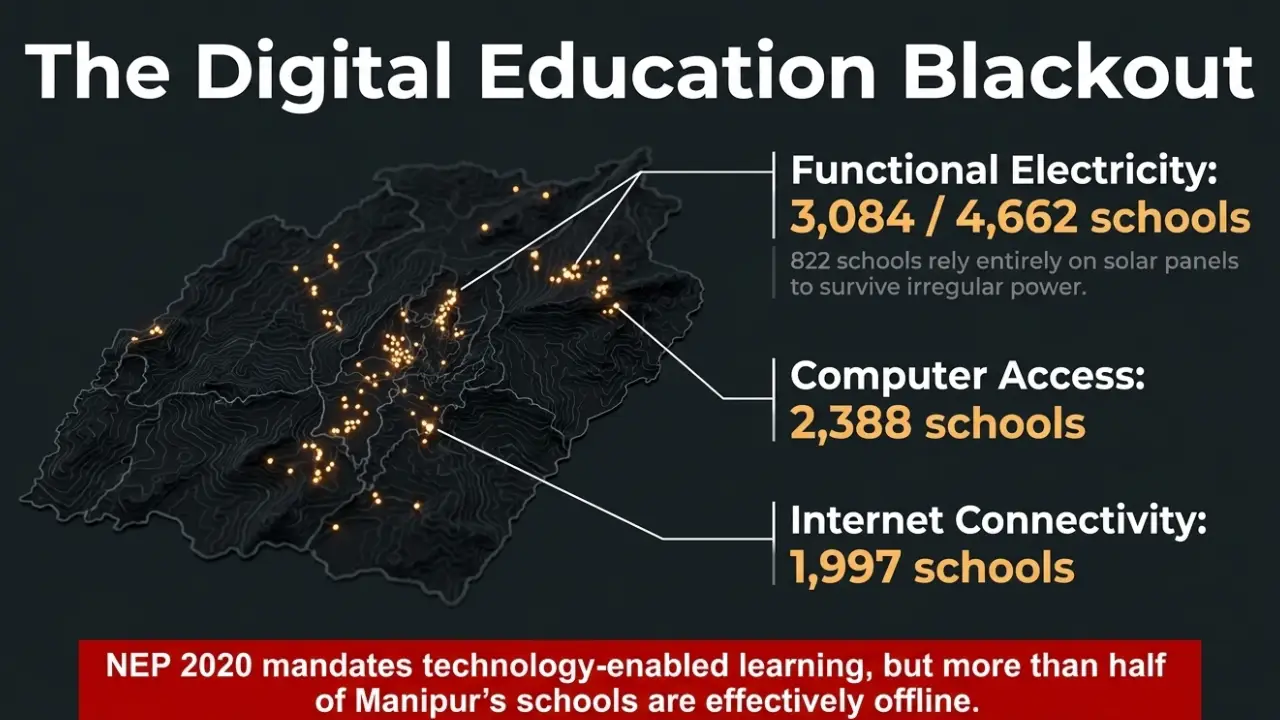
Reliable electricity continues to be another challenge for schools across Manipur. The report states that 3,371 schools have electricity connections, but only 3,084 reported functional electricity. To compensate for irregular power supply, 822 schools have installed solar panels.
However, the limited availability of electricity has directly affected the state's digital education ecosystem. Only 2,388 schools have computers, while just 1,997 schools have internet connectivity. Library facilities are also limited. Only 1,365 schools reported having libraries, book banks or reading corners, restricting access to supplementary learning materials for a large section of students.
The findings assume significance in the context of the National Education Policy (NEP) 2020, which places considerable emphasis on digital learning, technology-enabled classrooms and improved access to learning resources.
Without reliable electricity and internet connectivity, implementation of many digital education initiatives could remain uneven, particularly in rural and remote areas.
Student Dropout Remains a Major Challenge
One of the most concerning aspects of the UDISE+ report is the state's continuing struggle to retain students as they progress through school.
The dropout rate at the primary level stands at 14 per cent, increasing to 15.1 per cent at the upper primary stage before declining to 10.5 per cent at the secondary level.
Although enrolment at the primary stage remains high, the data shows that a considerable number of students leave the education system before completing secondary schooling.
This trend becomes even more apparent when viewed through the Gross Enrolment Ratio (GER). Manipur records a primary GER of 140, reflecting enrolment of students both within and outside the official age group. However, the GER drops sharply to 96 at upper primary, 82 at secondary and 64 at higher secondary level.
The steady decline suggests that a substantial proportion of students are unable to continue their education beyond the foundational years.
Education planners often view sustained enrolment through higher secondary education as critical to improving employability, higher education participation and long-term socio-economic development.
Early Childhood Education and Aadhaar Seeding
The report also highlights mixed progress in early childhood education. Of the 56,634 students admitted to Class I, only 29,507 had attended some form of preschool education before entering formal schooling.
Among these, 21,088 studied in the same school, 4,375 came from another school and 2,199 had attended Anganwadi or other Early Childhood Care and Education (ECCE) centres. The data suggests that nearly half of all children begin formal schooling without prior preschool exposure, despite the NEP's emphasis on foundational learning.
Another area identified for improvement is student database management. Student Aadhaar seeding in Manipur stands at 69.2 per cent, significantly below the national average of 90.2 per cent.
Officials consider Aadhaar integration important for ensuring accurate beneficiary identification, reducing duplication and improving the implementation of schemes such as Samagra Shiksha and PM POSHAN.
Higher Education Shows Institutional Growth
While school education continues to face challenges, the AISHE 2023-24 report presents a more encouraging picture of higher education. Manipur now has 12 universities, up from eight in 2019-20.
These include three Central Universities, two Institutes of National Importance, three State Public Universities and four State Private Universities.
The state also has 116 colleges, all of which submitted data for the survey, achieving a 100 per cent response rate under the coordination of State Nodal Officer Dr. W. Robindro Singh.
In addition, 38 standalone institutions, including nursing and teacher training institutes, contribute to the state's higher education network. The state's college density stands at 32 colleges per lakh population aged 18-23 years, matching the national average.
Female Students Outnumber Male Students
The report records 1,12,381 students enrolled in higher education during 2023-24. Interestingly, 56,573 are female students, marginally exceeding 55,808 male students. This trend is also reflected in the Gross Enrolment Ratio, where female GER stands at 31.5, compared to 30.0 for males.
The social composition of higher education also reflects Manipur's demographic diversity. Students belonging to Scheduled Tribes constitute 32.4 per cent of total enrolment, while Other Backward Classes account for 36.9 per cent. Scheduled Caste students account for 7,757 enrolments.
Most students—1,07,722—study through regular mode, while 4,582 pursue distance education and 75 are enrolled through online mode.
Faculty Strength Remains a Key Asset
The state's higher education institutions employ 6,845 faculty members, maintaining an overall Pupil-Teacher Ratio of 16, significantly better than the national average of 22.
Another notable feature is gender representation. Manipur reports 105 female faculty members for every 100 male faculty, placing it among the leading states in terms of gender balance within higher education teaching staff.
The academic workforce includes 509 Professors, 708 Associate Professors, and 4,967 Assistant Professors and Lecturers, supported by 5,488 non-teaching staff.
Enrolment Declines Despite Institutional Expansion
While the number of universities has increased over the past five years, student enrolment has shown a gradual decline. After reaching 1,38,499 students in 2020-21, enrolment has reduced to 1,12,381 in 2023-24.
The reasons behind the decline are not examined in the survey. However, education experts often point to factors such as demographic changes, migration, economic pressures, changing career choices and increased mobility of students seeking education outside the state as possible contributors.
Policy Implications
Taken together, the UDISE+ and AISHE reports highlight both the strengths and vulnerabilities of Manipur's education system.
The state has built a strong teaching workforce, maintained favourable pupil-teacher ratios and expanded its higher education institutions. Female participation in higher education has also remained encouraging.
However, these achievements coexist with persistent challenges. Large numbers of schools continue to lack safe drinking water, reliable electricity, internet connectivity and library facilities. At the same time, high dropout rates and declining enrolment through successive school levels indicate that retaining children in education remains one of the state's biggest policy challenges.
The reports provide valuable evidence for policymakers as they work towards implementing the goals of the National Education Policy 2020, which calls for universal access, improved foundational learning, digital education and reduced dropout rates. Addressing infrastructure deficits while strengthening student retention could play a crucial role in improving educational outcomes and preparing Manipur's young population for future opportunities.