Manipur's Draft Electoral Roll excludes 1,58,677 electors pending verification after the Special Intensive Revision. Claims and objections can be filed till August 4 before the final roll is published.
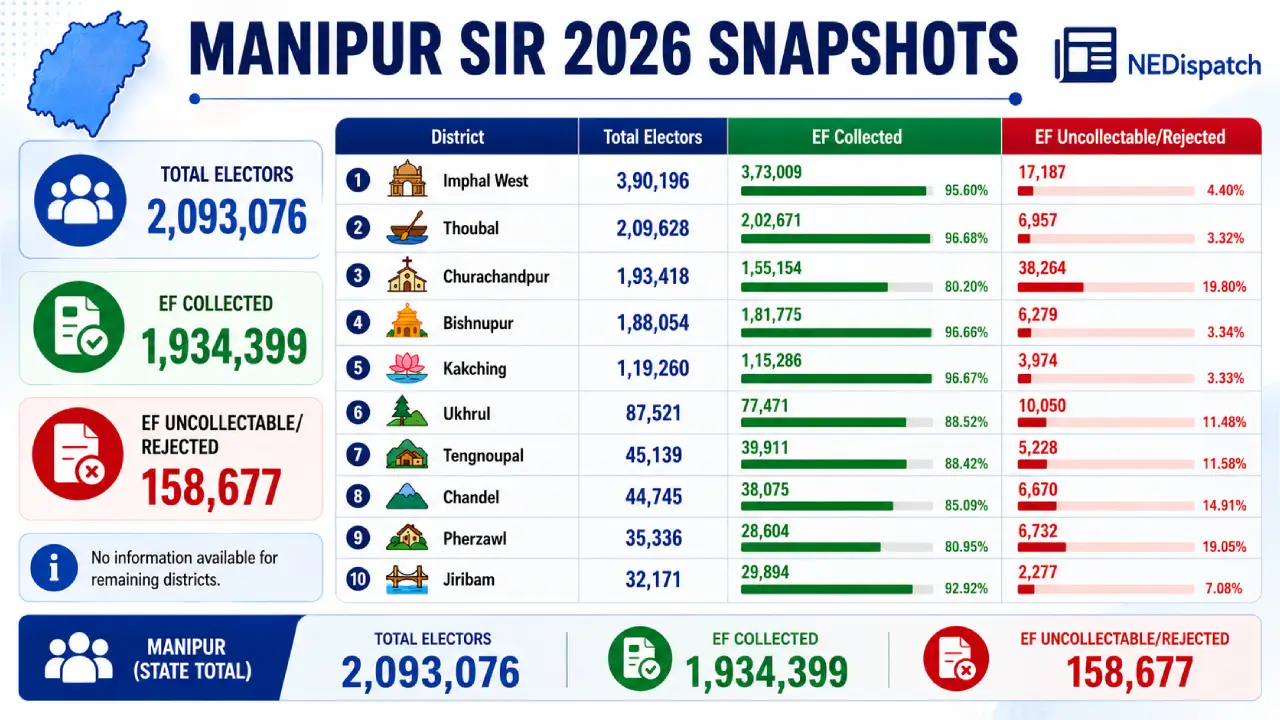
Imphal, July 5: The publication of Manipur's Draft Electoral Roll under the Special Intensive Revision (SIR) 2026 has brought 1,58,677 electors—7.58 per cent of the state's 20.93 lakh registered voters—under fresh scrutiny after their Enumeration Forms could not be collected during the month-long verification exercise. While these electors do not figure in the draft roll published on Sunday, election authorities have clarified that they have not been permanently deleted and will have an opportunity to establish their eligibility during the claims, objections and hearing process before the final electoral roll is published on September 6.
The draft roll, released by Chief Electoral Officer (CEO) Arun Kumar Sinha under the supervision of the Election Commission of India (ECI), marks the completion of the Enumeration Phase of the Special Intensive Revision carried out between May 30 and June 28.
The exercise is one of the most extensive electoral verification drives undertaken in Manipur in recent years and comes amid heightened public attention over the revision process. Election officials said the objective is to prepare a clean, updated and inclusive electoral roll while ensuring that no eligible elector is removed without following due legal procedure.
According to official figures, Manipur had 20,93,076 registered electors before the revision exercise commenced.
During the enumeration phase, 19,34,399 electors submitted their Enumeration Forms, resulting in an overall collection rate of 92.42 per cent.
The remaining 1,58,677 electors were categorised as "uncollectable", accounting for 7.58 per cent of the electorate.
Officials stressed that the figure should not be interpreted as deletion from the electoral roll, as every affected elector will be entitled to notice, hearing and appeal before any final decision is taken.
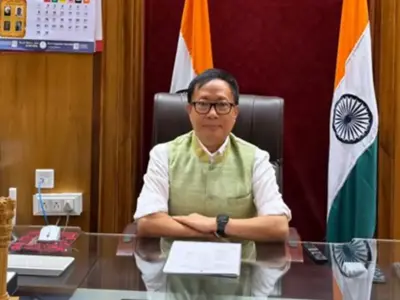
Addressing a press conference at the Chief Electoral Office in Lamphelpat, CEO Arun Kumar Sinha said the draft publication represents the beginning of public verification rather than the conclusion of the revision exercise.
He urged electors to examine the draft carefully and use the claims and objections period to seek inclusion, correction or raise objections wherever necessary.
The Election Department released a detailed analysis explaining why Enumeration Forms could not be collected from the 1,58,677 electors.
The largest group comprised 72,473 electors who had permanently shifted from their registered addresses.
Another 43,000 persons were confirmed to have died during the verification process.
Officials were unable to trace 34,740 electors despite field verification.
The exercise also detected 7,394 duplicate registrations, where individuals were enrolled in more than one Assembly Constituency.
Additionally, 1,070 electors declined to submit their Enumeration Forms.
Election officials said these figures emerged after extensive door-to-door verification by Booth Level Officers across the state.
Besides these categories, another 91,178 electors who submitted Enumeration Forms could not be mapped with the 2005 electoral roll, creating a separate category requiring document verification during the notice phase.
Officials clarified that these electors may still be included in the final roll after scrutiny of their documents and hearings conducted by Electoral Registration Officers.
The Election Commission has sought to address concerns arising from the publication of the draft roll by reiterating that names cannot be deleted arbitrarily.
Officials said the SIR guidelines clearly require Electoral Registration Officers to issue notice, conduct hearings and pass a reasoned "speaking order" before excluding any elector from the final roll.
Every elector whose eligibility is questioned will have an opportunity to produce documentary evidence supporting his or her claim.
Those dissatisfied with decisions of the Electoral Registration Officer can appeal before the District Election Officer under Section 24(a) of the Representation of the People Act, 1950.
A second appeal may also be filed before the Chief Electoral Officer under Section 24(b) of the Act.
Officials said these safeguards have been built into the revision process to ensure transparency and prevent wrongful exclusion.
The Special Intensive Revision involved a statewide administrative exercise spanning all 16 districts of Manipur.
The Election Department deployed:
60 Electoral Registration Officers (EROs)
84 Assistant Electoral Registration Officers (AEROs)
317 BLO Supervisors
2,956 Booth Level Officers (BLOs)
In addition, polling infrastructure has been strengthened with the number of polling stations increasing from 2,956 to 3,041, ensuring that no polling station serves more than 1,200 electors.
Political participation also increased during the revision process.
The number of Booth Level Agents (BLAs) nominated by recognised political parties rose from 5,003 before the exercise began to 6,363 by the time the draft electoral roll was published.
According to the CEO's office, recognised political parties were supplied with draft rolls and verification lists and participated in coordination meetings held throughout the revision process.
The district-wise data reveals considerable variation in Enumeration Form collection across Manipur.
Among the valley districts, Bishnupur recorded one of the highest verification rates, digitising 1,81,775 Enumeration Forms out of 1,88,054 electors, representing 96.66 per cent.
Thoubal achieved a verification rate of 96.68 per cent, while Kakching recorded 96.67 per cent.
Imphal West, the state's largest electoral district, digitised 3,73,009 forms out of 3,90,196 electors, resulting in a verification rate of 95.60 per cent.
Most uncollectable cases in these districts were attributed to deaths and electors shifting residence.
Jiribam reported a collection rate of 92.92 per cent, with 29,894 forms digitised out of 32,171 electors.
The revision exercise recorded comparatively higher levels of uncollectable Enumeration Forms in several hill districts.
Churachandpur reported the highest number, with 38,264 electors left out of the draft roll after only 1,55,154 Enumeration Forms were digitised from 1,93,418 electors. The district recorded a verification rate of 80.22 per cent.
Officials said the principal reasons were electors having permanently shifted and a large number of persons remaining untraceable during field verification.
Pherzawl also reported 6,732 uncollectable forms out of 35,336 electors, while Ukhrul recorded 10,050 uncollectable cases.
Chandel achieved 85.09 per cent verification and Tengnoupal recorded 88.42 per cent.
Election officials said the figures reflected varying local conditions, including migration patterns and field verification challenges, and should not be viewed as final exclusions.
Recognising the continuing impact of the ethnic violence that erupted in May 2023, the Election Commission adopted special arrangements for internally displaced persons (IDPs).
Enumeration Forms were distributed to displaced electors through designated district Nodal Officers in the districts where they are presently staying.
After collection, the forms were transmitted to the Booth Level Officers of the electors' original Assembly Constituencies for digitisation.
Officials said this arrangement was introduced to ensure that displacement does not deprive eligible citizens of their voting rights.
The Election Department also relied extensively on technology during the Special Intensive Revision.
A dedicated portal on the CEO's website enabled electors to search their names, family linkages and the digitisation status of their Enumeration Forms.
The status of digitisation was updated every two hours during the exercise.
Lists of electors categorised as Absent, Shifted, Death and Duplicate (ASDD) have also been displayed at Electoral Registration Officer offices and uploaded on the websites of the CEO and District Election Officers.
Officials said these measures were intended to maximise transparency and enable citizens to verify information independently.
To overcome connectivity issues in remote areas, special "shadow network" digitisation centres were established to facilitate data uploads by Booth Level Officers.
A 24-hour Voter Helpline (1950) and dedicated help desks also remained operational to assist senior citizens, persons with disabilities, migrant electors and other vulnerable groups.
With publication of the draft roll, the Election Commission has formally opened the Claims and Objections period from July 5 to August 4.
Eligible citizens who find their names missing may submit Form-6 for inclusion.
Objections against wrongful inclusion can be filed using Form-7, while corrections and transposition requests may be made through Form-8.
Applications may be submitted through Booth Level Officers, Electoral Registration Officers or online using the ECINET mobile application and the Voter Service Portal.
The Election Department has also urged electors who could not submit Enumeration Forms during the initial phase to apply along with the prescribed declaration.
The Election Commission will conduct hearings, scrutinise documents and dispose of all claims and objections between July 5 and September 2.
Following completion of the verification process, the Final Electoral Roll for Manipur will be published on September 6, 2026.
While the publication of the draft roll has drawn attention to the exclusion of 1.58 lakh electors, election authorities have emphasised that the revision process remains ongoing. They have appealed to all eligible citizens to verify their details during the statutory claims period, stressing that the final electoral roll will only be prepared after every claim, objection and appeal has been examined in accordance with the law.