Manipur Agriculture Department unveils an ambitious 2026-27 roadmap featuring irrigation support, crop insurance, model villages, natural farming, Chak-Hao promotion and climate-resilient agriculture amid rainfall deficit.
Imphal, July 21: Confronted with a significant monsoon rainfall deficit that threatens the ongoing Kharif season, the Manipur Agriculture Department has announced an extensive package of farmer-centric initiatives for 2026-27, combining climate resilience, mechanisation, natural farming, crop insurance, improved irrigation, quality seed production and post-harvest infrastructure to strengthen agricultural productivity and farmers' incomes across the state.
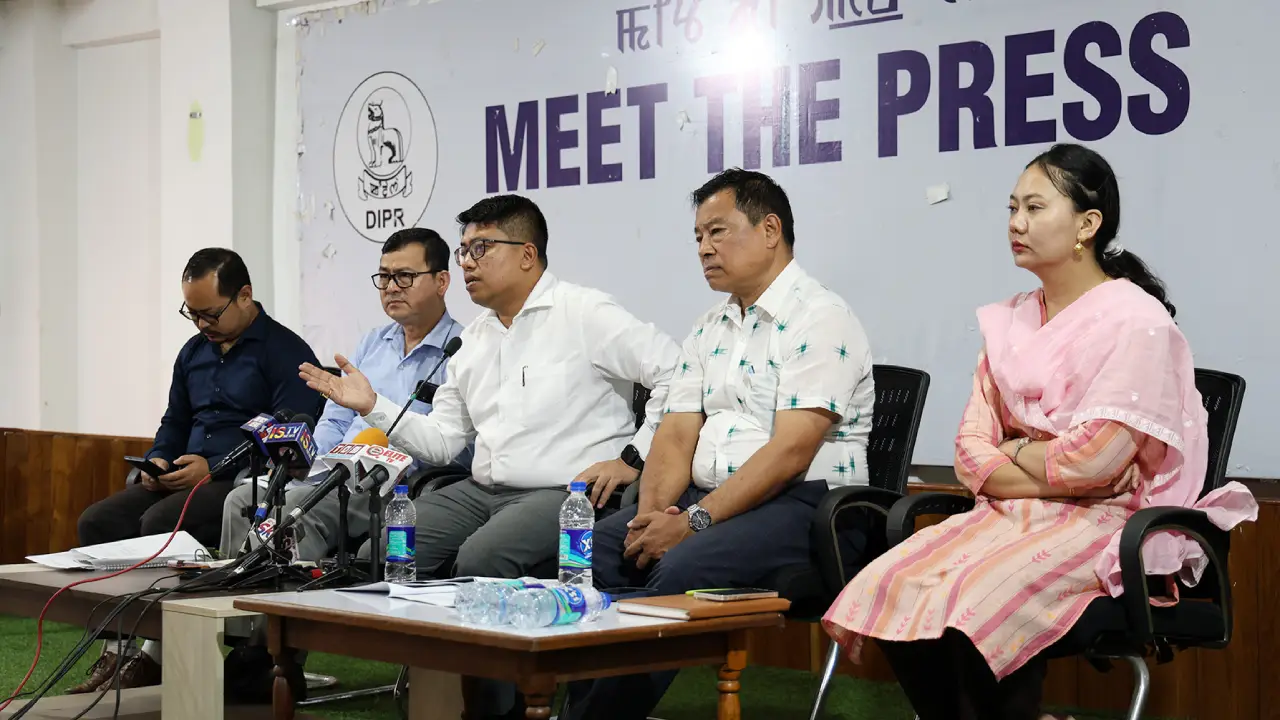
The initiatives were outlined by Director of Agriculture Peter Salam during the fifth edition of the "Meet the Press" programme organised by the Directorate of Information and Public Relations (DIPR) in Imphal on Tuesday. The Department also released a detailed media briefing highlighting the implementation of multiple Centrally Sponsored and State-funded schemes aimed at modernising agriculture while making it more resilient to climate change.
The Department revealed that Manipur is facing a substantial rainfall shortfall during the current cropping season.
According to official figures, the state received only 170.20 mm of rainfall in June 2026 against the normal 225 mm, resulting in a 25 per cent deficit. During July, rainfall has remained well below normal, with only around 250 mm recorded against the expected 375–400 mm, translating into an estimated 33 per cent deficit.
Officials said the Department is closely monitoring weather conditions and issuing advisories to farmers to minimise the impact of moisture stress on crops.
Despite the erratic monsoon, agriculture officials noted that Manipur cultivated 170,290 hectares of paddy during 2025-26, including 5,630 hectares under double cropping, while MARSAC estimated the state's total paddy area at 175,531 hectares. Total paddy production reached 349,610 metric tonnes, with an average productivity of 2.05 metric tonnes per hectare.
Irrigation Support and Crop Insurance
To help farmers cope with deficient rainfall, the Department is intensifying implementation of the Per Drop More Crop (PDMC) programme under the Pradhan Mantri Krishi Sinchayee Yojana (PMKSY).
Director Peter Salam announced that farmers purchasing water pump sets are eligible for Rs 10,000 financial assistance, which is transferred directly into beneficiaries' bank accounts through the Direct Benefit Transfer (DBT) system after purchase. The programme also supports sprinkler and drip irrigation systems, particularly for small and marginal farmers across both hill and valley districts.
The Department has also urged cultivators to enrol under the Pradhan Mantri Fasal Bima Yojana (PMFBY) before July 31, 2026, to safeguard crops against losses caused by drought, floods, pests and diseases.
Under the scheme, farmers cultivating High Yielding Variety (HYV) paddy during the Kharif season can avail insurance coverage of Rs 68,000 per hectare by paying a premium of only Rs 1,360 per hectare.
Nine Agriculture Model Villages to Receive Integrated Support
One of the flagship initiatives announced for 2026-27 is the creation of nine Agriculture Model Villages, each receiving integrated assistance under multiple government schemes.
The selected villages are:
Basikhong Chanam Sandrok (Imphal East)
Sangaithel (Imphal West)
Langmeidong Mamang Makha Heibi Makhong (Kakching)
Moirang Khunou VDF Camp and Keirenphabi Mamang Loukol (Bishnupur)
Gularthol (Jiribam)
Lenglong (Tamenglong)
Saranamei (Senapati)
B. Salvaphai (Churachandpur)
Nungbi Khullen (Ukhrul)
Each Model Village will receive:
Agricultural machinery worth Rs 40 lakh for community use.
Financial assistance of Rs 5 lakh for agricultural drones.
Rs 50,000 per family for vermicompost units.
Farm pond assistance of Rs 52,500 in valley districts and Rs 63,000 in hill districts.
Rs 1,600 assistance for bee boxes.
55 per cent subsidy on sprinkler irrigation systems.
Distribution of quality certified seeds under various Central schemes.
Officials said the villages are intended to serve as demonstration centres showcasing scientific farming, mechanisation and sustainable agricultural practices that can later be replicated elsewhere.
Push Towards Sustainable Farming
The Agriculture Department is also expanding programmes promoting bio-fertilisers, organic inputs and balanced nutrient management.
During Kharif 2025, demonstration projects covering 25 hectares across 100 plots used a combination of 75 per cent recommended chemical fertilisers and bio-fertilisers, resulting in an average yield increase of 480 kilograms per hectare while reducing the use of urea, Single Super Phosphate (SSP) and Muriate of Potash (MOP).
Encouraged by these results, the demonstration area has now been expanded to 116 hectares during 2026-27.
Additionally, 150 metric tonnes of bio and organic fertilisers have been allocated to district agriculture offices. Although the market price is Rs 480 per five-kilogram bag, farmers will receive them at a subsidised rate of Rs 250 per bag.
Peter Salam also cautioned farmers against excessive use of urea, emphasising that balanced fertiliser application based on Soil Health Card recommendations is essential for sustaining soil fertility and improving long-term productivity.
Natural Farming Programme to Double in Size
The Department is substantially expanding its Natural Farming programme.
During 2025-26, the National Mission on Natural Farming covered 80 clusters, involving around 10,000 farmers over 4,000 hectares across all sixteen districts.
For 2026-27, another 80 clusters covering an additional 10,000 farmers and 4,000 hectares will be added.
The Manipur Organic Mission Agency (MOMA) and the College of Agriculture, Central Agricultural University (CAU), Imphal have been authorised as Participatory Guarantee System (PGS) certification agencies, enabling certified farmers to market natural farming produce at premium prices.
Seed Quality Strengthened Through MASOCA
To improve seed quality and reduce dependence on external suppliers, the Government has established the Manipur Seed and Organic Certification Agency (MASOCA).
Created under the Seeds Act, 1966, and registered earlier this year, MASOCA will certify seed testing laboratories, processing units, foundation seed, certified seed and truthfully labelled seed while ensuring seed quality, purity and vigour.
The Department is also distributing certified seeds of mustard, soybean, sunflower and other crops under various Central schemes.
Major Focus on Chak-Hao Value Addition
The Department also announced measures to strengthen marketing of Manipur's GI-tagged Chak-Hao (black rice).
Among the proposals is the creation of a Rs 5 crore Corpus Fund to procure Chak-Hao at a fixed Minimum Support Price (MSP), which will be considered during the Revised Estimates.
The Government also plans to increase the number of integrated Chak-Hao processing units to four by 2027-28.
The proposed facilities will include modern milling, colour sorting, warehousing, vacuum packaging and parboiling technology to reduce post-harvest losses currently caused by poor storage and grain breakage during milling.
Officials also proposed establishing community aggregation centres, providing transport vehicles to Farmer Producer Companies (FPCs), and training farmers in grading, storage and value addition.
Free Oilseed Seeds for Farmers
Under the National Mission on Edible Oils-Oilseeds (NMEO-OS), launched in 2024, the Department has constituted 85 Village Cluster Programmes across all sixteen districts.
Quality seeds procured from the National Seeds Corporation will be distributed free of cost covering:
491 hectares of soybean
417.5 hectares of groundnut
10,000 hectares of mustard cultivation
The mission aims to increase domestic edible oil production while reducing dependence on imports.
Fertiliser Supply Strengthened
To ensure uninterrupted fertiliser availability, the Department has established approximately 170 urea distribution centres across Manipur.
Officials informed that nearly 1,54,400 bags of urea have already been distributed during the current season at the subsidised rate of Rs 270 per 45-kg bag.
Concluding the briefing, the Department reiterated its commitment to strengthening climate-resilient agriculture through scientific farming, irrigation expansion, mechanisation, quality inputs, improved post-harvest infrastructure and enhanced market access.
Officials encouraged farmers to actively participate in government programmes by contacting their respective District Agriculture Offices or the Directorate of Agriculture to avail benefits under various schemes.
Peter Salam said the combined initiatives are intended to improve agricultural productivity, enhance sustainability, reduce production risks and ultimately increase farm incomes across Manipur.