Persistent monsoon rain has brought relief to Manipur farmers after months of severe rainfall deficit, but experts warn the state's broader water crisis remains unresolved.
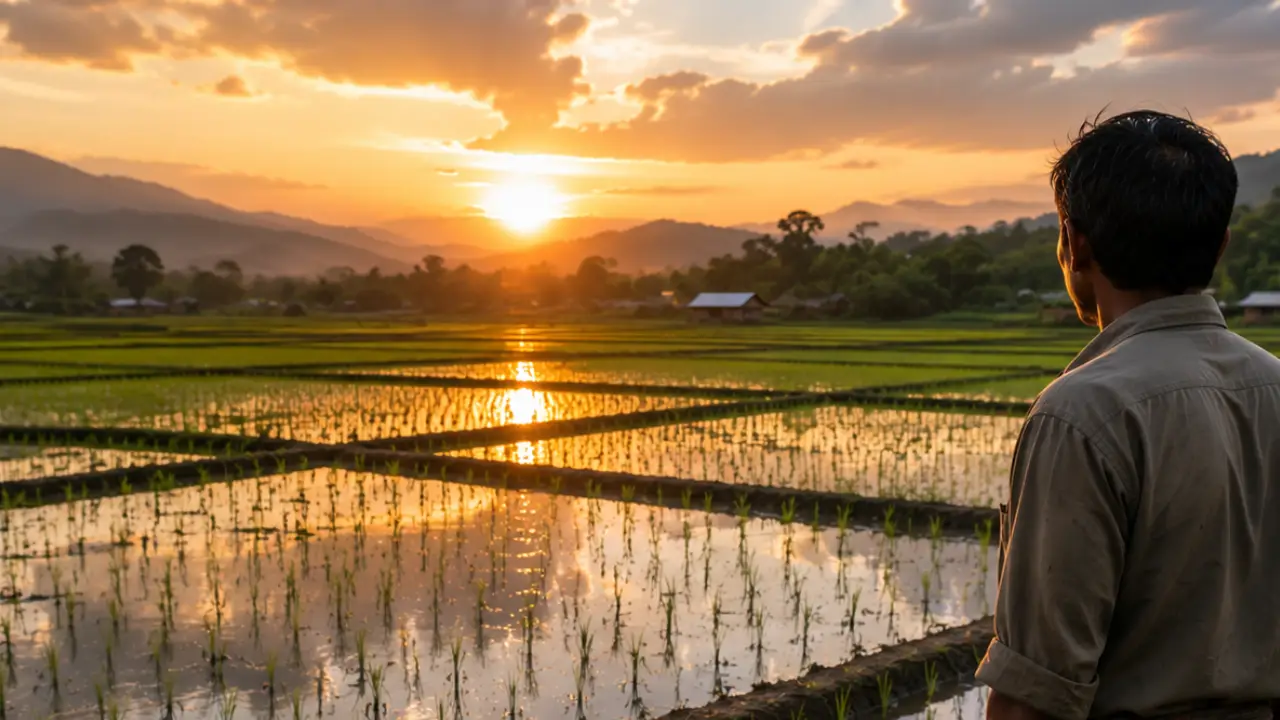
Imphal, July 19: After weeks of anxious anticipation, persistent monsoon rainfall has finally brought a measure of relief to Manipur's drought-stricken agricultural landscape. Sunday's prolonged showers soaked parched paddy fields across much of the state, reviving hopes for thousands of farmers whose kharif cultivation had been severely disrupted by one of the worst rainfall deficits in recent years.
Yet meteorologists and agricultural experts caution that the welcome rainfall should not be mistaken for the end of the crisis. The showers may have interrupted an alarming dry spell, but they have done little to erase the cumulative hydrological stress that has built up over several months. Behind the immediate respite lies a broader environmental emergency driven by climatic anomalies, ecological degradation, fragile water infrastructure and the continuing socio-political instability that has undermined resource management across the state.
According to weather observations, Sunday's rainfall occurred in two distinct phases.
The first spell began before dawn, with moderate showers between approximately 2:30 am and 6 am. After a brief morning pause, a second and much longer phase settled over the Imphal Valley from around 9 am until evening, bringing nearly ten hours of continuous light to moderate rainfall. The heaviest precipitation occurred during the afternoon before gradually weakening into a light drizzle.
Rainfall distribution varied considerably across districts. Tamenglong recorded the highest accumulation at 30.6 mm, followed by Khoupum with 18.5 mm, Ukhrul with 7.9 mm and Imphal Airport with 4.1 mm during the observation period.
Unlike short-lived cloudbursts that often produce damaging runoff, the rainfall remained relatively steady, allowing moisture to infiltrate the soil gradually. Agricultural experts describe this type of rainfall as particularly beneficial for rainfed paddy cultivation because it replenishes soil moisture without causing extensive erosion.
For farmers who had delayed transplantation due to dry fields, the rainfall represents an opportunity to resume agricultural operations.
Farmers Receive a Much-Needed Lifeline
The rainfall comes after weeks of mounting concern over delayed kharif sowing across Manipur.
Large areas of agricultural land had remained uncultivated because insufficient rainfall prevented farmers from preparing fields for transplantation. Many farmers had repeatedly postponed sowing operations while hoping for the arrival of sustained monsoon conditions.
The India Meteorological Department (IMD) has advised farmers to take advantage of the improved moisture conditions while also remaining cautious about potential waterlogging in soybean, black gram, ginger, turmeric and vegetable fields. Farmers have also been urged to move harvested produce indoors or protect it with tarpaulins because of high overnight humidity.
The seven-day forecast indicates that monsoon activity is likely to continue throughout the coming week with intermittent rainfall and thunderstorms, potentially providing additional support for delayed agricultural activities.
'I Thought This Season Was Lost': Rain Revives Hope for Farmers
For many farmers across the Imphal Valley, Sunday's persistent rainfall brought more than just water—it restored hope after weeks of uncertainty.
Laishram Anil, a farmer from Imphal West district, while talking to NE Dispatch, described how the prolonged dry spell had left his paddy field cracked and barren.
"For nearly a month I visited my field often hoping to see rain clouds. There wasn't enough water even to prepare the land for sowing. I had already borrowed money for seeds and fertilisers, but every passing day increased my fear that the entire kharif season would be lost," he said.
The farmer recalled that several neighbouring cultivators had also postponed transplantation because irrigation sources had nearly dried up and groundwater was insufficient to flood their fields.
"When the rain started before dawn on Sunday, I didn't think it would last. But it continued throughout the day. By evening, some water had collected in the fields, and for the first time in weeks, we felt we could begin preparing for transplantation. One day's rain cannot undo months of drought, but it has certainly given us hope."
His experience mirrors the situation across much of Manipur, where thousands of rain-fed farmers had been waiting for sustained rainfall before commencing paddy transplantation. Agricultural experts note that while the showers have significantly improved surface moisture, continued rainfall over the coming days will be crucial to restore soil water reserves and ensure a successful kharif season.
The renewed optimism among farmers, however, remains tempered by caution. Many acknowledge that another prolonged dry spell could once again jeopardise cultivation, underscoring the state's growing vulnerability to erratic monsoon behaviour and the need for long-term investments in irrigation, watershed management and climate-resilient agriculture.
Relief Cannot Erase Months of Rainfall Deficit
Despite Sunday's encouraging weather, the rainfall deficit accumulated since the beginning of the season remains severe.
By mid-July, East and Northeast India had recorded an overall rainfall deficit of around 36 percent, while Manipur remained among the worst-affected states in the region.
Earlier in the season, the state recorded only 53.7 mm of rainfall against a normal 173.2 mm during the monitored period, representing a deficit of nearly 69 percent. Several neighbouring northeastern states also experienced deficient rainfall, although Manipur ranked among the most severely affected.
The crisis did not begin with the monsoon.
Meteorological records show that the state experienced an almost complete collapse of winter rainfall. January 2026 recorded virtually no measurable precipitation, extending a prolonged dry period that began during the winter months of 2025. This meant that soil moisture reserves were already critically depleted even before the arrival of the southwest monsoon.
By the time the monsoon weakened under the influence of large-scale climatic disturbances, agricultural lands were already vulnerable.
El Niño and Atmospheric Conditions Weakened the Monsoon
Scientists attribute the weakened rainfall primarily to the strong El Niño event that developed during 2026.
El Niño alters atmospheric circulation across the Pacific Ocean, weakening the moisture-bearing winds that normally feed the Indian summer monsoon. The situation was compounded by other unfavourable atmospheric conditions.
The Indian Ocean Dipole remained neutral instead of shifting into a positive phase that could have partially compensated for El Niño's effects. Meanwhile, the Madden-Julian Oscillation, another major driver of tropical rainfall, remained positioned away from the Indian Ocean, limiting cloud formation over the Bay of Bengal.
During July, the monsoon also entered a prolonged "break phase", with the monsoon trough shifting northwards towards the Himalayan foothills instead of drawing moisture over eastern India and the Northeast.
Together, these climatic factors substantially reduced rainfall over Manipur during the most critical agricultural period.
Environmental Degradation Has Amplified the Crisis
Climate alone does not explain the severity of Manipur's water stress. Experts point to extensive ecological degradation over the past decade that has significantly weakened the state's natural capacity to retain water.
Forest loss across hill districts has reduced groundwater recharge while increasing surface runoff during rainfall events. Large-scale deforestation associated with illegal logging, shifting cultivation, infrastructure development and poppy cultivation has stripped many catchment areas of their protective vegetation.
As forests disappear, rainfall flows rapidly downstream instead of gradually replenishing springs and aquifers. The consequences have become increasingly visible.
Several perennial streams and feeder channels have dried up during recent years, while groundwater levels have steadily declined in both valley and foothill regions.
Riverbed sand and stone mining has further destabilised river systems by altering natural flow patterns and reducing groundwater recharge.
Conflict Has Complicated Climate Adaptation
Manipur's environmental challenges have unfolded alongside continuing ethnic conflict that has persisted since May 2023.
Security concerns have prevented many farmers from cultivating agricultural land located near sensitive areas, reducing overall food production even where rainfall has been sufficient.
Access to upstream catchments has also become increasingly difficult, limiting forest protection, watershed conservation and environmental monitoring.
Transport disruptions caused by periodic blockades have affected agricultural markets, increasing economic losses for farmers both within and beyond Manipur.
Recognising these challenges, security agencies and district administrations have coordinated efforts to provide protected access for farmers cultivating vulnerable agricultural zones.
Long-Term Solutions Require Structural Reform
While Sunday's rainfall offers immediate relief, experts emphasise that long-term resilience will depend on comprehensive policy reforms rather than seasonal weather alone.
Priority areas include restoring degraded watersheds through afforestation, protecting catchment forests, modernising water supply infrastructure, repairing leaking reservoirs, expanding rainwater harvesting, promoting groundwater recharge and encouraging drought-resilient agricultural practices.
Crop diversification is also increasingly viewed as essential. Some farmers have already begun experimenting with less water-intensive alternatives such as floriculture, although widespread adoption will require technical support, market access and financial assistance.
Research institutions, including ICAR and Central Agricultural University, have been promoting soil moisture conservation, agroforestry and climate-resilient farming practices to help farmers adapt to increasingly erratic weather patterns.
A Temporary Reprieve, Not the End of the Crisis
The return of steady monsoon rainfall has undoubtedly eased immediate concerns for thousands of farmers preparing their fields for transplantation. If forecast rainfall continues over the coming week, delayed kharif cultivation could recover significantly.
Nevertheless, the events of 2026 have underscored the vulnerability of Manipur's water systems to both global climate variability and long-standing local environmental degradation.
The current rainfall has interrupted the drought—but it has not erased the cumulative effects of months of hydrological stress. Whether Manipur emerges stronger from this crisis will depend less on the next spell of rain and more on sustained investments in ecological restoration, climate-resilient infrastructure and integrated water governance capable of withstanding an increasingly uncertain monsoon future.