At least eight people were killed after massive landslides and flash floods triggered by torrential monsoon rains devastated Nagaland's Mon district, with rescue operations continuing.
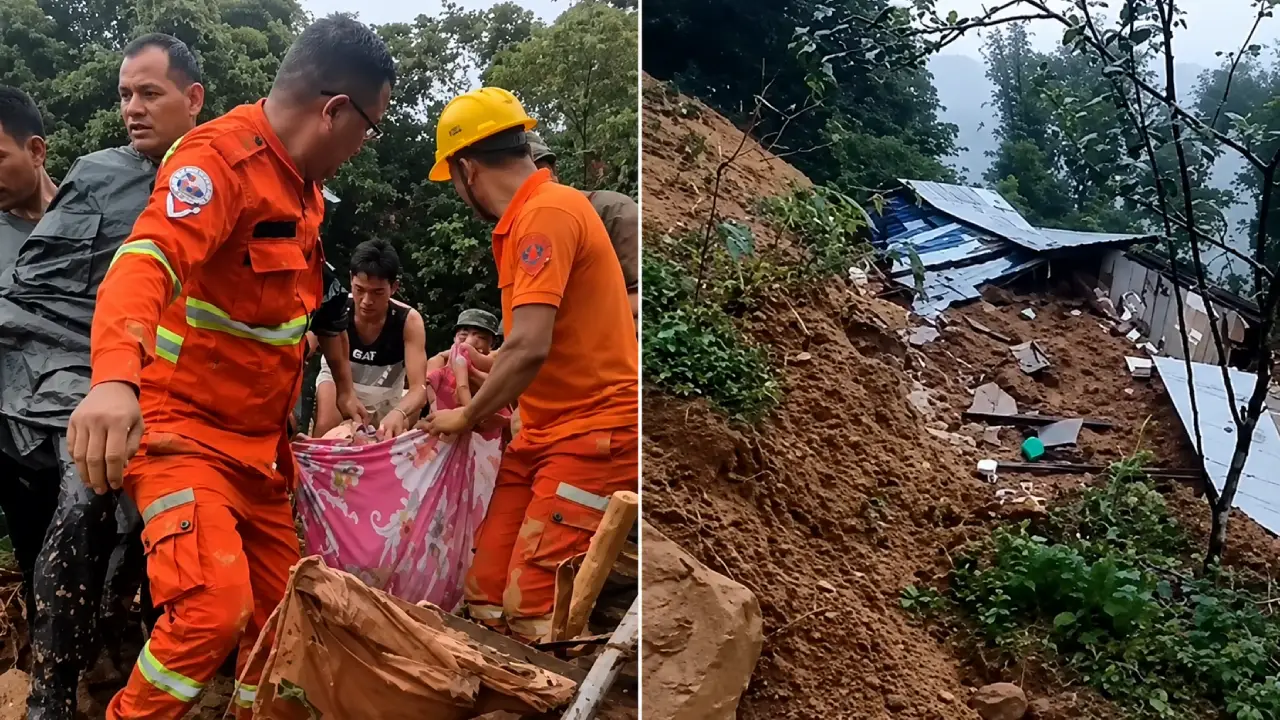
Mon (Nagaland), July 19: A series of devastating landslides and flash floods triggered by relentless monsoon rainfall claimed at least eight lives in Nagaland's Mon district on Sunday, leaving a trail of destruction across several towns and prompting a large-scale multi-agency rescue operation.
The disaster, which unfolded in the early hours of the morning, buried homes, displaced dozens of families and severely disrupted road connectivity in parts of Mon and neighbouring Mokokchung district. Authorities warned that the death toll could rise as rescue teams continue to search for people believed to be trapped beneath the debris.
The deadliest incident occurred around 6.30 am at Defence Colony in Mon town, situated below the Assam Rifles camp, where a massive landslide swept down the hillside after hours of incessant rainfall.
The landslide engulfed a cluster of 10 to 15 houses, including several reinforced concrete buildings, leaving entire families trapped beneath tonnes of mud, rocks and debris.
Rescue personnel recovered the bodies of three women and one man during the day. Officials said operations were continuing late into the evening to locate four others who remain missing and are feared buried under the collapsed structures.
Between 12 and 15 people sustained injuries, several of whom were admitted to nearby hospitals for treatment.
While Mon town bore the brunt of the disaster, heavy rainfall also triggered flash floods across Tizit town, where overflowing drains and swollen streams inundated low-lying neighbourhoods.
More than 30 households were affected as floodwaters entered homes, damaging household belongings and forcing families to move to safer locations.
Landslides and flooding were also reported from the Tuli subdivision of Mokokchung district, where roads were partially blocked and transportation disrupted due to debris and overflowing water channels.
The widespread nature of the disaster has highlighted the growing vulnerability of Nagaland's mountainous terrain during periods of prolonged monsoon rainfall.
A coordinated rescue operation involving multiple agencies is underway to locate survivors and provide emergency relief.
Personnel from the National Disaster Response Force (NDRF), State Disaster Response Force (SDRF), Nagaland Police, Assam Rifles, Territorial Army and local volunteers have been working continuously since Sunday morning to remove debris and search for those trapped beneath collapsed buildings.
Rescue teams are using heavy earthmoving equipment, including excavators and JCB machines, to clear landslide debris. However, officials said the operation remains extremely challenging because of continuing heavy rainfall, unstable hill slopes and fast-flowing surface runoff that threatens the safety of rescuers.
Authorities have not ruled out the possibility of additional landslides if rainfall persists over the coming days.
Nagaland Chief Minister Neiphiu Rio expressed grief over the tragedy and announced immediate financial assistance for the affected families.
The state government approved ?4 lakh as ex gratia compensation for the next of kin of each deceased victim, while ?74,000 will be provided to every injured person to support medical treatment and rehabilitation.
The Chief Minister also directed all concerned departments to expedite rescue and relief operations and ensure that affected families receive immediate assistance.
In view of the continuing rainfall forecast, the Government of Nagaland has directed all District Disaster Management Authorities (DDMAs) to remain on high alert.
District Emergency Operations Centres (DEOCs) have been activated to monitor the evolving situation, coordinate evacuations and respond swiftly to fresh incidents of landslides or flooding.
Heavy machinery has been deployed across vulnerable locations to restore road connectivity by removing mudslides and fallen earth that have blocked critical transport routes.
Meanwhile, district administrations have established temporary relief camps for displaced residents. However, officials said many affected families have chosen to stay with relatives and friends rather than move into government shelters.
Emergency supplies, including food, drinking water and other essential commodities, are being distributed to affected communities.
The India Meteorological Department (IMD) has forecast continued heavy rainfall across Nagaland during the coming week, raising concerns over additional landslides, flash floods and slope failures.
Authorities have urged residents living on vulnerable hill slopes, near rivers and in landslide-prone areas to remain vigilant, avoid unnecessary travel and immediately follow evacuation advisories issued by local administrations.
Disaster management officials warned that saturated soil conditions significantly increase the likelihood of fresh slope failures even after rainfall intensity decreases.
Sunday's disaster is the latest in a series of extreme weather events affecting the northeastern region during this year's monsoon season.
Experts note that prolonged spells of intense rainfall, combined with fragile hill geology, expanding settlements on unstable slopes and inadequate drainage infrastructure, have increased the frequency and severity of landslides across Nagaland and other Himalayan foothill states.
While emergency rescue operations remain the immediate priority, disaster management specialists argue that the recurring tragedies underscore the urgent need for improved land-use planning, hazard zonation, slope stabilisation measures and resilient urban infrastructure in the region's rapidly expanding hill towns.