Dr. Jitendra Singh says NESAC and NECTAR are accelerating technology-driven development in Northeast India through geospatial mapping, drones, AI, disaster management and scientific innovation.
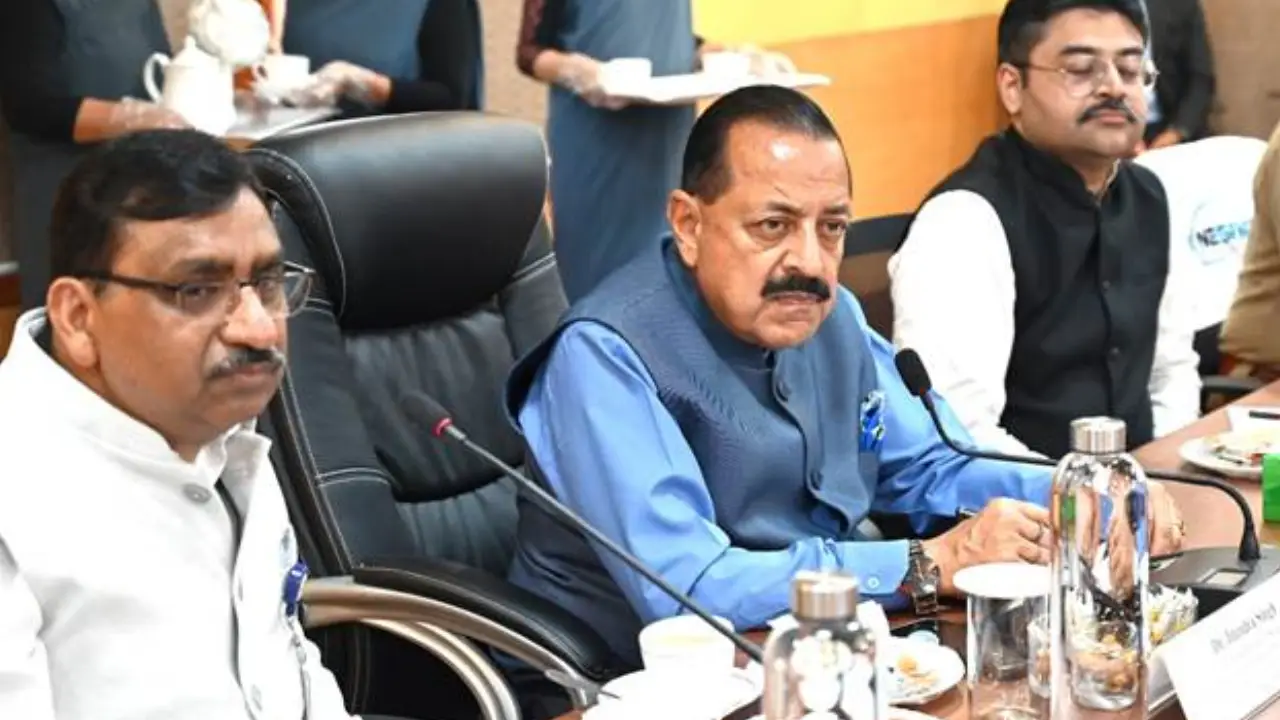
Shillong, July 14: Union Minister of State (Independent Charge) for Science and Technology, Earth Sciences, and Minister of State in the Prime Minister's Office, Personnel, Public Grievances and Pensions, Atomic Energy and Space, Dr. Jitendra Singh has said that scientific institutions in the Northeast are playing an increasingly important role in national development by applying space technology, geospatial intelligence, artificial intelligence and drone-based solutions to address regional challenges.
During visits to the North Eastern Space Applications Centre (NESAC) at Umiam and the North East Centre for Technology Application and Reach (NECTAR) in Shillong, the Minister reviewed ongoing projects, inaugurated new scientific facilities and urged greater collaboration among research institutions, state governments and industry to accelerate technology-led development across the eight Northeastern states.
NESAC Expands Role Beyond Space Applications
At NESAC, Dr. Jitendra Singh said the institution has evolved into a key scientific organisation supporting both national strategic priorities and socio-economic development through space-based technologies.
He noted that NESAC is contributing to geospatial mapping along the India-Myanmar international border as well as inter-state boundaries in the Northeast while simultaneously implementing projects covering agriculture, forestry, disaster management, natural resources, water management, urban planning and governance.
The Minister was briefed by NESAC Director Dr. S.P. Aggarwal, who presented an overview of nearly 130 projects, including around 50 recently completed and 78 ongoing initiatives.
The projects span multiple sectors such as agriculture, forestry, geosciences, water resources, geoinformatics, satellite communication, unmanned aerial vehicle (UAV) applications, atmospheric sciences, disaster management and capacity building.
Dr. Jitendra Singh observed that NESAC has increasingly become a bridge between advanced scientific research and practical developmental needs across the Northeast.
He stated that closer engagement with state governments has enabled space technology to become an effective tool for planning, governance, natural resource management and public service delivery.
Bamboo Mapping to Support Rural Economy
Highlighting the economic importance of bamboo, the Minister called for closer collaboration between NESAC, the North East Cane and Bamboo Development Council (NECBDC) and state governments.
He said scientific mapping of bamboo resources would strengthen resource planning, support value addition, improve supply chains and create sustainable livelihood opportunities across the region.
The Minister also emphasised the need to improve the precision of NESAC's flood early warning systems so that vulnerable communities receive location-specific and timely alerts.
He encouraged wider adoption of successful water harvesting models, including initiatives implemented at the Ramakrishna Mission in Cherrapunjee, to improve long-term water security in the region.
Strengthening Border Mapping and GeoTourism
Dr. Jitendra Singh highlighted the strategic significance of geospatial technologies in supporting national priorities, particularly in sensitive border regions.
He encouraged NESAC to continue strengthening its capabilities while maintaining close coordination with relevant government agencies.
The Minister also asked the Centre to expand its GeoTourism 'ManzilNE' dashboard by encouraging greater participation from the private tourism sector, enabling digital technologies to showcase the Northeast's ecological, cultural and tourism potential.
Calling for wider partnerships, he urged NESAC to deepen collaboration with central ministries, state governments, universities, research institutions, start-ups and private industry to accelerate the adoption of space-based applications across multiple sectors.
According to the Minister, such collaboration would help translate scientific innovations into scalable solutions capable of addressing the developmental needs of the Northeast.
Science Infrastructure Expands Across Northeast
During a separate review meeting at NECTAR, Dr. Jitendra Singh said the Northeast has witnessed unprecedented growth in scientific infrastructure over the past decade.
He pointed out that before 2014 the region had only two weather radars, including just one in Meghalaya despite Cherrapunji receiving some of the world's highest rainfall.
Today, the Northeast has 13 weather radars, significantly improving weather monitoring and disaster preparedness.
Similarly, the number of seismological observatories has increased from 84 before 2014 to 171, while specialised lightning detection stations have been established in Meghalaya and Tripura for the first time.
The Minister stated that these investments reflect the government's efforts to strengthen scientific preparedness, disaster resilience and technology-driven development across the region.
NECTAR Showcases Grassroots Innovation
Chairing a review meeting of institutions under the Department of Science and Technology, Dr. Jitendra Singh stressed that scientific research must directly benefit ordinary citizens.
He praised NECTAR for successfully converting laboratory innovations into technologies that support farmers, entrepreneurs, students and rural communities.
Among the innovations showcased was the Mobile Food Processing Unit, jointly developed by NECTAR and CSIR-CFTRI.
Describing it as a "processing on wheels" model, the Minister said the facility enables value addition at farmers' doorsteps, particularly benefiting small and marginal farmers through improved food processing, quality assurance, entrepreneurship and skill development.
Soil Testing and Organic Agriculture
The Minister also reviewed NECTAR's work under the PM-DevINE programme.
He appreciated the establishment of the Vasundhara Soil Organic Carbon Detection Laboratory-cum-Manufacturing Unit, which uses technology transferred from the Bhabha Atomic Research Centre (BARC).
Officials informed the Minister that nearly 2,500 farmers have already received soil testing kits, while the initiative aims to build a comprehensive soil health database for the Northeast.
The laboratory provides scientific soil analysis and recommendations expected to benefit farmers, agricultural universities and research institutions.
STEM Education Reaches Remote Areas
Dr. Jitendra Singh also visited NECTAR's STEM Education Laboratory, which promotes robotics, coding, artificial intelligence, 3D printing and innovation-based learning among school students.
Since becoming operational in January 2025, the laboratory has attracted significant participation.
He appreciated NECTAR's initiative to establish 50 STEM laboratories across five Northeastern states in collaboration with IIT Kanpur, benefiting nearly 25,000 students, particularly in remote regions.
Advanced Drone and Geospatial Laboratory
A major highlight of the visit was the inauguration of NECTAR's new Geo-Informatics Laboratory, described as one of the region's most advanced geospatial facilities.
The laboratory is equipped with 17 advanced drones, including LiDAR-enabled and hyperspectral Vertical Take-Off and Landing (VTOL) platforms, supported by high-performance computing systems and specialised geospatial software.
Officials informed the Minister that the facility has already completed projects covering more than 2,000 square kilometres, including forest carbon assessment, biodiversity conservation, mining restoration and disaster resilience.
Drone-based mapping has also supported more than 700 villages under the SVAMITVA Scheme, besides assisting scientific organic agriculture projects under PM-DevINE involving nearly 25,000 farmers.
Building Skilled Workforce
The Minister highlighted NECTAR's growing contribution to skill development.
According to officials, the institution has trained:
· 569 drone technicians
· 247 GIS and Remote Sensing professionals
· 107 certified drone pilots
· More than 4,500 students in emerging technologies
These programmes have also created livelihood opportunities for over 190 young people from the Northeast while contributing to India's Drone Mission and the vision of Atmanirbhar Bharat.
Technology for Rural Development
Dr. Jitendra Singh said NECTAR has emerged as a major technology implementation agency in the Northeast through programmes covering scientific organic agriculture, community seed banks, bamboo processing, banana fibre utilisation, post-harvest management, food processing, technology incubation and entrepreneurship.
He observed that these initiatives are strengthening farmer collectives, improving market access, supporting rural enterprises and creating sustainable livelihood opportunities.
The Minister also reviewed progress on NECTAR's permanent campus at New Shillong, stating that the upcoming facility would provide world-class infrastructure for research, technology demonstration, incubation, training and innovation.
Expressing confidence in the future role of both institutions, Dr. Jitendra Singh said NESAC and NECTAR are well positioned to become national centres of excellence in geospatial science, drone technology, artificial intelligence and technology-driven rural development while contributing to the vision of Viksit Bharat @2047.