A new study finds most higher secondary students in Manipur have average social competence, as digital pressures and prolonged educational disruption are reshaping adolescent wellbeing.
Imphal, July 28: A new academic study examining higher secondary students in Manipur's Imphal West district has found that most adolescents demonstrate only an average level of social competence, with female students and those from nuclear families showing stronger interpersonal and adaptive skills than their peers. While the research focuses on classroom behaviour and social development, its findings come at a time when young people in the state are navigating the combined effects of digital dependence, disrupted education and prolonged social instability.
Published in the International Journal of Research – GRANTHAALAYAH in May 2026, the study was conducted by researchers Anoubam Victoria Devi, Dr. Konjengbam Rashitombi Devi, Nongthombam Budhachandra Singh and Chingtham Suman Devi. It explores how gender and family environment influence the social competence of adolescents, an ability increasingly recognised as fundamental to academic success, emotional wellbeing and healthy participation in society.
The researchers define social competence as the capacity to understand others, regulate emotions, adapt to changing situations and maintain positive interpersonal relationships. They argue that these abilities influence not only social interactions but also confidence, resilience, problem-solving and overall educational outcomes.
Majority of students fall within average social competence
The descriptive study surveyed 100 Class XI and XII Science students between the ages of 15 and 18 from Sika Higher Secondary School, A.C.I. School and Ramlal Paul Higher Secondary School in Imphal West district. Researchers used the Social Competence Scale developed by Latika Sharma and Punita Rani before analysing the data using statistical methods including independent t-tests and one-way analysis of variance.
The findings indicate that social competence among the participants remains moderate overall.
Twenty-eight percent of students were classified as having an average level of social competence, while 27 percent fell below average and another 26 percent were placed in the low category. Only 14 percent demonstrated above-average competence, and just five percent achieved the highest category.
Although the results suggest that many adolescents possess adequate interpersonal skills for everyday interactions, the relatively small proportion of highly socially competent students indicates considerable scope for strengthening emotional intelligence, communication and conflict-resolution skills during the higher secondary years.
Female students record significantly higher scores
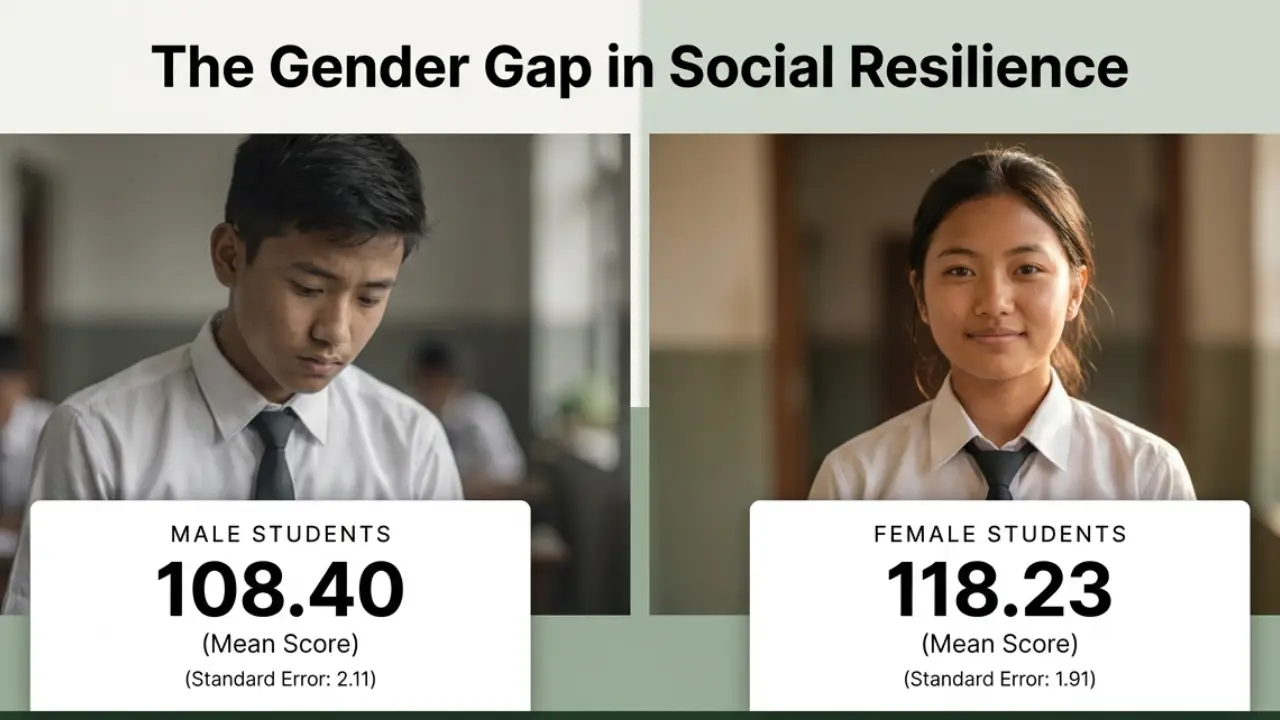
One of the study's most notable findings is the statistically significant difference between male and female students.
Female students recorded a mean social competence score of 118.23, compared with 108.40 among male students.
According to the researchers, female adolescents generally appeared more socially adaptive and resilient in interpersonal situations. The paper notes that girls were more consistent in demonstrating social competence, although it acknowledges that previous research on gender differences has produced mixed conclusions across different populations.
Rather than suggesting inherent differences, the findings point towards the influence of socialisation, communication styles and behavioural development during adolescence.
Family environment influences social development
The research also examined the relationship between family structure and social competence.
Students from nuclear families achieved a higher average score (115.72) than students from joint families (108.98), a difference that the researchers found to be statistically significant.
The authors suggest that home environments characterised by clearer emotional communication and stronger parent-child interaction may contribute to the development of better interpersonal skills. They emphasise that family relationships play an important role in shaping how adolescents respond to social situations beyond the classroom.
Social competence extends beyond the classroom
The researchers argue that social competence should not be viewed simply as the ability to make friends. Instead, they describe it as a critical life skill that influences emotional stability, academic performance, self-esteem, leadership and long-term psychosocial adjustment.
Students with stronger social competence are generally better equipped to cooperate with peers, resolve conflicts, communicate effectively and cope with stressful situations.
The study also observes that rapid technological change has transformed how adolescents interact, with online communication increasingly replacing face-to-face engagement. It suggests that cooperative learning environments and positive classroom interactions can help students who struggle with interpersonal skills.
Beyond the study: A broader picture of Manipur's adolescents
While the research provides valuable insight into social competence among students in Imphal West, it also raises broader questions about the environment in which today's adolescents are growing up.
Separate research and analysis by NE Dispatch, drawing on government reports, published studies, field surveys and education policy documents, indicates that young people in Manipur face a combination of challenges extending well beyond traditional classroom settings.
Digital lifestyles are reshaping social behaviour
One of the most significant developments is the rapid growth of digital engagement.
Field-based findings indicate that approximately 78 percent of adolescents check their mobile devices at least once every hour, while 35 percent remain almost continuously connected.
Mental health research has linked prolonged daily screen exposure—particularly beyond four hours—to substantially higher rates of anxiety, depression and chronic stress. Constant notifications and social media engagement activate dopamine-driven reward mechanisms that can encourage compulsive device use while reducing meaningful offline interaction.
The psychological effects extend beyond screen time itself.
Highly curated online content has intensified what psychologists often describe as the "compare and despair" phenomenon, contributing to body image concerns and feelings of social inadequacy. Local youth surveys suggest that more than half of adolescents express concern about physical appearance and social acceptance.
Sleep deprivation has also become increasingly common, with around 73 percent of adolescents reportedly using smartphones immediately before bedtime, a habit associated with reduced attention, emotional regulation and executive functioning.
Academic pressure, uncertainty about future careers and cyberbullying further compound these stresses, making social competence increasingly important as a protective factor.
Years of educational disruption
The educational experiences of Manipur's adolescents have also been shaped by consecutive crises.
Learning losses first emerged during the COVID-19 pandemic, when prolonged school closures widened existing inequalities in access to education.
Recovery efforts were interrupted by the ethnic violence that began in May 2023.
Available government data indicate that more than 14,700 school-going children were displaced during the conflict. Ninety-six government schools were converted into relief centres, while others in affected areas became temporary security camps or suffered damage.
Although authorities succeeded in re-admitting most displaced students to schools, classroom overcrowding, interrupted learning and social displacement affected the quality of education for many children.
Mental health professionals have also documented elevated levels of trauma among children living in relief camps, where grief, uncertainty and prolonged displacement have affected emotional wellbeing and concentration.
Students pursuing higher education outside Manipur experienced different but equally significant challenges. Internet shutdowns disrupted communication with families, interrupted digital financial transactions and contributed to secondary traumatic stress as many watched the crisis unfold from distant campuses.
Strengthening education beyond infrastructure
Over recent years, Manipur has introduced reforms aimed at improving learning outcomes through initiatives such as the School Fagathansi Mission and the STAR Education Programme, which combines structured pedagogy with technology-supported classroom management.
The STAR programme's offline-first teaching model during internet disruptions demonstrated the importance of building resilient education systems capable of functioning during emergencies.
However, educational recovery now requires attention not only to infrastructure and learning outcomes but also to emotional wellbeing.
Education specialists increasingly recommend integrating social-emotional learning, trauma-informed teaching, digital wellbeing and cyber-safety education into school curricula so that students develop resilience alongside academic knowledge.
A lesson for policymakers
Taken together, the published study and the broader evidence suggest that strengthening adolescent wellbeing in Manipur will require a more holistic approach than improving examination performance alone.
Social competence, mental health, family support, digital literacy and stable learning environments have become deeply interconnected.
As Manipur continues rebuilding its education system after years of disruption, helping young people develop empathy, communication skills, emotional resilience and healthy social relationships may prove just as important as investments in infrastructure or academic achievement.