Parliamentary data reveals significant variations in handloom insurance enrolment, targets and fund allocation across states, with Manipur's figures drawing attention due to sharp year-to-year changes.
Imphal, July 21: Official data presented in Parliament on Tuesday has highlighted significant variations in the implementation of two central insurance schemes for handloom weavers, with Manipur emerging as one of the most striking cases where enrolment figures, annual targets and fund allocations appear to move in markedly different directions over a five-year period.
The figures, shared in a written reply to the Lok Sabha by Minister of State for Textiles Pabitra Margherita, relate to the implementation of the Pradhan Mantri Jeevan Jyoti Bima Yojana (PMJJBY) and the Pradhan Mantri Suraksha Bima Yojana (PMSBY) under the Handloom Weavers' Welfare component of the National Handloom Development Programme (NHDP).
While the Ministry's reply outlines the mechanism for fixing annual targets and releasing funds, a comparison of the data across states reveals substantial differences between planned coverage, actual enrolment and financial assistance, particularly in Manipur.
The PMJJBY and PMSBY are implemented to provide life and accident insurance coverage to eligible handloom weavers and workers across the country.
The Ministry said the schemes operate on an annual policy cycle from June 1 to May 31, and since 2021-22, implementation has been carried out through state governments and Union Territory administrations.
According to the Ministry, annual targets are fixed on the basis of the indicative number of eligible handloom weavers and workers submitted by the respective states. Funds are released accordingly, while awareness is created through Weavers' Service Centres and Handloom Helpline Centres.
The Ministry also informed Parliament that independent evaluation studies are undertaken before existing schemes are continued or modified.
The parliamentary data shows that enrolment under the insurance schemes has generally increased over the last five years. National enrolment stood at 111,957 beneficiaries in 2021-22 before rising to 217,534 in 2024-25. Provisional figures for 2025-26 place enrolment at 202,393.
At the same time, annual targets have expanded considerably. The nationwide target increased from 209,349 eligible beneficiaries in 2021-22 to 468,756 in 2025-26.
However, enrolment has remained below the annual target. In 2025-26, for example, just over 202,000 beneficiaries had been enrolled against a target of nearly 469,000.
The data indicates that implementation levels vary significantly among states, with some reporting consistent growth while others record sharp fluctuations from one year to another.
Among all states, Manipur records one of the most unusual patterns.
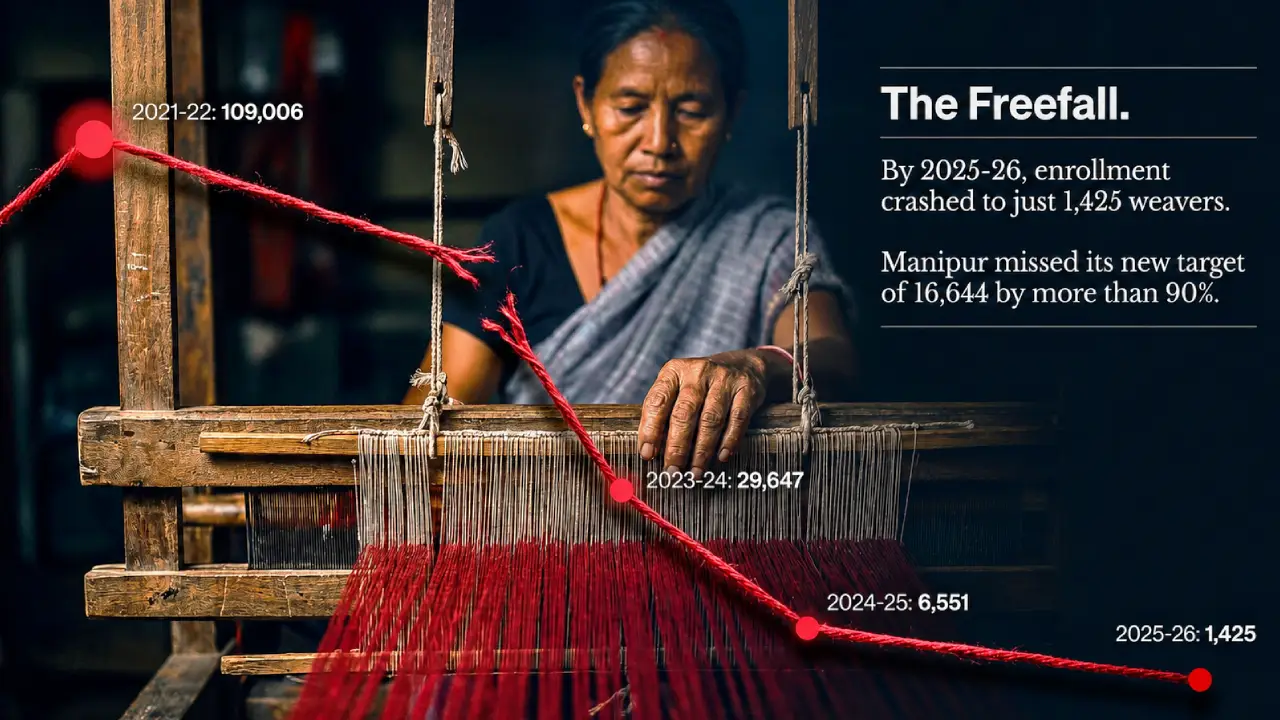
For the 2021-22 policy year, the state reported enrolment of 109,006 handloom weavers and workers. That figure accounted for almost the entire national enrolment of 111,957 beneficiaries recorded for the same year.
However, the state's target for 2021-22 was listed as 1,695 beneficiaries. The parliamentary reply does not explain the large difference between the target and the reported enrolment.
Following the exceptionally high figure in 2021-22, enrolment in Manipur declined sharply. The number fell to 28,218 in 2022-23 before increasing marginally to 29,647 in 2023-24. Enrolment then dropped to 6,551 in 2024-25 and stood at 1,425 under the provisional figures for 2025-26.
The trend also differs from the targets fixed for the state. For 2025-26, Manipur's target was 16,644 beneficiaries, while provisional enrolment was 1,425. The Ministry's reply does not provide reasons for the fluctuations in either enrolment or target achievement.
The financial data accompanying the parliamentary reply also shows notable differences between enrolment and fund releases.
In 2021-22, when Manipur reported enrolment of more than 109,000 beneficiaries, the state received Rs 1.92 lakh under the programme. By comparison, some states that reported no enrolment during the same period received substantially higher allocations.
Tamil Nadu received Rs 69.28 lakh, Odisha Rs 64.64 lakh and Karnataka Rs 39.27 lakh despite recording zero enrolment in the corresponding table for that year. The parliamentary reply does not explain the basis for these differences.
The data further shows that no fresh funds were released to Manipur during 2023-24 and 2024-25, although the state reported a combined enrolment of more than 36,000 beneficiaries during those two years.
A note accompanying the financial statement states that states were permitted to utilise funds released during 2021-22 in the following financial year, which may account for the absence of additional releases during 2022-23. However, the reply does not specifically explain the funding pattern recorded in subsequent years.
Interestingly, Manipur recorded its highest fund release of the five-year period in 2025-26. The state received Rs 36.98 lakh despite provisional enrolment falling to 1,425 beneficiaries, the lowest level during the period under review.
The parliamentary data does not indicate whether the release relates to current enrolment, previous commitments or another administrative process.
While Manipur's enrolment declined after 2021-22, Assam recorded sustained growth over the same period. The state reported no enrolment during 2021-22 but registered 24,551 beneficiaries in 2023-24.
Enrolment then increased sharply to 112,435 in 2024-25, making Assam the largest contributor among the northeastern states. The state's target for that year was 110,000 beneficiaries, closely matching the reported enrolment.
Financial assistance to Assam also increased over time, with Rs 133.69 lakh released during 2025-26. Unlike Manipur, Assam's enrolment, targets and fund releases appear to follow a broadly similar upward trend.
The remaining northeastern states recorded comparatively small numbers throughout the five-year period.
Arunachal Pradesh, Meghalaya, Mizoram, Nagaland, Sikkim and Tripura generally reported enrolments ranging from a few dozen to a few hundred beneficiaries.
Mizoram, which reported no enrolment during several earlier years, recorded 1,800 beneficiaries in 2024-25. Tripura's enrolment gradually declined from 2,160 beneficiaries in 2022-23 to 279 under the provisional figures for 2025-26.
Targets and fund allocations in these states also remained comparatively modest.
The parliamentary data also illustrates changing regional contributions to the schemes.
States such as Tamil Nadu, Karnataka and Telangana, which initially reported low or no enrolment under the programme, have since recorded substantial increases.
Tamil Nadu reported 48,767 beneficiaries in 2025-26. Telangana enrolled more than 19,000 beneficiaries, while Karnataka consistently recorded enrolment ranging between 16,000 and 24,000 over successive years.
These states now account for a larger share of the national beneficiary base compared with the initial years of implementation.
In its reply, the Ministry reiterated that the schemes are implemented through state governments and Union Territories.
Annual targets are based on the indicative number of eligible weavers submitted by states, while awareness campaigns are conducted through the Ministry's field institutions.
The Ministry also said independent evaluation studies are carried out periodically to assess the effectiveness of existing schemes and recommend improvements where necessary.
However, the parliamentary reply does not provide state-specific explanations for large differences between targets, enrolment and fund releases reflected in the data.
The figures presented to Parliament point to considerable variation in the implementation of the handloom insurance schemes across the country.
While some states recorded gradual expansion with enrolment broadly matching annual targets, others, particularly Manipur, reported trends that differ significantly from both their targets and funding patterns.
The parliamentary data itself does not indicate whether these differences arose from administrative processes, utilisation of previously released funds, revisions in beneficiary databases or other implementation factors.
Given the importance of PMJJBY and PMSBY in extending social security to handloom workers, the data is likely to draw attention to how beneficiary identification, target setting and fund allocation are carried out across states, particularly where official figures show substantial year-to-year variations.