A Resurgent Manipur report alleges institutional failures, security lapses and unresolved historical land disputes contributed to the abduction and killing of six Liangmai Naga civilians, while calling for an independent investigation, accountability and reforms to restore public trust.
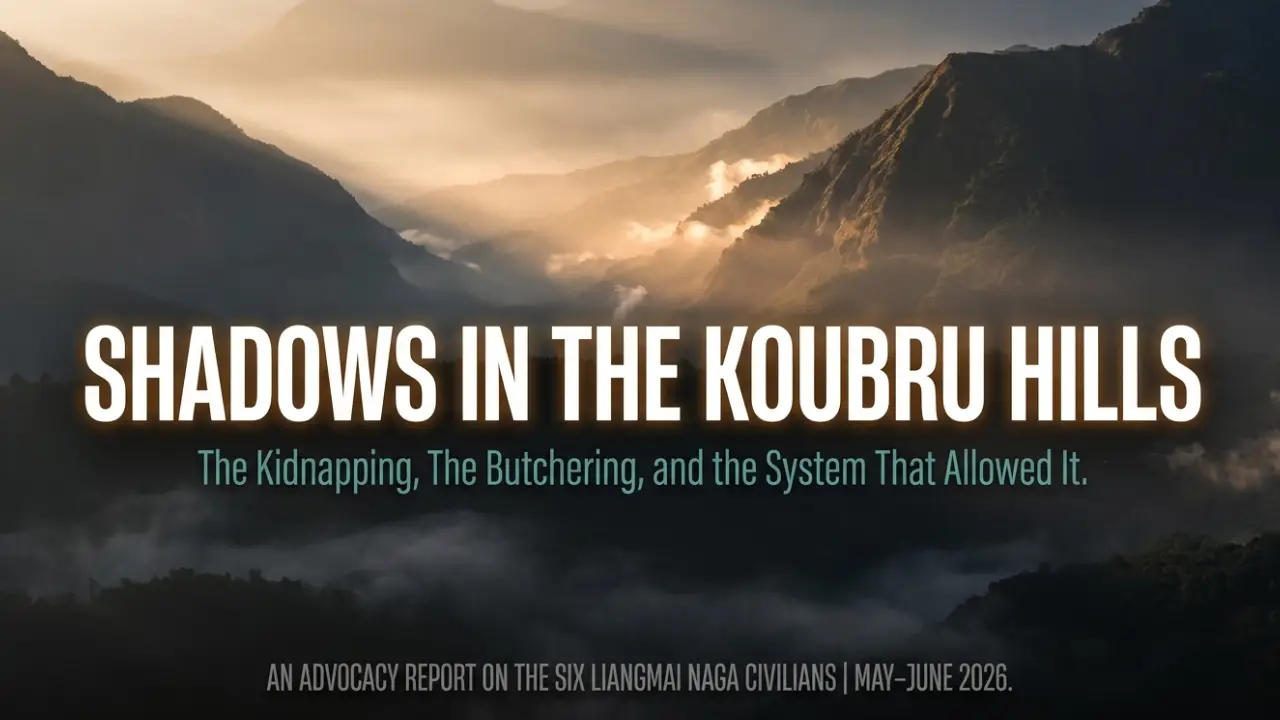
Imphal, July 1: A new advocacy report by Resurgent Manipur has alleged that the abduction and killing of six Liangmai Naga civilians in May and June 2026 was not an isolated act of violence but the outcome of prolonged institutional failures, unresolved historical land disputes, and alleged lapses in the implementation of security arrangements in Manipur's hill areas.
The report, Justice for the Six Liangmai Nagas, released in June 2026, reconstructs the sequence of events from the abduction of 20 Liangmai civilians on May 13 to the recovery of the bodies of six men on June 10. It also places the incident within the broader context of longstanding disputes over land ownership, settlement expansion and the functioning of the Suspension of Operations (SoO) agreement involving Kuki armed groups.
The findings have renewed calls from Naga civil society organisations for an independent investigation, accountability for those responsible and reforms to existing security mechanisms.
According to the report, the six victims were Pastor Kenpibou, Pastor Rev. Manu, Church Deacon Ch. Phenrilung, Phenrongwibou Thiumai, Dilip Thiumai and Kaliwangbou Abonmai. The report describes them as non-combatant civilians from the indigenous Liangmai Naga community residing in the Koubru range.
It states that on the evening of May 13, a group of 20 Liangmai civilians—including 11 women, an infant and the six men—was allegedly abducted by armed Kuki militants and civilians at Leilon Vaiphei while returning to Konsakhul after attending a wedding.
One of the central questions raised in the report concerns the location of the abduction. The incident allegedly occurred near the Leimakhong military station, home to the 57 Mountain Division of the Indian Army. The report argues that such a large-scale abduction occurring close to a major military installation raises serious questions about the effectiveness of the security response.
While the women and children were reportedly released within days, the six men remained missing for nearly four weeks.
The report describes the following weeks as a prolonged hostage crisis marked by conflicting narratives.
According to Resurgent Manipur, Liangmai organisations repeatedly sought the safe release of the six men, while Kuki civil society groups publicly denied that they were being held.
During the standoff, Liangmai groups detained 14 Kuki civilians, describing the move as an attempt to secure the release of the missing men. The report notes that the detainees were released on humanitarian grounds on June 9.
The following day, June 10, the bodies of the six missing men were discovered in a highly decomposed condition.
The report alleges that the victims had been tied, mutilated, dismembered and beheaded, with one severed head reportedly missing. It characterises the killings as an act intended to terrorise and dehumanise the Liangmai Naga community.
On June 25, according to the report, Kuki-Zo Council Chairman Henlienthang Thanglet publicly described the killings as a "grave mistake" and expressed regret. However, the All Naga Students' Association, Manipur (ANSAM) rejected the statement, maintaining that it fell short of genuine accountability and reiterating demands for immediate arrests.
Beyond the immediate incident, the report devotes significant attention to the historical land relationship between Konsakhul and Leilon Vaiphei.
It cites archival records indicating that Leilon Vaiphei originated as a tenant settlement established under a formal land lease agreement signed on October 19, 1920, between Konsakhul chief Phengamang and Vaiphei representative Shonglal Khoute.
According to the agreement reproduced in the report, the Vaiphei settlement was permitted to occupy land within Konsakhul's traditional boundaries for 100 years. In return, tenants were required to recognise the customary authority of the landlord village and pay annual tribute.
The report further references administrative orders issued by the Manipur State Darbar during the 1930s and 1940s which, it says, required Kuki settlers to obtain permission from Naga chiefs before establishing settlements and to pay house tax accordingly.
Resurgent Manipur argues that the lease expired in 2020 and contends that any continued occupation or expansion beyond the original agreement requires fresh legal or customary approval.
The report claims that Leilon Vaiphei has expanded from what it describes as a single tenant settlement into a cluster of 21 villages over several decades.
It alleges that much of this expansion has occurred inside the Kangchup-Leimakhong-Irang-Imphal-Iril Protected Forest, an area notified under the Indian Forest Act in 1967.
Drawing on government records, the report also points to previous actions taken by the state government against settlements established inside protected forests, including the cancellation of recognition granted to villages located within the Churachandpur-Khoupum and Tairenpokpi-Tamenglong Protected Forests.
The report argues that disputes over settlement expansion, forest encroachment and traditional village boundaries have increasingly fuelled tensions among communities in Manipur's hill districts.
A substantial section of the report focuses on the implementation of the Suspension of Operations framework between the Government of India, the Manipur government and Kuki armed organisations.
Resurgent Manipur alleges that the Kuki National Front (Progressive), a signatory to the agreement, was involved in the killings, though these allegations remain subject to investigation.
The report argues that the SoO framework prohibits participating groups from engaging in kidnappings, extortion or armed violence, and contends that inadequate enforcement has weakened public confidence in the arrangement.
Naga organisations cited in the report also oppose the establishment or relocation of SoO camps within what they describe as ancestral Naga territories, alleging that such camps have facilitated militant activity and intensified local tensions.
The report additionally references concerns expressed by organisations including the Foothills Naga Coordination Committee and the Rongmei Naga Council Manipur regarding infrastructure projects and the movement of armed groups through Naga-inhabited areas.
Another key theme in the report is the alleged disparity in the security response during the crisis.
It notes that despite the six civilians remaining in captivity for 27 days, security agencies were unable to rescue them.
The report also cites an incident on May 31 in which a Liangmai villager injured during an attack while repairing a water pipeline allegedly faced delays in evacuation after security personnel encountered road blockades.
In contrast, it claims that injured Kuki militants received armed escorts for medical treatment and, in earlier instances documented by Naga organisations, were transported by helicopter to hospitals outside the state.
The report argues that such perceived inconsistencies have deepened mistrust among affected communities and intensified criticism of the state's crisis management.
The report concludes by urging a series of legal, administrative and institutional measures.
Among its principal recommendations is an independent investigation by the National Investigation Agency (NIA) into the abduction and killings.
It also seeks a comprehensive review of the implementation of the Suspension of Operations agreement, verification of historical land and settlement records, enforcement against illegal encroachments in protected forests, and reforms aimed at improving civilian protection during conflict situations.
In addition, the report calls for compensation and legal assistance for the families of the victims, along with public recognition of the six men whose deaths it says have become emblematic of broader concerns surrounding governance, security and inter-community relations in Manipur.
While the report reflects the perspective of Resurgent Manipur and allied Naga organisations, many of its allegations—including responsibility for the killings, failures by security agencies and claims relating to settlement expansion—remain matters that would require investigation and official verification. The publication nevertheless adds a detailed account to the growing body of documentation surrounding one of the most disturbing incidents recorded during Manipur's continuing ethnic conflict.