Spain defeated Argentina 1-0 in extra time to win the 2026 FIFA World Cup at MetLife Stadium, claiming a second title as Ferran Torres scored the decisive goal in the 106th minute.
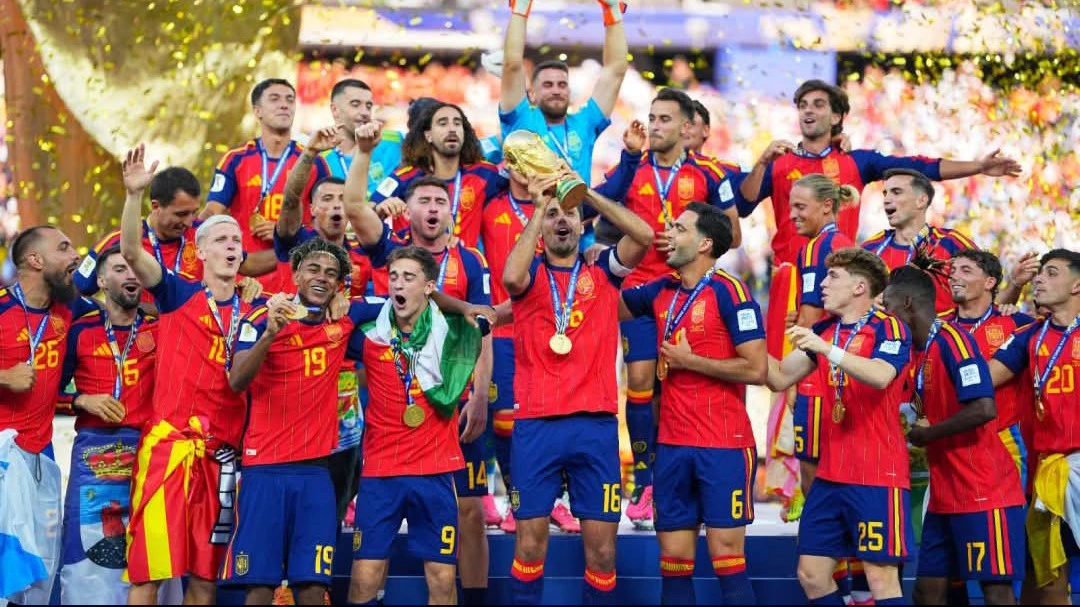
EAST RUTHERFORD, July 19: Spain defeated Argentina 1-0 in extra time on Sunday to win the 2026 FIFA World Cup, closing out the largest and most-attended tournament in the competition's history with a defensive masterclass at MetLife Stadium, officially designated New York New Jersey Stadium for the event.
Substitute Ferran Torres scored the only goal of the match in the 106th minute, converting from close range after Nico Williams headed a cross into his path. The goal ended a scoreless deadlock that had run through 90 minutes of regulation and into a tense first period of extra time, one in which Argentina goalkeeper Emiliano Martínez set a new World Cup final saves record to keep his team level.
The victory gives Spain its second World Cup title, 16 years after its first triumph in South Africa in 2010, and denies Argentina the chance to become the first repeat men's champion since Brazil won consecutive titles in 1958 and 1962. Lionel Messi, who has indicated the tournament was likely his last World Cup appearance, finished the match without a goal as Spain's defense limited Argentina to almost no clean offensive chances across 120 minutes.
“Martínez made 11 saves, breaking the previous World Cup final record of eight, set in the 1994 final between Brazil and Italy.”
THE FINAL
Spain controlled possession for long stretches of the match, with midfielder Rodri dictating tempo and repeatedly cutting off passing lanes to Messi. Argentina managed no shot of its own until deep into extra time, forcing Martínez into a virtuoso individual performance: he made 11 saves, breaking the previous World Cup final record of eight, set in the 1994 final between Brazil and Italy — also the last time the tournament was played in the United States. His two biggest stops came at the end of regulation, first denying a low effort from Nico Williams, then tipping a Lamine Yamal free kick over the bar in stoppage time to force extra time.
Tempers frayed after halftime. Argentina's Leandro Paredes was shown a yellow card for shoving Rodri to the ground off the ball and then pushing Dani Olmo during the ensuing confrontation, Argentina's second caution of the match after Lisandro Martínez was booked in the first half. The match turned decisively in stoppage time of regulation, when referee Slavko Vincic issued Argentina midfielder Enzo Fernández a second yellow card — his first had come for disputing an earlier call — following a challenge on 18-year-old Spanish defender Pau Cubarsí. The dismissal left Argentina to play the rest of the match, including all of extra time, with 10 men.
Spain appeared to break through early in extra time when Nico Williams put the ball in the net, but the goal was disallowed after a video review found a foul in the buildup. The decisive moment came instead 39 seconds into the second period of extra time: Pedro Porro's cross found Williams at the back post, Williams headed the ball back across goal, and Torres — on the field for less than 20 minutes as a substitute — volleyed it in. Torres became just the second substitute in tournament history to score a World Cup final winner.
SCALE AND SPECTACLE
The final capped a tournament FIFA has confirmed as the most-attended in World Cup history. Cumulative attendance passed 3.6 million during the group stage, surpassing the previous all-time record of roughly 3.59 million set at the 1994 World Cup, also hosted by the United States — a mark reached in far fewer matches, since the 2026 field expanded from 32 to 48 teams and 104 total matches, up from 64 in Qatar in 2022.
Sunday's final drew a capacity crowd and a high-profile mix of dignitaries, including U.S. President Donald Trump, First Lady Melania Trump, Secretary of State Marco Rubio, King Felipe VI of Spain, Canadian Prime Minister Mark Carney, Mexican President Claudia Sheinbaum and FIFA President Gianni Infantino. Trump was met with audible boos from sections of the crowd when he appeared on stadium screens following Jennifer Hudson's performance of the U.S. national anthem, and again when he took the field alongside Infantino for the trophy presentation to Spain captain Rodri.
The match also featured the first halftime show in World Cup history. Curated by Coldplay frontman Chris Martin, the 11-minute program was produced by Global Citizen in support of the FIFA Global Citizen Education Fund and featured co-headliners Madonna, Justin Bieber, Shakira and BTS, along with a guest appearance by Nigerian singer Burna Boy, conductor Gustavo Dudamel, the PS22 Chorus, and characters from Sesame Street and The Muppets.
ROAD TO THE FINAL
The path to Sunday's final ran through soccer's traditional powers on both sides of the bracket, a product of a new seeding format that kept the tournament's four top-ranked teams — Spain, Argentina, France and England — apart until the semifinals.
Spain opened its knockout run with a 3-0 win over Austria before advancing through the round of 16. In the quarterfinals, Belgium's Charles De Ketelaere became the first player to score against Spain all tournament, equalizing after a Fabián Ruiz goal, before substitute Mikel Merino scored a late winner following a goalkeeping error to send Spain through. In the semifinal against France, Mikel Oyarzabal converted a penalty in the 22nd minute after Lamine Yamal drew the foul, and Pedro Porro added a second goal in the 58th minute to complete a 2-0 win that eliminated the tournament's top-ranked team.
Argentina's route was far more turbulent. La Albiceleste opened the knockout stage with a 3-0 win over Algeria, then needed a stoppage-time goal from Fernández to beat Egypt in the round of 16 after Argentina twice trailed by two goals, with Cristian Romero and Messi scoring the equalizers before Fernández's late winner. In the quarterfinals, Argentina needed extra time to beat 10-man Switzerland, with Julián Álvarez and Lautaro Martínez scoring in the closing stages. The semifinal against England followed the same pattern: Argentina trailed 1-0 until the 85th minute, when Fernández scored from long range to force extra time, and Martínez won it two minutes into the additional period.
THIRD-PLACE MATCH
England claimed third place Saturday in Miami Gardens, Florida, beating France 6-4 in the highest-scoring match at a World Cup since 1982 and the most goals ever in a third-place playoff. England built a 4-0 halftime lead through goals from Declan Rice, Ezri Konsa and a brace from Bukayo Saka, before France mounted a dramatic second-half comeback with two goals from Kylian Mbappé and one from Bradley Barcola. Saka completed his hat trick from the penalty spot in the 87th minute, and although Ousmane Dembélé pulled France within one in second-half stoppage time, Jude Bellingham sealed the result with the match's 10th goal shortly after. Mbappé's brace made him the World Cup's all-time leading scorer across tournaments, while Bellingham's goal set a new scoring record for an England player at a major tournament.
HISTORICAL CONTEXT AND RECORDS
The 2026 tournament was the first World Cup expanded to 48 teams and the first jointly hosted by three countries — the United States, Mexico and Canada — spanning six weeks from June 12 to July 19. FIFA has described the event's prize pool as the largest in the tournament's history, though the governing body has not published a final, independently confirmed figure.
Spain's win extended a 37-match unbeaten run for the team that includes its 2024 European Championship title, according to team officials. The result also denied Argentina a chance to match Brazil's back-to-back titles from 1958 and 1962, a feat no nation has managed since. Spain becomes the first nation to hold the men's and women's World Cup titles at the same time, following the Spanish women's team's 2023 title.
INDIVIDUAL AWARDS
FIFA confirmed its tournament awards following the final.
Award Winner Note
Golden Boot Kylian Mbappé (France) 10 goals in 8 matches; first player to win in two consecutive World Cups
Golden Ball Rodri (Spain) Best overall player, voted by media following the semifinals
Golden Glove Unai Simón (Spain) Top goalkeeper of the tournament
Young Player Award Pau Cubarsí (Spain) Best player under 21; anchored Spain's defensive record
Fair Play Award Netherlands Best disciplinary record among the field
LOOKING AHEAD
Spain's title sets up an opportunity to defend its crown at the 2030 World Cup, to be jointly hosted by Portugal, Spain, Morocco, Uruguay, Argentina and Paraguay. Messi, who will be 43 by the time that tournament is played, has not confirmed whether he will continue playing internationally, though he could still appear at the 2028 Copa América.
For Spain, Sunday's win closes a tournament in which the team was cast as an underdog entering the semifinals against France, only to finish the competition unbeaten and having allowed a single goal across seven matches — a run that head coach Luis de la Fuente's side will look to build on heading into the next major international tournaments.