A national NIRDPR study finds high Gram Sabha awareness across Northeast India but says livelihood pressures, governance issues, weak infrastructure and transparency concerns continue to limit meaningful public participation in grassroots democracy.
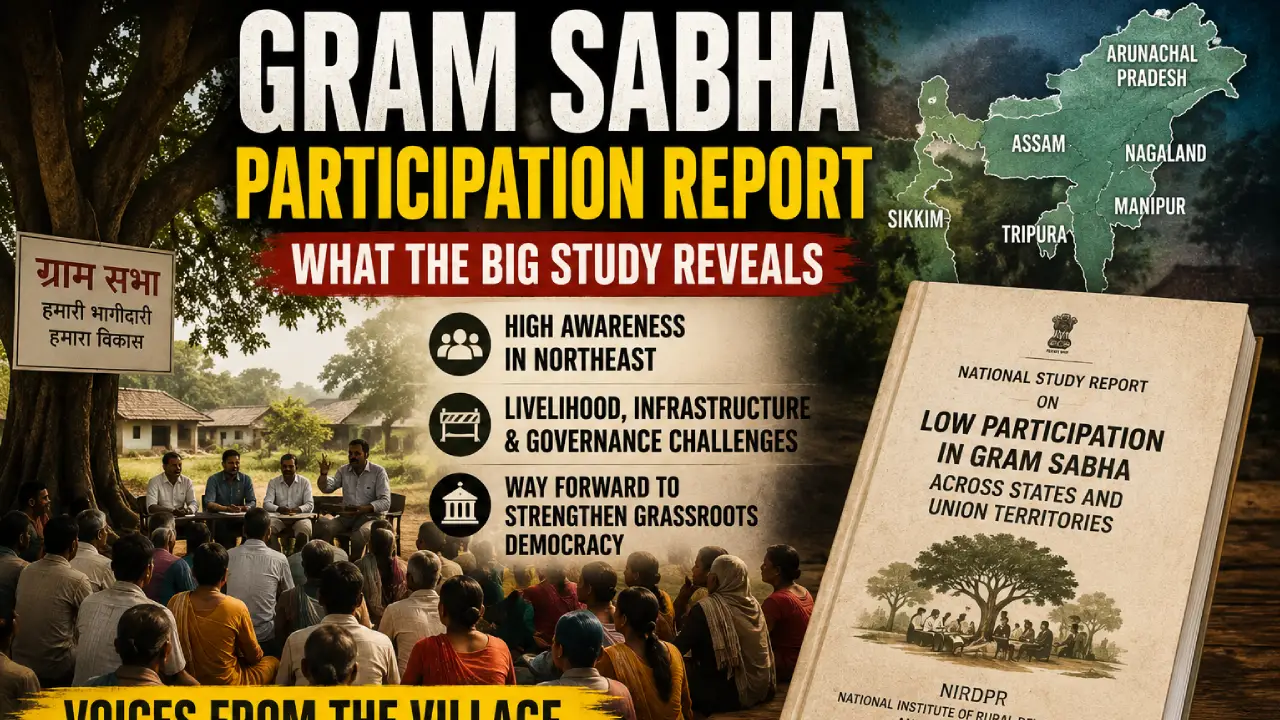
New Delhi, July 1: A comprehensive national study released by the National Institute of Rural Development and Panchayati Raj (NIRDPR) has found that while awareness of Gram Sabha meetings is high across much of Northeast India, actual participation continues to be constrained by livelihood pressures, infrastructure gaps, governance issues and weak institutional responsiveness.
The report, titled "Low Participation in Gram Sabha across States and Union Territories", was released by NITI Aayog Member Dr. R. Balasubramaniam along with Ministry of Panchayati Raj Secretary Vivek Bhardwaj. Based on one of the country's largest field assessments of grassroots democracy, the two-volume study surveyed around 7,790 respondents from 400 Gram Panchayats across 26 States and Union Territories, covering 213 districts, including Panchayats under the Panchayats (Extension to Scheduled Areas) Act (PESA) and women-friendly Gram Panchayats.
The report examines the functioning of Gram Sabhas—the constitutional village assemblies established under the 73rd Constitutional Amendment—and identifies both national and state-specific barriers affecting citizen participation.
Releasing the report, Dr. Balasubramaniam described the Gram Sabha as the truest expression of participatory democracy, saying meaningful participation cannot be imposed through rules alone but must be encouraged by building trust and giving citizens a sense of ownership over local development. Ministry of Panchayati Raj Secretary Vivek Bhardwaj said the findings would help shape targeted reforms, particularly for women, youth and marginalised communities.
According to the study, livelihood obligations remain the biggest obstacle to participation nationwide. Agricultural work, daily wage employment and seasonal migration prevent many rural residents from attending meetings. Poor communication about meeting schedules, delayed implementation of decisions and limited presence of departmental officials have also weakened public confidence in Gram Sabhas.
The report highlights that Northeastern states generally perform well in terms of awareness and attendance but face distinct challenges shaped by geography, infrastructure and socio-economic conditions.
The study surveyed 91 respondents across six Gram Panchayats in three districts of Manipur, where more than 90 per cent reported being aware of Gram Sabha meetings and their rights. Women were found to be active participants in local governance.
However, participation remains affected by governance-related issues. Around 60 per cent of respondents cited livelihood constraints, while more than half pointed to lack of transparency. Nearly one-third reported domination of discussions by a few influential individuals, and around 30 per cent said they did not feel comfortable expressing their opinions during meetings. More than 62 per cent also complained about delays in implementing government schemes.
Although most surveyed Gram Panchayats had meeting halls, the report noted shortcomings in seating capacity and meeting infrastructure. It also found that while WhatsApp has become a widely used communication tool, Panchayats largely lack digitised records, video conferencing facilities and audio-visual equipment.
The report recommends improving transparency, reducing elite dominance and strengthening public trust to make Gram Sabhas more effective in Manipur.
In Arunachal Pradesh, awareness of Gram Sabha meetings reached nearly 98 per cent, while more than 73 per cent reported active participation.
The study, however, identified severe infrastructure deficiencies. Very few Panchayats had dedicated meeting halls, and respondents reported the absence of adequate seating, meeting space and digital facilities. Livelihood commitments, particularly agriculture, remained the biggest barrier to attendance.
Assam recorded almost universal awareness and high attendance levels across the surveyed Panchayats.
Nevertheless, respondents cited daily wage work, farming commitments, delayed implementation of welfare schemes and long distances to meeting venues as major reasons for irregular participation. Although internet connectivity and digital communication through WhatsApp are widespread, many respondents considered existing Gram Sabha halls inadequate for local populations.
The report identifies Talap Gaon Panchayat in Tinsukia district as a model example of community mobilisation through systematic outreach and citizen engagement.
Nagaland also demonstrated high awareness and attendance, with strong participation from Scheduled Tribe communities.
However, many respondents said information about Gram Sabha meetings did not reach every household, while others admitted they lacked a clear understanding of the purpose of the institution itself. Livelihood and agricultural responsibilities also affected attendance.
Although internet access and digital communication are strong, physical infrastructure, including adequate meeting space and seating, remains uneven across the surveyed Panchayats.
Sikkim emerged as one of the strongest performers in both awareness and participation, with almost all respondents reporting familiarity with Gram Sabha meetings and their rights.
The state also showed advanced digital readiness, including digitised records and widespread internet access. However, respondents raised concerns about political interference, favouritism in beneficiary selection and insufficient follow-up on decisions taken during meetings.
Tripura recorded 100 per cent awareness of Gram Sabha meetings and very high attendance.
Even so, respondents identified delays in government schemes, political interference, dominance by influential individuals and inadequate physical infrastructure as persistent challenges. Only one-third of surveyed Panchayats had dedicated Gram Sabha halls.
Rather than prescribing a uniform national approach, the report advocates state-specific reforms tailored to local conditions.
Among its key recommendations are scheduling meetings outside peak agricultural seasons, improving household-level awareness campaigns through Self-Help Groups and frontline workers, strengthening accountability by presenting Action Taken Reports at every Gram Sabha, investing in dedicated meeting infrastructure, and expanding digital tools for record management and citizen participation.
The report also calls for greater transparency, stronger grievance redressal mechanisms and more inclusive discussions to ensure that women, youth and marginalised communities can participate meaningfully in local governance.
It concludes that while constitutional provisions have established Gram Sabhas as the foundation of rural democracy, their effectiveness ultimately depends on building public trust, improving institutional responsiveness and ensuring that decisions taken during meetings translate into visible outcomes for local communities.