How natural light, fresh air, and mindful technology use shape learning outcomes. A practical, research-backed guide to building a study environment that blends digital tools with traditional habits for deeper focus and retention.
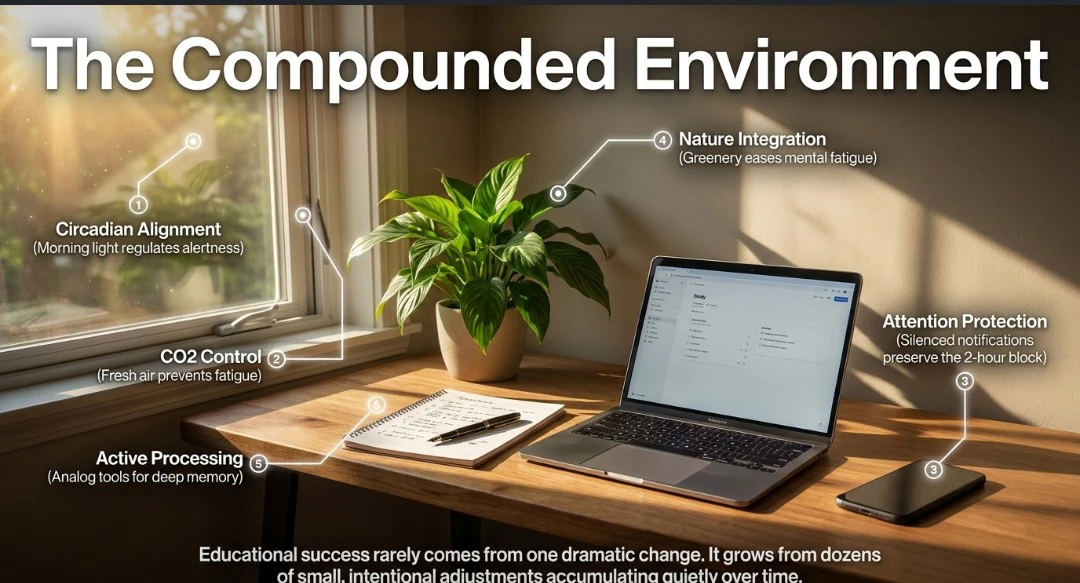
A study environment is often imagined as a desk, a chair, and a lamp. Yet the spaces where students learn are far more than that — they quietly shape concentration, motivation, and even emotional well-being. Some students struggle because their homes are noisy. Others sit in beautifully furnished study rooms, only to find themselves pulled apart by notifications. Creating a productive learning space today is no longer just about access to books or the internet. It is about striking a balance between technology and nature.
When people discuss academic success, they usually focus on teaching methods, study schedules, or exam strategies. The learning environment gets far less attention, despite its profound influence on how effectively the brain works. Research increasingly points to natural light, fresh air, comfortable temperature, and controlled digital use as major factors shaping attention and cognitive performance. A UNESCO report on learning environments notes that well-designed educational spaces intentionally maximize natural light and ventilation, because the physical environment directly supports learning.
For students in Manipur, this discussion carries particular weight. Many homes are multi-generational, where television sounds, conversations, visitors, and household chores compete with study time. This has partly fuelled the rise of study-room businesses and learning pods across urban areas in recent years. While these facilities offer quiet, the underlying principles of a good learning environment can just as easily be applied at home, without major expense.
Human biology evolved under daylight, not under the glow of LED screens. Exposure to natural light helps regulate the body's internal clock, improves alertness, and supports better sleep — which, in turn, strengthens learning and memory. Researchers have found that classrooms with abundant natural light tend to be linked with stronger academic progress, particularly in reading and science.
This doesn't mean every student needs a room full of large windows. Even placing a study table near a window can make a real difference. Morning light is especially beneficial, while curtains or blinds can soften harsh glare and keep the space comfortable. During power cuts — still common in many parts of Manipur — maximizing daylight also reduces dependence on artificial lighting.
Fresh air matters just as much, though we rarely notice it until a room turns stuffy. Poor ventilation allows carbon dioxide levels to build up, leading to fatigue, slower thinking, and weaker concentration. A large Danish study spanning hundreds of classrooms found that students in better-ventilated rooms generally performed better academically than those in poorly ventilated ones.
The lesson extends well beyond schools. Opening a window before a study session, letting fresh air circulate, or simply stepping outside during a break can refresh both body and mind. Good learning, it turns out, begins with good breathing.
Perhaps the greatest challenge facing students today isn't poor lighting or ventilation — it's digital overload.
Technology has transformed education. Online tutorials, AI-powered learning assistants, educational videos, interactive simulations, and digital libraries have democratized access to knowledge. A student in Imphal today can learn programming from Harvard, mathematics from MIT, or music production from professionals across the world — opportunities unimaginable just a generation ago.
But every powerful tool carries a hidden cost. The same smartphone that opens the door to learning also delivers endless notifications, short-form videos, social media updates, gaming alerts, and algorithm-driven entertainment. Modern platforms are built to compete relentlessly for human attention. Without conscious boundaries, study sessions splinter into dozens of interruptions — a student may spend two hours "studying" while actually absorbing only thirty minutes of focused learning.
This is why balance matters more than technology itself. Rather than letting devices dominate the study experience, students need to decide when technology earns a place — and when traditional methods simply work better.
Digital tools excel at searching information, watching demonstrations, building presentations, solving complex problems, practicing code, or getting personalized feedback from AI tutors. Handwritten notes, on the other hand, remain remarkably effective for reflection, summarization, and long-term understanding. Research by Pam Mueller and Daniel Oppenheimer found that students who took notes by hand often showed deeper conceptual understanding than those who typed everything on laptops, since handwriting forces active processing rather than verbatim transcription.
None of this means rejecting digital devices — it means giving each tool its proper role. One practical routine: start by reading from a textbook or printed material, use an AI assistant or educational website to clarify difficult concepts, work through problems on paper, summarize the lesson in a notebook, then review key points with digital flashcards. Technology becomes a companion, not a master.
As a parent, I've seen this play out while guiding my own son's learning. We often pair online courses with handwritten planning sheets and printed progress trackers. The screen delivers knowledge efficiently, but paper gives a sense of ownership — crossing off a completed task with a pen simply feels more satisfying than tapping a checkbox on a screen. That small physical act reinforces commitment.
Nature deserves a place within study spaces too. A small indoor plant, a glimpse of trees through a window, or a short walk during a study break can ease mental fatigue. Our brains were never designed to sit locked inside enclosed digital worlds for hours on end. A few minutes of greenery, fresh air, or birdsong lets attention recover before the next stretch of demanding work.
Evenings deserve protection as well. Bright blue light from digital devices can delay sleep, especially late at night, and poor sleep weakens memory consolidation — meaning hours of studying may leave surprisingly little behind. Ironically, sleeping well often does more for exam performance than squeezing in another hour of late-night revision.
The ideal study environment is neither purely traditional nor entirely digital — it's thoughtfully blended. A comfortable chair, adequate lighting, fresh air, minimal clutter, a notebook, a pen, reliable internet, and carefully managed technology together create the conditions where learning can flourish.
Educational success rarely comes from one dramatic change. More often, it grows from dozens of small, intentional adjustments that accumulate quietly over time: turning a desk toward natural light, opening a window before studying, silencing notifications for an hour, alternating between screen-based learning and handwritten reflection, taking short breaks outdoors. Individually, these may look insignificant. Together, they build an environment that sustains attention, supports healthier habits, and deepens understanding.
As education keeps evolving alongside artificial intelligence and digital innovation, perhaps the deepest lesson is this: the human brain still learns best when it stays connected to both technology and nature. The future of learning doesn't belong to screens alone, or to books alone — it belongs to students who know how to use both wisely.
(Keithellakpam Manikanta Meetei is a seasoned journalist and a former educator. He also writes under his pen name Keicha Chingthou Mangang instead of his actual name. You can contact him at chingthouheiya@gmail.com)