The Ministry of Panchayati Raj's latest Devolution Index shows Tripura leading the Northeast in Panchayat empowerment, while Manipur ranks last among hilly and northeastern states.
New Delhi, July 22: India has recorded a gradual improvement in the devolution of powers to Panchayati Raj Institutions (PRIs), according to the Ministry of Panchayati Raj's latest assessment, but the gains remain uneven across states, with significant disparities visible in the Northeast.
The findings are contained in the Ministry's "Status of Devolution to Panchayats in States – An Indicative Evidence-Based Ranking, 2024", released in February 2025 and referred to in a written reply tabled in the Lok Sabha on Monday.
The report measures how effectively states have transferred powers, finances and administrative responsibilities to Panchayats, providing one of the most comprehensive assessments of grassroots governance across the country.
According to the Ministry, the national devolution score improved from 39.9 per cent during 2013-14 to 43.9 per cent in 2021-22, indicating gradual progress in strengthening local self-government.
The assessment, however, also reveals wide differences among states, particularly in the Northeastern region, where Tripura emerged as the best-performing state while Manipur ranked last among the states evaluated under the Hilly and Northeastern category.
Measuring devolution
The Constitution places Panchayats under the jurisdiction of state governments, making them responsible for devolving powers, finances and administrative authority to local bodies through their respective Panchayati Raj laws.
Article 243G empowers state legislatures to assign Panchayats responsibilities relating to economic development, social justice and the 29 subjects listed in the Eleventh Schedule of the Constitution.
To assess how effectively states have implemented these provisions, the Ministry evaluates six broad dimensions:
Together, these indicators form the Devolution Index, which measures the extent to which Panchayats function as institutions of local self-government.
Southern states dominate national rankings
Among the general category states, Karnataka topped the national rankings with a Devolution Index score of 72.23, followed by Kerala at 70.59 and Tamil Nadu at 68.38.
These states scored consistently well across multiple indicators, particularly in institutional framework, administrative capacity and financial devolution. Punjab and Jharkhand occupied the lower end of the rankings among general category states.
Among Union Territories, Jammu and Kashmir ranked first, followed by the Andaman and Nicobar Islands.
Tripura tops Northeast
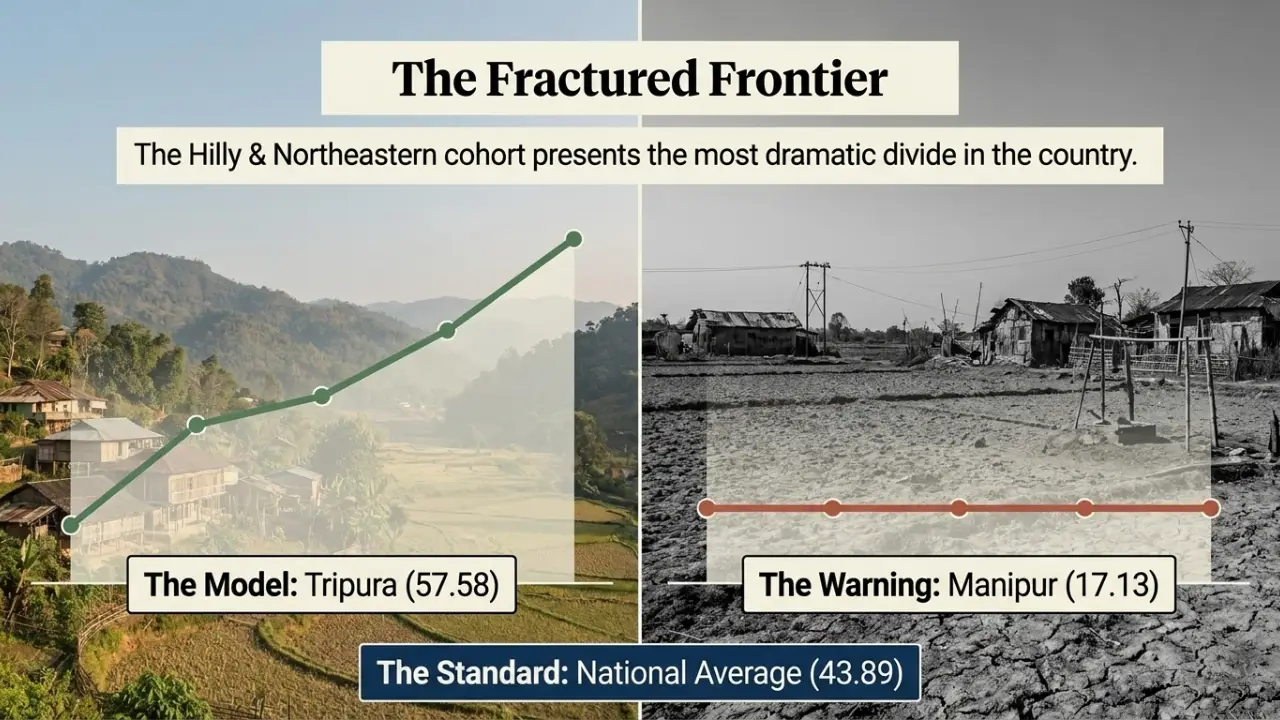
Within the Hilly and Northeastern category, Tripura emerged as the highest-ranked state with a Devolution Index score of 57.58, comfortably exceeding the national average of 43.89.
The report attributes Tripura's performance to relatively stronger financial devolution and institutional framework.
The state recorded one of the highest scores in the finances component while also performing well in framework and functionaries. Himachal Pradesh and Uttarakhand occupied the second and third positions in the category.
Among the Northeastern states, Assam ranked fourth with a score of 49.06, while Sikkim followed closely at 43.81, almost matching the national average.
Sikkim recorded the highest score within the category for the functions component, indicating greater transfer of responsibilities to Panchayats. Arunachal Pradesh ranked sixth with a score of 17.96.
Manipur ranks last
Manipur recorded the lowest Devolution Index score among the Hilly and Northeastern states. The state received an overall score of 17.13, less than half the national average and substantially below regional leader Tripura.
The report notes that previous data was used in assessing Manipur, a qualification also applied to Arunachal Pradesh.
Across all major indicators, Manipur ranked at or near the bottom of the category. Its framework score stood at 34.05, compared with the national average of 54.29.
The functions component, which measures the extent to which Panchayats are entrusted with responsibilities and participate in government schemes, recorded 11.23, well below the national average of 29.18. The finances component also remained comparatively low.
Manipur scored 13.17, while the national average stood at 37.04. The functionaries component, which evaluates staffing, infrastructure and digital connectivity, recorded 21.40, compared with a national average of 50.96.
The report itself does not identify the reasons for these lower scores but indicates that the state's overall performance remained below both national and regional averages across most dimensions.
The rankings highlight considerable variation in the performance of Northeastern states. Tripura, Assam and Sikkim all scored above or close to the national average, while Arunachal Pradesh and Manipur recorded substantially lower scores.
The data suggests that progress in decentralisation has not been uniform across the region, with states following markedly different trajectories in devolving powers and strengthening local institutions.
Centre focuses on capacity building
While Panchayats remain a state subject, the Ministry said it continues to support states through centrally sponsored capacity-building programmes.
Among them is the Revamped Rashtriya Gram Swaraj Abhiyan (RGSA), implemented since 2022-23 to strengthen the administrative and institutional capacity of Panchayati Raj Institutions.
The programme supports orientation courses, refresher training, thematic workshops and exposure visits for elected representatives and Panchayat officials.
The Ministry has also collaborated with the Indian Institute of Management Ahmedabad to develop training modules on enhancing Panchayats' Own Source Revenue (OSR), helping local bodies improve financial sustainability.
Other initiatives include leadership programmes through institutions such as the Indian Institutes of Management and Indian Institutes of Technology, as well as the Shashakta Panchayat Netri Abhiyan, which focuses on strengthening the capacity of women elected representatives.
Gradual progress, uneven outcomes
The Ministry's latest assessment suggests that decentralisation has continued to advance nationally, although the pace and extent of reform vary considerably among states.
While several states have strengthened the financial, administrative and institutional powers of Panchayats, others continue to record comparatively low levels of devolution across multiple indicators.
For the Northeast, the report presents a mixed picture. Tripura and Assam have emerged among the stronger performers, while the findings indicate that Manipur and Arunachal Pradesh continue to lag behind on several measures used to assess grassroots governance.