The United Naga Council has urged the Centre to terminate the Suspension of Operations agreement with Kuki militant groups, citing repeated attacks, alleged SoO violations and security failures in Manipur.
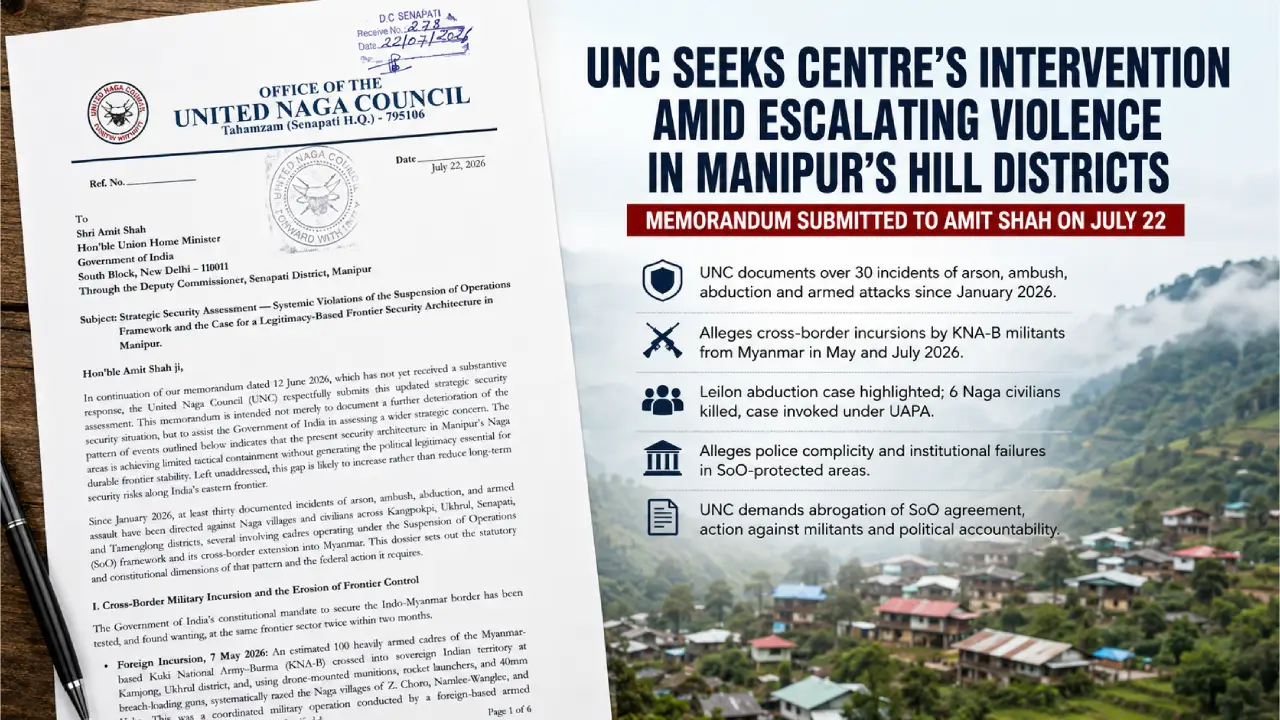
Imphal, July 22: The United Naga Council (UNC) has submitted a fresh memorandum to Union Home Minister Amit Shah, calling for the immediate termination of the Suspension of Operations (SoO) agreement with Kuki militant groups and seeking what it described as a "legitimacy-based frontier security architecture" to address the deteriorating security situation in Manipur's hill districts.
The memorandum, submitted through the Deputy Commissioner of Senapati on Wednesday, follows an earlier representation made on June 12. The UNC said the latest document was intended not only to highlight recent incidents of violence but also to present what it described as a broader strategic assessment of the security situation along Manipur's eastern frontier.
According to the council, the existing security framework has been effective only in providing "limited tactical containment" and has failed to generate the political legitimacy needed for long-term stability in the region.
The UNC claimed that since January 2026, at least 30 documented incidents involving arson, ambushes, abductions and armed attacks had targeted Naga villages and civilians across Kangpokpi, Ukhrul, Senapati and Tamenglong districts.
According to the memorandum, several of these incidents allegedly involved cadres operating under the Suspension of Operations framework and armed groups with links across the Indo-Myanmar border.
The council argued that the pattern of violence reflected not isolated law-and-order issues but a larger security challenge requiring intervention by the Union government.
Raises concerns over cross-border attacks
A major portion of the memorandum focuses on alleged cross-border incursions from Myanmar.
Referring to an incident on May 7, the UNC alleged that around 100 heavily armed cadres of the Myanmar-based Kuki National Army-Burma (KNA-B) entered Indian territory through Kamjong district and attacked the Naga villages of Z. Choro, Namlee-Wanglee and Kaka using drone-mounted explosives, rocket launchers and other heavy weapons.
The council claimed the attack took place close to an Assam Rifles post and questioned the effectiveness of the existing border security mechanism.
The memorandum also referred to another incident on July 1, alleging that Kuki militants, acting in coordination with the KNA-B, first set fire to Phaimol village before launching attacks on the Tangkhul Naga settlements of Humin Thana and Kherongram near the Indo-Myanmar border.
According to the UNC, 25 houses were destroyed during the incident.
The council contended that repeated attacks at the same frontier sector indicated shortcomings in preventing cross-border militant movement despite the presence of central security forces.
Leilon killings highlighted
The memorandum also revisited the abduction and killing of six Naga civilians from Leilon Vaiphei village.
According to the UNC, 18 unarmed Naga civilians were allegedly abducted on May 13 by individuals linked to the Kuki National Front-President (KNF-P), which is part of the United People's Front (UPF) and is covered under the Suspension of Operations agreement.
It stated that while 12 of those abducted were later released, the remaining six were killed. Their bodies were recovered on June 10.
The memorandum noted that investigators had invoked provisions of the Unlawful Activities (Prevention) Act (UAPA) in the case, arguing that the incident had already crossed the statutory threshold for terrorism.
The council maintained that the issue now lay not in legal classification but in ensuring accountability.
Allegations of institutional failure
The UNC also alleged that the effectiveness of the SoO framework had been undermined by failures within the state's security apparatus.
The memorandum referred to a criminal complaint naming a serving Manipur Police personnel in connection with the alleged handover of abducted civilians to militants.
According to the council, such allegations, if established, point to institutional weaknesses in enforcing the ground rules governing the Suspension of Operations agreement.
It argued that allowing SoO-protected cadres to continue operating despite alleged violations risked eroding public confidence in both the peace process and the state's security institutions.
Calls for review of SoO framework
The memorandum devotes significant attention to what it describes as the broader strategic implications of the current peace framework.
The UNC argued that military deployments alone cannot ensure lasting peace without the confidence of local communities.
Drawing comparisons with the Naga peace process, including Article 371A, the 1997 ceasefire and the 2015 Framework Agreement, the council maintained that long-term stability in the Northeast had historically depended on political legitimacy and sustained engagement rather than security measures alone.
According to the memorandum, the Suspension of Operations agreement with Kuki militant groups has, in practice, shifted from being a peace-building mechanism to one that allegedly provides legal protection to groups accused of continuing armed activities.
The council cautioned that failure to distinguish between groups complying with peace agreements and those allegedly violating them could weaken public trust in future peace initiatives across the region.
Six key demands placed before Centre
The UNC urged the Ministry of Home Affairs to take a series of measures, including:
Immediate termination of the Suspension of Operations agreement with all Kuki militant groups.
Formal designation of the Kuki National Front-President (KNF-P) as a terrorist organisation.
Prompt action to remove Manipur minister Nemcha Kipgen from the Council of Ministers, alleging that her continuation in office could undermine public confidence in investigations relating to the Leilon incident.
Arrest and prosecution of individuals named in connection with the Leilon case under the Unlawful Activities (Prevention) Act.
An independent review of the security deployment along the Kamjong sector of the Indo-Myanmar border.
Formal engagement between the Ministry of Home Affairs and the United Naga Council, along with other Naga customary institutions, to develop what it termed a legitimacy-based security and reconciliation framework for Manipur's hill districts.
Memorandum copied to constitutional and international bodies
The memorandum was also forwarded to several constitutional and institutional authorities, including the Chief Justice of India, the Leader of the Opposition in the Lok Sabha, the Parliamentary Standing Committee on Home Affairs and the United Nations Special Rapporteur on the Rights of Indigenous Peoples.
The UNC said the objective of the memorandum was not to escalate confrontation but to encourage the creation of a security framework in which enforcement measures and political legitimacy work together to ensure durable peace along India's eastern frontier.