ANSAM has urged Manipur University to operationalise its ST/SC Cell, review the CUET-only PG admission policy, establish CUET centres in hill districts, and revisit reservation seat conversion practices.
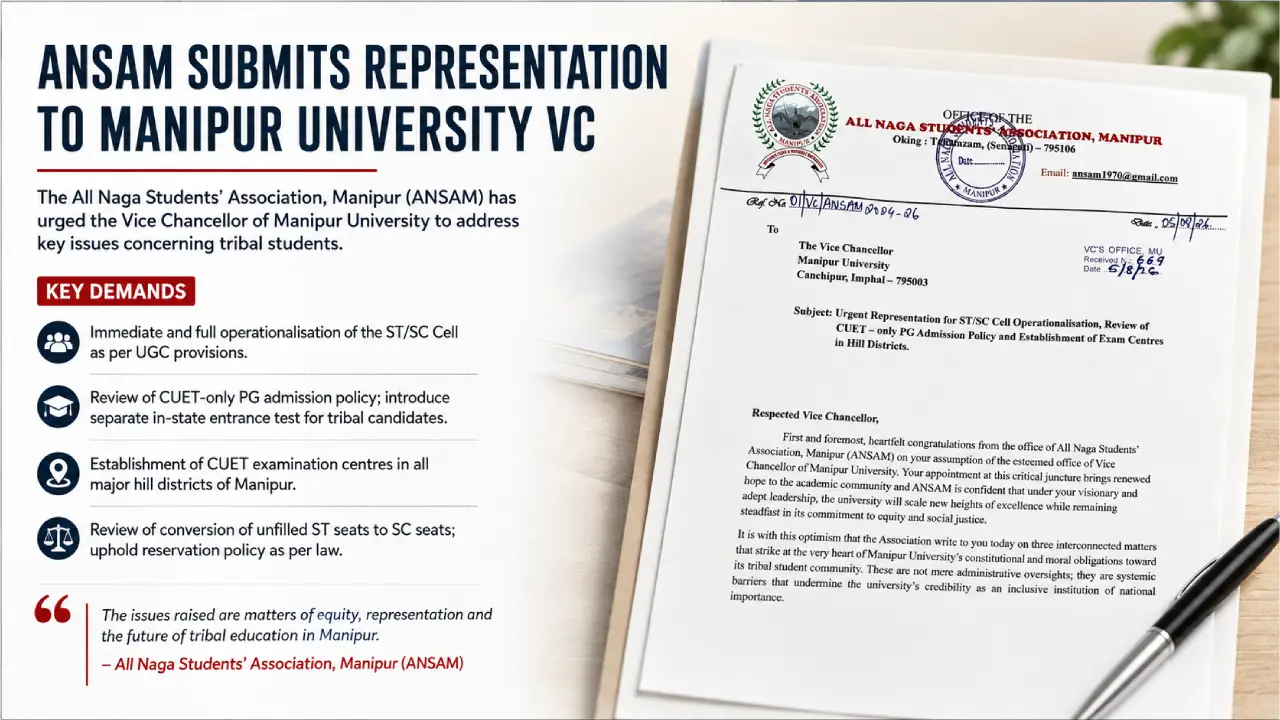
Imphal, August 6: The All Naga Students' Association, Manipur (ANSAM) has submitted a representation to the Vice Chancellor of Manipur University, urging immediate reforms on issues affecting tribal students, including the operationalisation of the university's ST/SC Cell, a review of the CUET-only postgraduate admission policy, establishment of examination centres in hill districts, and a review of reservation seat conversion practices.
The memorandum, received by the Vice Chancellor's Office on August 5, congratulated the newly appointed Vice Chancellor on assuming office and expressed hope that the university would strengthen its commitment to academic excellence and social justice.
ANSAM stated that despite the University Grants Commission (UGC) mandating such a mechanism, the university's ST/SC Cell continues to function only in a nominal capacity.
The association urged the Vice Chancellor to ensure the Cell is fully operational to implement reservation policies in admissions and recruitment, monitor the welfare and progress of Scheduled Tribe and Scheduled Caste students and staff, and function as an effective grievance redressal mechanism.
According to the memorandum, activating the Cell is necessary to bring the university into full compliance with UGC provisions.
Concerns over CUET-only PG admissions
A major concern raised by ANSAM relates to the university's practice of admitting postgraduate students solely through the Common University Entrance Test (CUET).
The association argued that the policy places tribal students from remote districts at a disadvantage because of geographical, logistical and security-related challenges.
It pointed out that most tribal-dominated districts in Manipur do not have CUET examination centres, forcing students to travel long distances to appear for the examination. The association further noted that the prevailing law and order situation in the state has made travel to Imphal and other examination centres difficult and, in many cases, unsafe.
According to ANSAM, relying exclusively on a centrally administered entrance examination under such circumstances ignores the realities faced by students from remote tribal areas.
The memorandum warned that if admissions continue to depend solely on CUET, the number of tribal students enrolled at the university could be limited largely to those residing in or around Imphal, which, it argued, would be inconsistent with the role of a Central University serving the entire state.
To address the issue, ANSAM proposed that the university introduce a separate in-state entrance examination for postgraduate programmes as a special measure for tribal candidates, stating that such an approach would help ensure reservation policies are implemented in a meaningful manner.
Demand for CUET centres in hill districts
The association also urged the university to take up the matter with the National Testing Agency (NTA) and the UGC for establishing CUET examination centres in all major hill districts of Manipur.
It specifically cited districts including Ukhrul, Senapati, Churachandpur, Tamenglong and Chandel, stating that the absence of examination centres amounts to structural exclusion for students living in those regions.
ANSAM said every district headquarters should have a functional CUET examination centre so that students are not compelled to choose between their education and their safety.
Review sought on seat conversion
The representation also called for a review of the university's practice of converting unfilled Scheduled Tribe seats to Scheduled Caste seats.
According to ANSAM, such conversions require greater scrutiny as they may undermine the intent of the reservation policy.
The association referred to the reservation framework applicable to Manipur University—31 per cent for Scheduled Tribes, 2 per cent for Scheduled Castes and 17 per cent for Other Backward Classes—and cited the Central Educational Institutions (Reservation in Admission) Amendment Act, 2012, which provides reservation-related provisions for Central educational institutions located in the North Eastern region and tribal areas.
Appeal for corrective measures
In its concluding remarks, ANSAM stated that the issues raised are matters of equity, representation and access to higher education for tribal communities.
The association expressed hope that the Vice Chancellor would initiate corrective measures at the earliest, stating that timely intervention would strengthen confidence in the university and reinforce its commitment to inclusive governance.