Tensions between Assam and Meghalaya have disrupted interstate movement after violence in Shillong triggered blockades and vehicle restrictions, reviving concerns over the unresolved border dispute and testing fragile relations between the neighbouring northeastern states.
Shillong/Guwahati, August 24: Tensions between Assam and Meghalaya have intensified after violence during a Khasi Students’ Union (KSU) motorcycle rally in Shillong triggered attacks on vehicles, protests and blockades along key entry points between the two states. Although the two governments have since moved to restore safe interstate movement, Assam-registered vehicles are still reportedly being stopped in parts of Meghalaya, while transport operators remain wary of crossing the border.
The immediate crisis is rooted in the violence reported in Shillong on August 19, but the confrontation has unfolded against the backdrop of a much older and unresolved territorial dispute between the neighbouring states. The two governments reached an agreement in 2022 covering six of 12 disputed areas, but six other areas remain to be settled.
The latest episode therefore represents more than a dispute over movement of vehicles. It has exposed how quickly a law-and-order incident in one state can generate retaliatory action in the other, particularly in communities living along an inter-state boundary where questions of identity, territory and security remain politically sensitive.
How the latest tension began
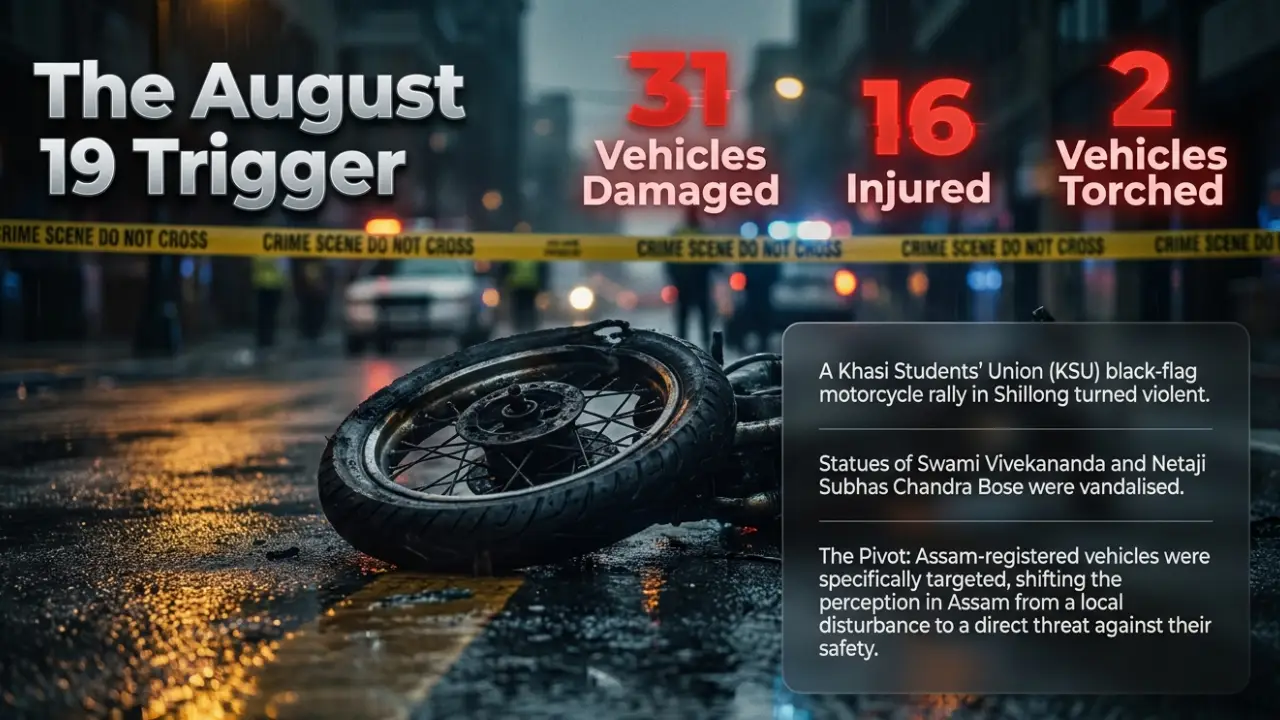
The immediate trigger was a black-flag motorcycle rally organised by the KSU in Shillong on August 19. The rally turned violent, with vehicles damaged and some set on fire. Meghalaya Police said 31 vehicles were damaged and 16 people were injured, while two vehicles were set ablaze.
Reports also said statues of Swami Vivekananda and Netaji Subhas Chandra Bose were vandalised during the unrest, adding to public anger in Shillong. The incidents prompted a heavy security response, including flag marches by security forces in the city.
A particularly sensitive aspect of the violence was the reported targeting of Assam-registered vehicles. For people and transport operators in Assam, the incidents were seen not simply as a local disturbance in Shillong but as a threat to their safety while travelling through Meghalaya.
That perception quickly translated into action on the Assam side.
Blockades spread across the Assam-Meghalaya routes
From August 20, Assam-based taxi and commercial vehicle operators began blocking Meghalaya-bound traffic at Jorabat and Khanapara, two of the principal gateways from Guwahati towards Shillong. The agitation subsequently extended to other routes, including Rani, Boko, Hahim and Lampi Road.
The blockade disrupted one of the Northeast's important road corridors. The Guwahati-Shillong route carries tourists, students, workers, traders and residents travelling between the two states, while Meghalaya also depends on road connectivity through Assam for access to other parts of the Northeast.
The disruption soon became a two-way problem. While Meghalaya-bound vehicles were stopped in Assam, Meghalaya-registered vehicles and other travellers faced restrictions on movement. The situation created stranded passengers and commercial vehicles on both sides.
The North East Petroleum Mazdoor Union also announced an indefinite stoppage of loading and unloading of petroleum products for Meghalaya during the agitation, raising concerns about the possible effect of the confrontation on fuel supplies.
By August 22, the Jorabat blockade had entered its third day, prompting authorities to intensify efforts to prevent the dispute from developing into a wider confrontation.
Governments move to contain the crisis
The Assam and Meghalaya governments responded with ministerial-level talks on August 22.
The meeting at the Koinadhara State Guest House in Guwahati was led by Meghalaya Deputy Chief Minister Sniawbhalang Dhar and Assam minister Atul Bora, along with senior officials from both states. The discussions lasted more than three hours and focused on the safety of travellers, attacks on vehicles and restoring interstate movement.
Meghalaya expressed regret over the Shillong violence and assured Assam that action would be taken against those responsible. The Meghalaya government informed the meeting that the KSU president, vice-president and general secretary had been arrested under the Meghalaya Maintenance of Public Order Act.
Police had registered 15 FIRs in connection with the violence and identified five masked individuals allegedly involved in attacks, particularly those targeting Assam-registered vehicles. A Special Investigation Team was also constituted to investigate the violence and identify those responsible for prosecution.
The two governments also agreed on a broader mechanism for managing future incidents.
A dedicated coordination mechanism is being established between the Inspector General of Special Branch, Assam, and the Inspector General of Law and Order, Meghalaya. Permanent district-level committees involving officials from Nongpoh and Kamrup Metropolitan, along with police officers from both sides, are also to be constituted to deal with day-to-day border issues.
A separate committee involving senior transport officials and representatives of tourist vehicle associations will address interstate tourist transport.
Thousands of vehicles caught in the disruption
The scale of the disruption became apparent as authorities worked to evacuate stranded travellers.
According to information presented after the August 22 meeting, more than 3,770 Assam-registered vehicles had been safely escorted out of Meghalaya. The Assam control room received 54 distress calls involving 175 people, while Meghalaya's control room received 379 distress calls.
Authorities also reported that several hundred vehicles had earlier been held up in Meghalaya, including a backlog estimated at around 400 to 500 vehicles at one stage.
The two governments agreed that remaining stranded passengers and vehicles would be escorted towards Assam and that arrangements would be made for safe movement in both directions.
The measures are particularly important for southern Assam, whose road connectivity with other parts of the state can involve travel through Meghalaya. The two governments agreed to ensure safe passage for such vehicles as well as for people travelling between different parts of Meghalaya through Assam.
Blockade suspended, but normalcy remains fragile
Following the ministerial meeting, Assam-based cab operators suspended their blockade after receiving assurances regarding safety and investigation into the Shillong violence.
However, the suspension has not immediately restored full confidence.
Reports on August 24 said Assam-registered vehicles were still being stopped and turned back from Meghalaya despite the drivers' unions having suspended their three-day blockade. Cab operators also remained reluctant to resume normal services because of continuing fears over the safety of drivers and passengers.
The situation illustrates the difference between lifting a physical blockade and restoring public confidence. Even after governments reach an understanding, transport operators and ordinary travellers may remain unwilling to resume movement until they are convinced that the security assurances are being implemented.
The larger issue: a border dispute dating back decades
The present confrontation cannot be understood entirely through the events of August 2026.
Assam and Meghalaya share an inter-state boundary of about 884.9 km. The dispute has its origins in the reorganisation of the Northeast and the creation of Meghalaya as a separate state in 1972. Meghalaya has historically contested the interpretation of parts of the boundary inherited from the period when the state was part of Assam.
In 2011, Meghalaya formally identified 12 areas of difference with Assam. These included Tarabari, Gizang, Hahim, Langpih, Borduar, Boklapara, Nongwah-Mawtamur, Khanapara-Pillangkata, Desh Doomreah, Block I and Block II, Khanduli-Psiar and Ratacherra.
The disputed areas cover locations where competing claims involve questions of historical boundaries, local population, administrative control and the interpretation of territorial contiguity.
These disagreements have periodically produced local confrontations, particularly when residents, forest officials, police personnel or other state agencies operate in areas where the two governments have differing claims.
The 2022 agreement was a breakthrough, but not a final settlement
The most significant attempt to resolve the dispute came in 2021 and 2022, when Assam Chief Minister Himanta Biswa Sarma and Meghalaya Chief Minister Conrad K. Sangma began a structured process to settle the dispute in phases.
Six relatively less complicated areas were selected for the first phase: Tarabari, Gizang, Hahim, Boklapara, Khanapara-Pillangkata and Ratacherra. Regional committees involving representatives from both states conducted field visits and consultations.
The two sides agreed to use five broad principles while assessing the competing claims: historical perspective, ethnicity of the local population, contiguity with the existing boundary, people's will and administrative convenience.
On March 29, 2022, the two chief ministers signed an MoU in New Delhi in the presence of Union Home Minister Amit Shah covering the six areas.
The agreement dealt with approximately 36.79 square kilometres in the six sectors. Under the settlement formula, Assam received control over about 18.46 square kilometres and Meghalaya about 18.33 square kilometres.
The Union government described the agreement as a major step towards resolving a dispute that had persisted for decades. The Ministry of Home Affairs continues to state that boundary demarcation in the six settled areas is being carried out by the Survey of India in consultation with both states.
But the agreement did not settle the entire border.
Six disputed areas remain
The remaining six areas are Khanduli and Psiar, Block I and Block II, Borduar, Langpih, Nongwah-Mawtamur and Desh Doomreah. Both states have constituted regional committees for these areas.
These remaining sectors are generally considered more complicated because of the nature of competing claims and the historical, demographic and administrative questions involved.
The Meghalaya government has continued to seek progress on the second phase. The state has said that the regional committees are tasked with examining village claims, establishing geographical locations and preparing asset registers in cooperation with Assam.
The Assam government likewise maintains that bilateral efforts are continuing to reach a mutually acceptable settlement. Its Border Protection and Development Department says nodal officers from both states have been appointed and that regional committees are being used to address the remaining areas.
This means that the two states have moved considerably beyond the confrontational phase of earlier decades, but the political and administrative dispute has not disappeared.
Why the border remains sensitive
The Assam-Meghalaya boundary is not simply a line separating two administrative jurisdictions.
For people living in border settlements, the question can affect access to roads, government services, markets, schools, voting rights and local administration. A boundary pillar or a disputed stretch of road can therefore become a much more significant issue than its physical size suggests.
The situation in Hahim in 2026 illustrates this problem. A disputed boundary pillar has become a source of uncertainty for villagers, with the dispute reportedly affecting political participation and raising questions over which state's administration residents fall under.
Such disputes can also acquire an ethnic dimension because many border communities have strong historical and cultural identities that do not necessarily correspond neatly with administrative boundaries.
This is one reason why isolated incidents involving police, forest personnel, vehicles or local residents can quickly become politically charged.
From border dispute to interstate mistrust
The latest crisis also shows how the meaning of a border dispute can change.
The August violence did not occur at one of the six formally unresolved territorial sectors. Instead, the immediate confrontation developed around the movement and safety of people travelling between the two states.
The response nevertheless quickly acquired an interstate character. Assam-based transport operators imposed restrictions on Meghalaya-bound traffic, while concerns were raised in Meghalaya over restrictions affecting Meghalaya vehicles and travellers.
This creates a dangerous cycle.
An incident involving a group of people can generate fear among an entire state's population. That fear can then produce collective action against travellers or vehicles identified by registration plates. Such measures can affect people who had no connection with the original incident.
Once that happens, an isolated law-and-order case risks becoming a broader question of interstate identity.
The economic cost of confrontation
Assam and Meghalaya are closely linked economically and socially.
Guwahati functions as a major gateway for Meghalaya, while Meghalaya provides important road links for parts of Assam. Shillong is also a major tourism destination, with visitors commonly travelling through Assam.
Any prolonged disruption therefore affects far more than taxi drivers.
Tour operators, hotels, restaurants, fuel suppliers, traders, students, patients travelling for medical treatment and ordinary commuters can all be affected when road movement becomes uncertain.
The recent blockade demonstrated this vulnerability. The two governments' decision to establish a dedicated committee on tourist transport acknowledges that the problem has implications for a shared regional economy, not merely for law and order.
What happens next
The immediate priority for both governments is to prevent the August violence from turning into a prolonged cycle of retaliation.
The first test will be whether vehicles can move freely and safely in both directions. The second will be whether the investigation into the Shillong violence results in credible legal action. The third will be whether the assurances given to transport operators are sufficient to restore confidence.
The longer-term challenge is more difficult.
The remaining six border disputes need to move from committee-level discussions towards a settlement acceptable to communities on both sides. The experience of the first six areas shows that political agreements can establish a framework, but actual demarcation and acceptance on the ground require sustained administrative work.
The governments have also recognised the need for mechanisms that can deal with problems before they become crises. Permanent district-level committees, police coordination and transport coordination could provide an institutional channel for resolving smaller disputes without allowing them to become interstate confrontations.
The Assam-Meghalaya border is unlikely to become completely free of disagreements overnight. But the current crisis also demonstrates why the two states need to separate genuine territorial negotiations from incidents involving public safety.
The 2022 agreement showed that compromise is possible even after decades of disagreement. The events of August 2026 show that the political settlement must be matched by public confidence, reliable law enforcement and a functioning mechanism for handling disputes at the local level.
For now, the blockade may have been suspended, but the deeper test for Assam and Meghalaya is whether the latest crisis can be contained without allowing distrust between communities and neighbouring states to harden further.