Union Cabinet approves Rs.23,731 crore GOBARdhan National Circular Bioenergy Scheme to expand compressed biogas production, boost rural economy and promote clean energy.
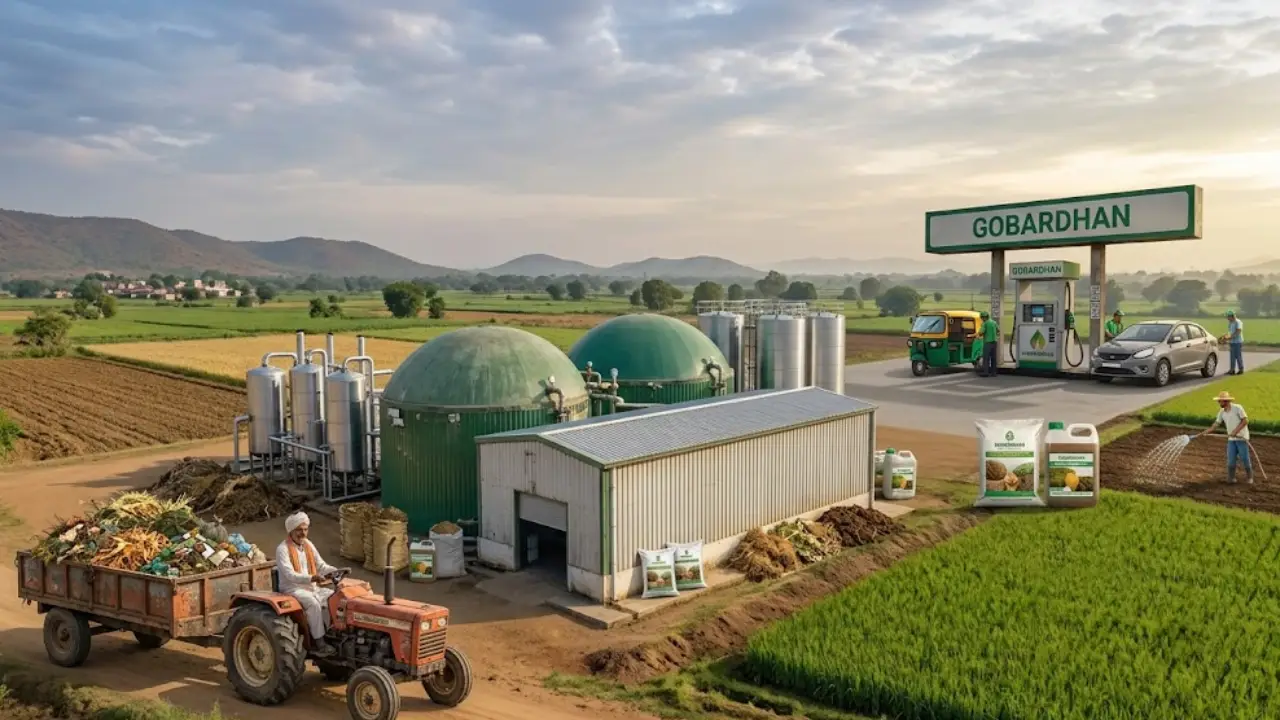
New Delhi, August 6: The Union Cabinet, chaired by Prime Minister Narendra Modi, has approved the GOBARdhan (National Circular Bioenergy) Scheme with a total financial outlay of Rs.23,731 crore, aimed at scaling up India’s compressed biogas (CBG) sector and converting organic waste into clean energy, organic manure and rural economic opportunities.
The scheme will be implemented from FY 2026-27 to FY 2035-36 and seeks to establish Compressed Biogas as a significant component of India’s future energy mix.
The government stated that GOBARdhan will utilise agricultural residue, cattle dung, press mud, municipal organic waste and other biomass resources to produce renewable fuel while creating additional income avenues for farmers, rural entrepreneurs and waste management stakeholders.
The scheme is expected to increase domestic CBG production nearly ten-fold, encourage large-scale private investment and develop a circular bioeconomy across the country.
Integrated framework for CBG sector growth
The Ministry of Petroleum and Natural Gas will administer the scheme, which brings together multiple interventions across the CBG value chain, including assured demand, pricing support, capital assistance, pipeline connectivity, credit support and technology development.
The government said the initiative will provide a predictable framework for investors, lenders and developers, helping improve project viability and accelerate the expansion of CBG plants.
The scheme builds upon earlier initiatives such as the Sustainable Alternative Towards Affordable Transportation (SATAT) programme, Market Development Assistance for organic manure, Biomass Aggregation Machinery Scheme, Development of Pipeline Infrastructure Scheme and Central Financial Assistance under the National Bioenergy Programme.
According to the government, these measures have already supported the commissioning of more than 200 CBG plants, while strengthening production systems, organic manure value chains and market linkages.
Six key components of GOBARdhan
The scheme includes six major components designed to strengthen different stages of the CBG ecosystem.
Assured CBG offtake mechanism
GOBARdhan will establish a dedicated CBG Offtake Assurance framework to provide producers with a reliable market.
Procurement by City Gas Distribution (CGD) entities will support the implementation of the notified CBG blending obligation, which targets 3% in FY 2026-27, 4% in FY 2027-28 and 5% from FY 2028-29 onwards for the CNG transport and domestic PNG segments.
The government said the framework will provide a long-term demand signal, improve capacity utilisation and encourage private investment.
Stable pricing support
The scheme introduces a government-backed pricing framework with an administered CBG price of Rs.2,110 per Metric Million British Thermal Unit (MMBTU).
The framework will provide revenue certainty for producers while maintaining consumer affordability through a combination of government support and market-based cost-sharing.
The pricing mechanism will have a minimum ten-year horizon to support investment decisions and capacity expansion.
Capital assistance for projects
Eligible greenfield CBG projects will receive capital assistance of up to Rs.2 crore per tonne per day (TPD) of installed CBG capacity.
The support will cover key value-chain assets, including feedstock aggregation, organic manure processing and value addition activities.
Brownfield projects expanding their production capacity will also be eligible for assistance.
The government said the financial support will reduce initial investment burdens and encourage participation from private developers, MSMEs, cooperatives and rural entrepreneurs.
Pipeline infrastructure development
GOBARdhan will support pipeline infrastructure connecting CBG plants with trunk pipelines and City Gas Distribution networks.
The government stated that improved connectivity will reduce evacuation costs, increase market access and enable higher utilisation of domestically produced renewable gas.
Credit guarantee support
A dedicated credit guarantee mechanism will be introduced to improve access to institutional finance for eligible MSME-based CBG projects.
By reducing lending risks, the mechanism is expected to improve availability of affordable credit, reduce collateral requirements and encourage participation by MSMEs, women entrepreneurs and first-time developers.
CBG ecosystem challenge fund
The scheme will also establish a CBG Ecosystem Challenge Fund to support district-level implementation and strengthen local value chains.
The fund will support activities such as biomass resource mapping, feedstock aggregation infrastructure, district-level CBG planning, technology adoption, process improvement, organic manure value addition, capacity building and stakeholder awareness.
Supporting India’s energy security
The government said CBG can contribute to meeting India’s growing demand for natural gas across transport, household, industrial and commercial sectors.
Since CBG has properties similar to natural gas, it can be integrated into existing gas infrastructure, allowing renewable fuel production without requiring separate distribution systems.
Each CBG plant is also expected to create local economic activity through biomass collection, transportation, plant operations and organic manure production.
The scheme is aimed at reducing dependence on imported fossil fuels, improving waste management and lowering greenhouse gas emissions through productive utilisation of organic resources.
The Union government said GOBARdhan will help create a new clean gas economy with benefits including:
Nearly ten-fold growth in domestic CBG production.
Increased renewable fuel availability and improved energy security.
Greater private investment through improved project economics.
New income opportunities for farmers, cooperatives and rural entrepreneurs.
Scientific management of agricultural and municipal organic waste.
Expansion of the organic manure sector through production of Fermented Organic Manure (FOM) and Liquid Fermented Organic Manure (LFOM).
Faster project implementation through a unified national framework and digital governance.
The government described GOBARdhan as a step towards transforming India’s organic resources into clean energy, rural livelihoods and economic value, while supporting the broader goals of Atmanirbhar Bharat and Viksit Bharat.