Centre tells Supreme Court that NFSU found no untampered portion in audio clip allegedly linked to former Manipur CM N Biren Singh, as court orders fresh forensic comparison.
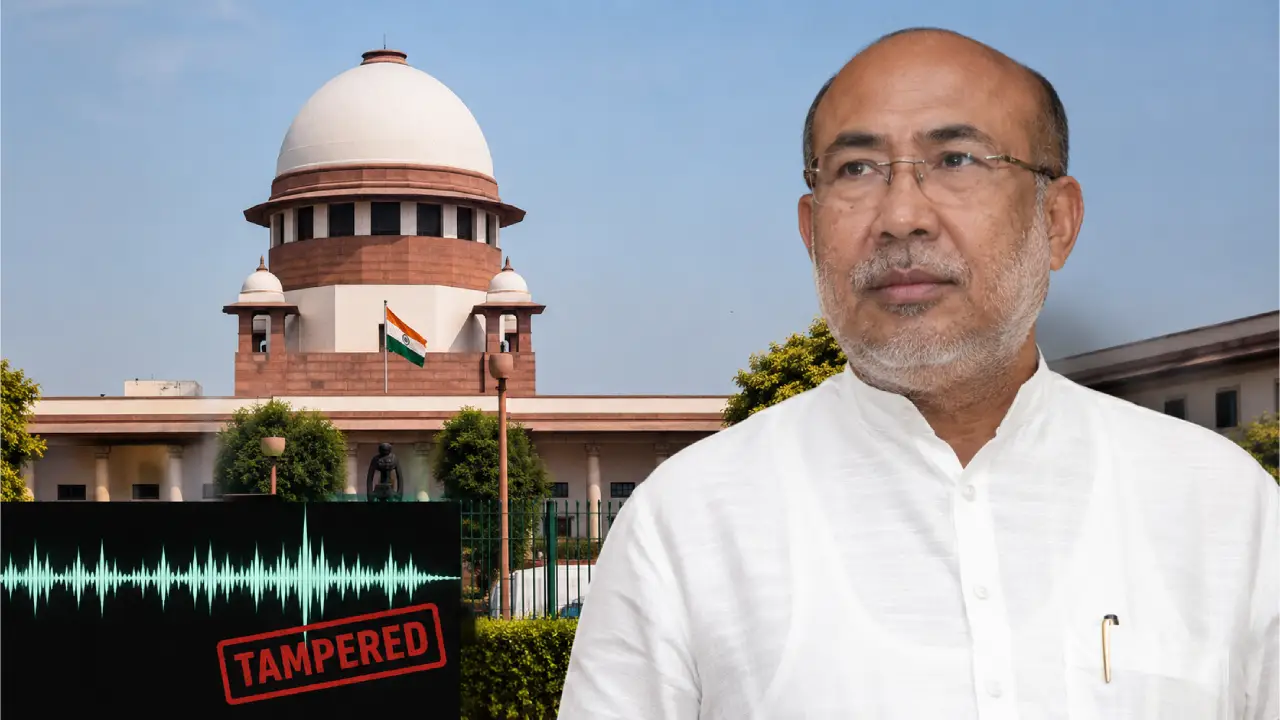
New Delhi, August 7: The Centre on Friday told the Supreme Court that a forensic examination found the audio recording allegedly linked to former Manipur Chief Minister N. Biren Singh to be tampered with, with no identifiable untampered portion available for scientific comparison.
The submission was made during the hearing of a petition filed by the Kuki Organisation for Human Rights Trust concerning audio recordings allegedly implicating Singh in connection with the Manipur violence.
A bench of Justices Sanjay Kumar and Vinod Chandran heard the matter, during which Additional Solicitor General (ASG) Aishwarya Bhati informed the court that the National Forensic Sciences University (NFSU) had concluded that the recording showed signs of editing, processing and signal alterations affecting the integrity of speech parameters.
“The opinion of the NFSU is there is no untampered portions. There are variations at different intervals across the entire length,” Bhati submitted before the bench.
According to the Centre’s submission, the forensic institution found that the recording was not original and that the available material could not provide reliable untampered portions for comparison.
“The language that they use is — the recording is not original, indications of editing, processing, signal alterations is compromising the integrity of speech parameters. It’s contrary to scientific principles,” Bhati told the court.
She further submitted that untampered portions could not be reliably identified and that controlled recordings were not provided by the state or police.
The submission came after the Supreme Court, during the previous hearing, had asked why NFSU could not compare Exhibit-A with Exhibit-B, including any available untampered portions, and had sought clarity on whether the forensic agency stood by its earlier report concerning Doordarshan recordings and whether a voice sample of Singh was required.
Senior advocate Prashant Bhushan, appearing for the petitioner, disputed aspects of the Centre’s submission. He told the court that the controlled recordings provided by the petitioners were not from Doordarshan but from other YouTube channels, while the Doordarshan recording had been independently obtained by NFSU.
Bhushan informed the court that the petitioners had the complete audio recording, which was around two hours and 36 minutes long, and were willing to provide it for forensic examination.
However, he said the original device on which the recording was made would not be handed over as it could reveal the identity of the alleged whistleblower.
“The original device on which it was recorded is not being handed over because that will allow them to ascertain the identity of the person,” Bhushan submitted.
He said the recording was originally made on a phone and was later copied onto a pen drive.
During the hearing, Justice Sanjay Kumar asked Bhushan about the possibility of providing the recording to the other side for further examination.
Bhushan said admitted voice recordings of Singh, including speeches available on YouTube, had earlier been provided for comparison.
ASG Bhati said that while the petitioners were providing the pen drive, the original device was not being supplied.
She added that NFSU would require the raw file without alterations and would need to verify the hash value of the digital copy.
Bhushan questioned the reference to a “raw file”, saying he was not clear about what was meant by the term.
Passing its order, the Supreme Court recorded that NFSU would not undertake comparison of the available voice recordings in their current form.
The court noted that Bhushan had stated that the complete audio clip had been copied onto a pen drive from the original device.
The bench directed that the pen drive, described as the first copy of the original recording, be furnished to the other side and forwarded to NFSU for comparison with admitted voice recordings of the concerned individual.
The Supreme Court also directed the Manipur government to provide admitted recordings of Singh for the purpose of comparison.
The petitioner has been given one week to submit the recordings, while NFSU has been allowed to complete the forensic exercise as expeditiously as possible, preferably within six weeks.
The case relates to allegations surrounding the handling of the Manipur violence that erupted in May 2023. The claims made through the audio recordings remain disputed, and the forensic examination will determine whether the material can be scientifically verified.