Global experts at Manipur University outlined strategies for AI-driven innovation, research commercialisation, intellectual property management and stronger university-industry collaboration.
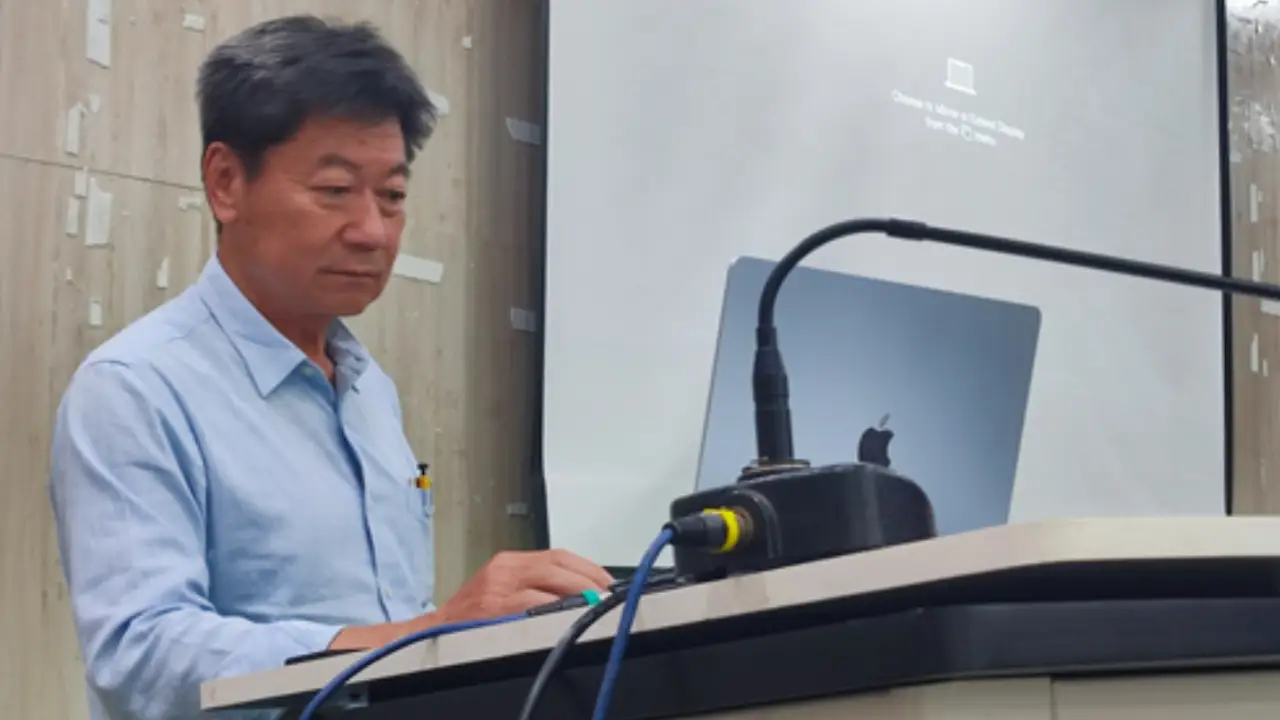
Imphal, August 4: A stronger culture of Artificial Intelligence (AI)-driven research, intellectual property management and university-industry collaboration is essential for transforming academic research into innovations that benefit society and the economy, experts said during a lecture-cum-interaction programme organised by the Department of Computer Science and Engineering, Manipur Institute of Technology (MIT), Manipur University on Tuesday.
The programme, held at the Court Hall of Manipur University, brought together international experts, academicians, researchers and students to discuss the evolving role of AI in higher education, innovation ecosystems, technology transfer and research commercialisation. Vice Chancellor (In-Charge) Prof. R.K. Hemakumar Singh and Dean of the School of Engineering Prof. N. Basanta Singh attended the event along with faculty members and research scholars.
The session featured Prof. Virach Sornlertlamvanich, Professor in the Department of Data Science at Musashino University, Tokyo, Japan, and Mr. Mairembam Shanjoy Singh, Director of IP2Impact Ltd., United Kingdom, who shared international perspectives on responsible AI adoption and strategies for translating research into practical applications.
AI Should Support Human Intelligence
Addressing the gathering, Prof. Virach said Artificial Intelligence has emerged as a transformative technology with the potential to reshape higher education and research. However, he emphasised that AI should complement human intelligence rather than replace it.
He observed that generative AI can rapidly generate ideas by drawing upon existing knowledge, but meaningful research continues to depend on human reasoning, critical thinking, experimentation and evidence-based validation.
AI-generated outputs, he said, should always be carefully examined before they are applied in research or decision-making.
"Artificial Intelligence can accelerate routine tasks, but it cannot replace scientific judgement or the analytical thinking required to solve complex problems," he noted.
Referring to Nobel laureate Daniel Kahneman's theory of human cognition, Prof. Virach explained the distinction between System 1, which involves fast and intuitive thinking, and System 2, characterised by slower, deliberate and analytical reasoning.
While AI excels at handling repetitive processes and analysing large volumes of information quickly, he said researchers must continue to rely on analytical thinking when evaluating evidence, drawing conclusions and solving challenging scientific problems.
Framework for Future AI Education
Prof. Virach also presented the Three Pillars of the MUDS/MIDS Programme, an educational framework centred on AI Creation and Applications, AI Algorithm Design, and Social Innovation, all integrated through research-based learning.
According to him, the framework is designed to prepare graduates not only for careers in Artificial Intelligence and data science but also for innovation across sectors such as healthcare, agriculture, business and public administration.
He stressed that future AI education should encourage interdisciplinary learning and equip students with both technical expertise and the ability to address societal challenges through innovation.
Universities Must Commercialise Research
Delivering the second lecture, Mr. Mairembam Shanjoy Singh focused on research commercialisation and the need for universities to create structured innovation ecosystems that enable research outcomes to generate economic and social value.
Drawing on his experience in the United Kingdom, Shanjoy explained how leading universities have established systems for intellectual property management, technology transfer and startup development, allowing scientific discoveries to reach industry and society more effectively.
He said universities should formulate commercialisation policies suited to their own institutional strengths and regional contexts instead of simply replicating models adopted elsewhere.
Commercialisation, he added, does not necessarily require establishing startup companies. Universities can also create impact by licensing research outputs to existing industries through well-defined intellectual property agreements.
Such arrangements, he said, not only encourage technology adoption but also create additional revenue streams for both researchers and educational institutions.
Building a Strong Innovation Ecosystem
Shanjoy emphasised that successful research commercialisation requires dedicated institutional support.
He recommended establishing technology transfer offices supported by legal and commercial experts, along with transparent governance mechanisms and incentive systems that encourage faculty members to pursue innovation alongside teaching and research.
He also suggested that universities diversify their academic offerings by introducing specialised short-term and professional training programmes that respond to industry requirements.
Such initiatives, he said, could strengthen collaboration between academia and industry while generating additional institutional income.
Rejecting the perception that universities located in smaller regions face limitations, Shanjoy said institutions like Manipur University have the potential to become recognised centres of innovation by building on local strengths while adopting globally proven practices.
Interactive Discussions on Emerging Technologies
The lecture concluded with an interactive session during which faculty members, research scholars and students engaged the speakers on emerging developments in Artificial Intelligence, Natural Language Processing, intellectual property rights, innovation management, startup ecosystems and research commercialisation.
Participants also discussed ethical considerations surrounding generative AI, the growing role of AI in academic research and opportunities for strengthening collaboration between universities and industry.
The discussions reflected increasing interest among researchers and students in applying advanced technologies to solve real-world challenges while creating opportunities for entrepreneurship and knowledge transfer.
The organisers said the programme aimed to expose participants to international best practices in Artificial Intelligence, innovation and university-industry collaboration while encouraging a stronger culture of research, entrepreneurship and technology transfer within Manipur University.