Official data shows Manipur mobilised over 1.38 lakh rural women under DAY-NRLM, but funding gaps and limited monitoring of Rs 502.5 crore in Finance Commission grants pose implementation challenges.
Imphal, August 4: More than 1.38 lakh rural women in Manipur have been mobilised into Self Help Groups (SHGs) under the Centre's flagship rural livelihoods programme over the past five years, but a substantial gap between sanctioned funds and actual central releases has emerged as a key challenge to expanding livelihood opportunities in the state. At the same time, while Manipur received over Rs 500 crore under the Fifteenth Finance Commission's tied grants for drinking water and sanitation, the absence of centrally maintained utilisation data has made it difficult to assess how effectively those funds were spent at the grassroots level.
Official data from the Ministry of Rural Development and the Ministry of Jal Shakti point to two parallel realities. On one hand, community mobilisation under the Deendayal Antyodaya Yojana-National Rural Livelihoods Mission (DAY-NRLM) has continued despite difficult conditions. On the other, gaps in fund disbursement and limited visibility into the implementation of decentralised infrastructure projects raise questions about the pace and effectiveness of rural development initiatives.
The findings also follow official data showing that a majority of Manipur's Panchayats remain in the lower performance categories under the Panchayat Advancement Index, with limited institutional capacity-building reported over recent years.
Women's Self Help Groups Continue to Expand
The DAY-NRLM remains the Centre's principal programme for reducing rural poverty by organising women into Self Help Groups and strengthening community institutions that promote savings, credit access, entrepreneurship and sustainable livelihoods.
Nationally, the programme has mobilised more than 10.08 crore women into around 92 lakh SHGs, making it one of the world's largest community-based women's empowerment initiatives.
In Manipur, the programme has mobilised 1,38,777 rural women during the last five years.
While considerably smaller than Assam's 39.78 lakh beneficiaries or Tripura's 4.95 lakh, the figure places Manipur ahead of several other Northeastern states, including Nagaland, Arunachal Pradesh, Mizoram and Sikkim.
Officials say these community institutions have become important platforms for financial inclusion, livelihood promotion and social development, particularly in rural areas where access to formal economic opportunities remains limited.
Livelihood Support Extends Beyond SHGs
The rural livelihoods mission operates through several specialised components designed to address different aspects of poverty alleviation.
Besides strengthening Self Help Groups, the programme supports rural entrepreneurship through the Start-up Village Entrepreneurship Programme (SVEP), which assists SHG members in establishing non-farm enterprises.
Women farmers receive targeted assistance under the Mahila Kisan Sashaktikaran Pariyojana (MKSP), aimed at improving agricultural productivity and increasing women's participation in farming activities.
The mission also includes the Deen Dayal Upadhyaya Grameen Kaushalya Yojana (DDU-GKY), which provides placement-linked skill training for rural youth, while Rural Self Employment Training Institutes (RSETIs) offer short-term entrepreneurial training across the country.
Together, these initiatives seek to improve household incomes while promoting financial inclusion and social empowerment, particularly among Scheduled Castes, Scheduled Tribes, Other Backward Classes and other disadvantaged groups.
Allocation and Release Figures Reveal Funding Gap
Despite continued community mobilisation, Manipur's financial performance under DAY-NRLM reflects a significant disparity between planned allocations and actual central releases.
Official figures indicate that over the past five years:
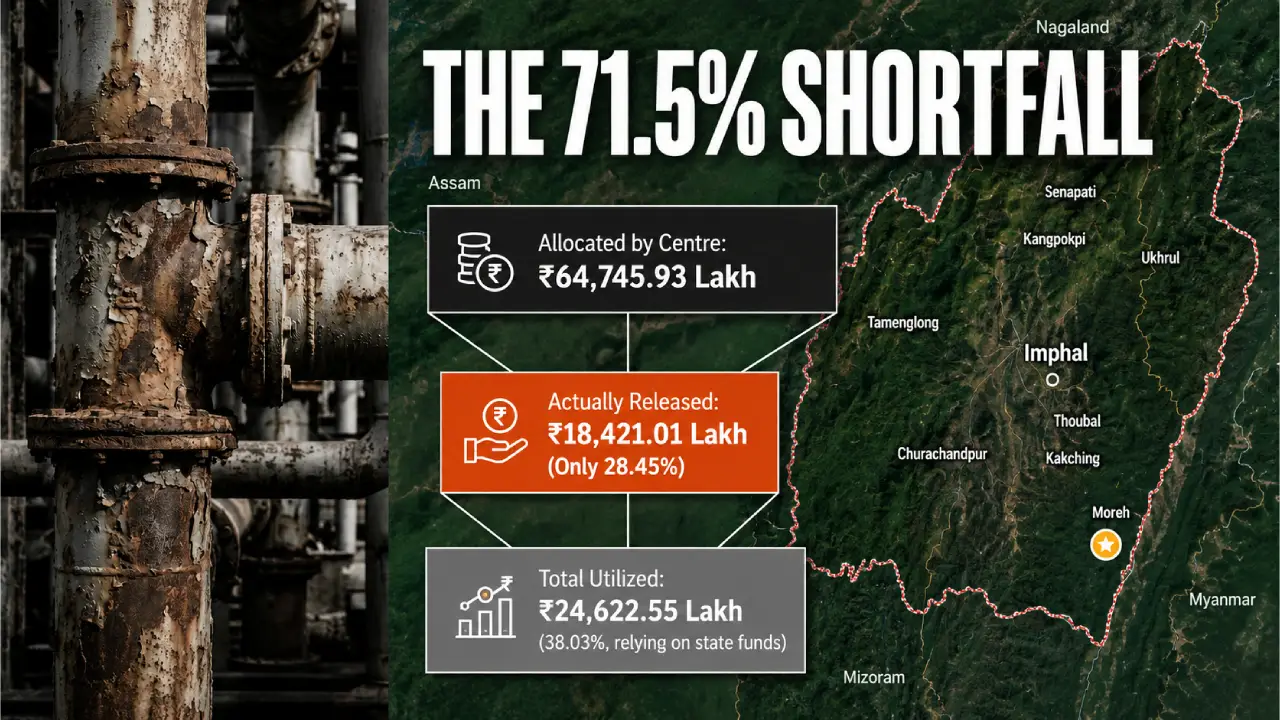
Central allocation: Rs 64,745.93 lakh
Central release: Rs 18,421.01 lakh
Total utilisation: Rs 24,622.55 lakh
This means only 28.45 per cent of the allocated central funds were released to the state.
The unreleased amount stood at approximately Rs 46,324.92 lakh, representing 71.55 per cent of the original allocation.
Interestingly, expenditure exceeded the amount released by the Centre by over Rs 6,200 lakh, suggesting that spending was supplemented through state contributions or unspent balances carried forward from previous years.
Even then, total utilisation represented only 38.03 per cent of the original central allocation.
The figures illustrate the extent to which actual programme implementation depends not only on approved allocations but also on the timely release of funds.
Northeast Comparison Shows Wider Differences
The contrast becomes more evident when compared with other Northeastern states.
Assam secured central releases amounting to over 95 per cent of its allocation and ultimately utilised more than its allocated amount.
Meghalaya similarly received almost 95 per cent of sanctioned funds and reported utilisation of nearly 97 per cent.
Arunachal Pradesh also recorded releases exceeding 84 per cent of allocations.
Tripura obtained nearly 70 per cent, while Nagaland received close to 57 per cent.
Only Mizoram and Sikkim recorded lower release ratios than Manipur.
Although Sikkim's release percentage was marginally lower, Manipur's unreleased allocation—amounting to more than Rs 463 crore—represents one of the largest funding gaps in absolute terms within the region.
Such disparities may influence the pace at which community institutions receive revolving funds, livelihood investments and support for income-generating activities.
Funding Remains Critical for Community Institutions
The success of Self Help Groups depends not only on their formation but also on continued financial support.
Community Investment Funds, bank credit linkage, livelihood grants and enterprise financing play an essential role in enabling SHGs to expand economic activities.
Where fund flows remain constrained, community institutions may face difficulties in scaling up income-generating initiatives despite successful mobilisation of women.
The data therefore suggests that while institutional mobilisation has progressed in Manipur, ensuring adequate financial support remains equally important for achieving long-term livelihood outcomes.
Water and Sanitation Receive Dedicated Finance Commission Support
Alongside livelihood programmes, rural local bodies in Manipur have also benefited from dedicated funding for drinking water and sanitation under the Fifteenth Finance Commission.
The Department of Drinking Water and Sanitation under the Ministry of Jal Shakti acts as the nodal agency for administering these tied grants.
Across the country, the Fifteenth Finance Commission earmarked 60 per cent of grants to Rural Local Bodies specifically for water supply, sanitation and maintaining Open Defecation Free (ODF) status.
Half of the tied grants are reserved for drinking water infrastructure, including water supply systems, rainwater harvesting and water recycling.
The remaining half supports sanitation infrastructure and waste management.
Manipur Received Over Rs 500 Crore
Between 2020-21 and 2025-26, Manipur received cumulative tied grant allocations amounting to Rs 502.50 crore.
Annual allocations were:
2020-21: Rs 88.50 crore
2021-22: Rs 78.60 crore
2022-23: Rs 81.00 crore
2023-24: Rs 82.20 crore
2024-25: Rs 87.00 crore
2025-26: Rs 85.20 crore
The allocation declined after the first year before gradually recovering during subsequent financial years.
Within the Northeast, Manipur ranked in the middle in terms of cumulative allocations.
Assam received the largest allocation at Rs 4,554 crore, followed by Arunachal Pradesh, Tripura and Meghalaya.
Manipur received slightly less than Meghalaya and Tripura but substantially more than Nagaland, Mizoram and Sikkim.
Limited Central Visibility Over Utilisation
While allocation figures are available, the central monitoring framework does not maintain detailed implementation data for these grants.
According to official disclosures, the Department of Drinking Water and Sanitation does not centrally maintain:
District-wise allocations and expenditure.
Gram Panchayat-wise releases or utilisation.
Component-wise expenditure on drinking water and sanitation.
Details of completed works.
Information on delayed utilisation or unspent balances.
As a result, although Manipur received over Rs 500 crore in tied grants, there is no central database indicating how much was actually utilised, where projects were implemented or whether any funds remained unspent before the Fifteenth Finance Commission cycle concluded on March 31, 2026.
The Commission's award period has now ended, and any pending or unutilised allocations from that cycle have officially lapsed.
Governance Capacity Remains Linked to Implementation
The absence of centrally available utilisation data becomes particularly significant when viewed alongside broader governance indicators.
Official figures released by the Ministry of Panchayati Raj show that 57.65 per cent of Manipur's Panchayats fall within the lowest performance category under the Panchayat Advancement Index.
At the same time, only 383 Panchayat stakeholders in the state received formal training under the Revamped Rashtriya Gram Swaraj Abhiyan over the last five years.
Although the available data does not establish a direct relationship between Panchayat performance and the utilisation of Finance Commission grants, limited institutional capacity may affect planning, project execution and financial management at the grassroots level.
As implementation responsibilities increasingly shift to local governments, strengthening administrative capacity alongside improving financial flows is likely to remain central to enhancing the effectiveness of rural development programmes.
The official data highlights that while Manipur has built a substantial network of women's community institutions and received significant allocations for rural infrastructure, sustained progress will depend on efficient fund disbursement, stronger local governance systems and improved monitoring mechanisms capable of tracking outcomes across villages and local bodies.