Centuries before mechanical refrigeration, Tang Dynasty chemists discovered how dissolving saltpeter in water could freeze ice on demand — reshaping Chinese cuisine and trade.
For most of human history, ice was a gift of geography and season. Communities near frozen rivers cut blocks of it in winter, packed it in straw and sawdust, and buried it in pits to slow the melt until summer. If the winter was mild, or the region too warm to freeze anything at all, there was no ice to be had — no matter how much anyone was willing to pay.
That changed in China more than a thousand years ago, during the final century of the Tang Dynasty. Somewhere in a Daoist alchemist's workshop or a court mineral-processing shed, someone noticed something odd: dropping saltpeter into water didn't just dissolve — it made the water cold enough to grow ice crystals on the outside of the container. It was, as far as the historical record shows, the first time anyone had figured out how to manufacture ice from liquid water without relying on winter at all.
From River Ice to Royal Rationing
Before this discovery, Chinese ice supply ran entirely on the old system. The Book of Songs, a poetry collection dating back roughly three thousand years, already describes seasonal teams cutting river ice and storing it in underground chambers called Ling Yin. By the time of the Zhou Dynasty, this had become a formal bureaucratic operation, run by officials called Ling Ren who managed the labor of harvesting, insulating, and eventually distributing the ice for royal rituals, banquets and food storage.
It was, by any measure, an inefficient system. Historical accounts suggest as much as two-thirds of stored ice melted away before summer despite thick layers of insulation. And because access was tightly controlled through ceremonial distribution known as Ban Bing, ordinary city residents simply went without. Ice in early Tang Chang'an was so scarce during peak summer that chronicles describe it as being priced “equal in value to gold and jade” — a luxury reserved for the imperial family and the highest ranks of the court.
An Accident in the Alchemist's Workshop
The shift away from this system had less to do with refrigeration research and more to do with the parallel rise of Daoist alchemy and early gunpowder chemistry. Alchemists of the period, working in mountain laboratories and court workshops, were mining and purifying large quantities of saltpeter — potassium nitrate — both for elixir experiments and for the emerging military application of gunpowder.
It was during the purification process, while recrystallizing saltpeter out of water, that workers apparently observed the temperature drop. Dissolving the mineral pulled heat out of the surrounding liquid so effectively that ice crystals formed on nearby vessels. What began as an incidental observation in a mineral workshop became, in effect, the first documented method of active chemical refrigeration — centuries before Europe would develop anything comparable through mechanical means.
Why It Actually Works
The chemistry behind the trick is straightforward, even if the Tang craftsmen who exploited it didn't have modern thermodynamic vocabulary for it. When solid potassium nitrate dissolves, breaking apart its crystal structure takes more energy than is released when the resulting ions settle into the surrounding water. That energy gap has to come from somewhere — and it comes out of the water itself, in the form of heat. The net effect is a strongly endothermic reaction that pulls the solution's temperature down rapidly.
Later analysis of the process puts a rough number on it: dissolving roughly 1.5 grams of saltpeter for every gram of ice a workshop wanted to produce was, under close-to-ideal conditions, enough to fully freeze a comparable quantity of water. In practice, Tang workshops likely used more than that, since real-world heat loss and imperfect insulation meant the reaction had to work harder than the textbook minimum.
A Simple but Clever Setup
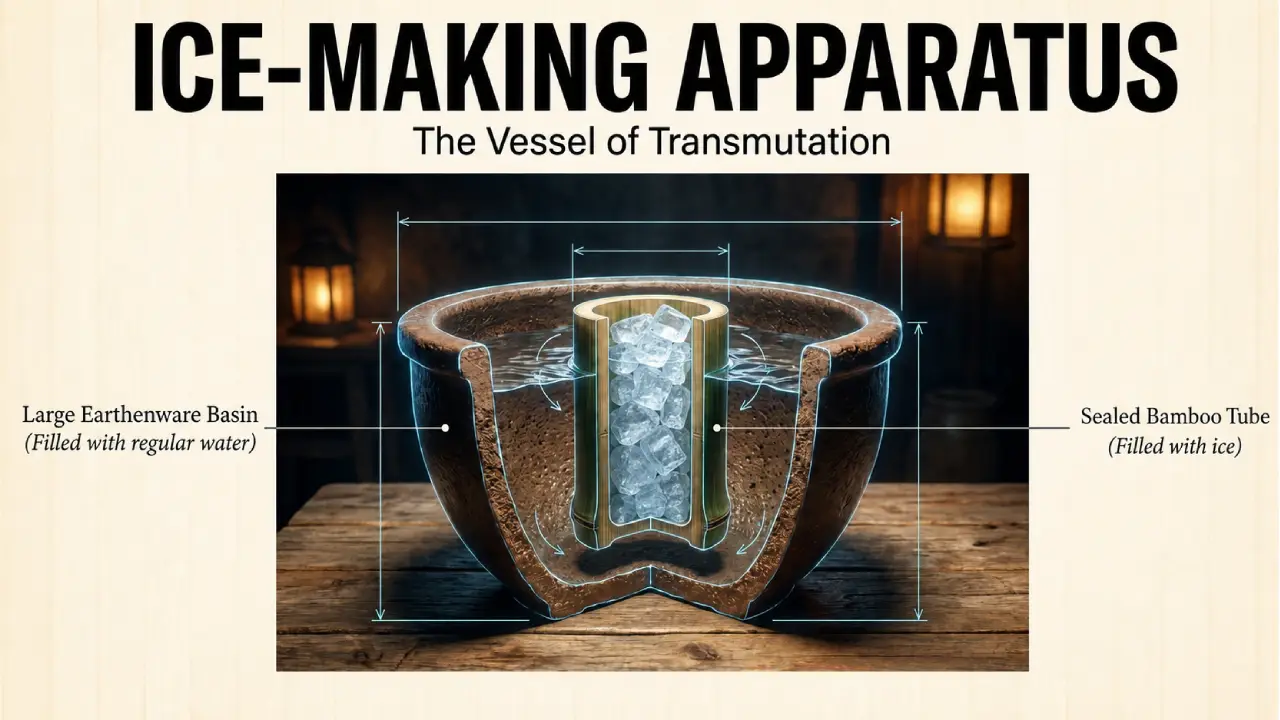
The engineering itself was uncomplicated but effective. Because saltpeter renders water undrinkable, craftsmen couldn't just mix it with the water they wanted to freeze. Instead, they used a nested double-vessel system: an insulated earthenware outer tub held water mixed with dissolving saltpeter, while a smaller, more conductive inner container — often thin ceramic, copper or bronze — sat inside it, holding the pure well water meant to become ice. Well water was chosen deliberately for being cooler than surface water in summer, cutting down the amount of cooling the reaction needed to do.
Workers crushed and stirred saltpeter into the outer bath to speed up dissolution, and as the solution dropped below freezing, heat drained out of the inner vessel through its conductive walls until the target water solidified. Once the block of ice was extracted, the spent saltpeter solution wasn't simply discarded — it was left in shallow pans to evaporate, letting the mineral recrystallize so it could be dried, collected, and reused in future batches. That recyclability is part of what made the method commercially viable rather than a one-off curiosity.
Ice Becomes a Business — and a Dessert
The consequences went well beyond keeping drinks cold. Once ice production no longer depended on winter harvests or long-distance transport, private merchants and specialized guilds known as Bing Hu could produce it through the summer on demand. Ice stopped being an imperial monopoly and became an urban commodity, available — at a price — to a much wider slice of society than the aristocracy that had previously enjoyed exclusive access.
That new supply fed directly into culinary experimentation, particularly among elite Tang households influenced by dairy traditions from northern steppe cultures. The best-documented result is a dessert called Su Shan, or “Butter Mountain,” — melted butterfat or cream mixed with honey, sugar and aromatic flavorings like camphor or rose water, then dripped over metal dishes chilled on beds of saltpeter ice. As the dairy mixture hit the cold surface, it hardened into jagged mountain-like shapes, later decorated with gold leaf and flower petals for aristocratic banquets. Tomb murals from the period, including those in the tomb of Prince Zhanghuai, depict palace attendants carrying these frozen creations on platters — physical evidence that the dessert wasn't just a literary flourish.
By the following Song Dynasty, the technology had moved fully into public commerce. Street vendors in cities like Kaifeng and Hangzhou sold iced drinks and frozen fruit desserts to ordinary residents, a level of everyday access to cooling that would have been unthinkable a few centuries earlier.
A Chinese Discovery That Traveled
The knowledge didn't stay in China. As Silk Road trade expanded between the ninth and thirteenth centuries, awareness of saltpeter's cooling properties spread into the Islamic world, where Arabic and Persian scholars openly credited the Chinese origin — referring to the mineral as “Chinese snow” or “Chinese salt” in their own languages. A thirteenth-century Syrian physician, Ibn Abi U?aybi‘a, documented the technique being used to chill drinks for royal courts, a method later adapted in the Mughal Empire to prepare cold fruit sherbets.
When the underlying chemistry eventually reached early modern Europe, natural philosophers took it in a slightly different direction. Rather than dissolving saltpeter directly in water, experimenters like Giambattista della Porta — writing in 1589 — mixed saltpeter or sea salt into crushed ice or snow, exploiting freezing-point depression rather than the dissolution reaction the Tang alchemists had relied on. That European variant eventually enabled the freezing of sweetened creams and fruit mixtures into sorbets and early ice creams.
But the distinction matters historically: the Tang method was the first recorded technique for producing ice directly from liquid water, with no snow, ice or freezing weather required to start the process. It was, in that narrow but real sense, the first artificial refrigeration technology on record — born not in a physics laboratory, but in the search for alchemical elixirs and gunpowder ingredients.