Indigenous groups in Manipur call for recognition of traditional midwives, stronger community healthcare and protection of Indigenous land, forests and knowledge.
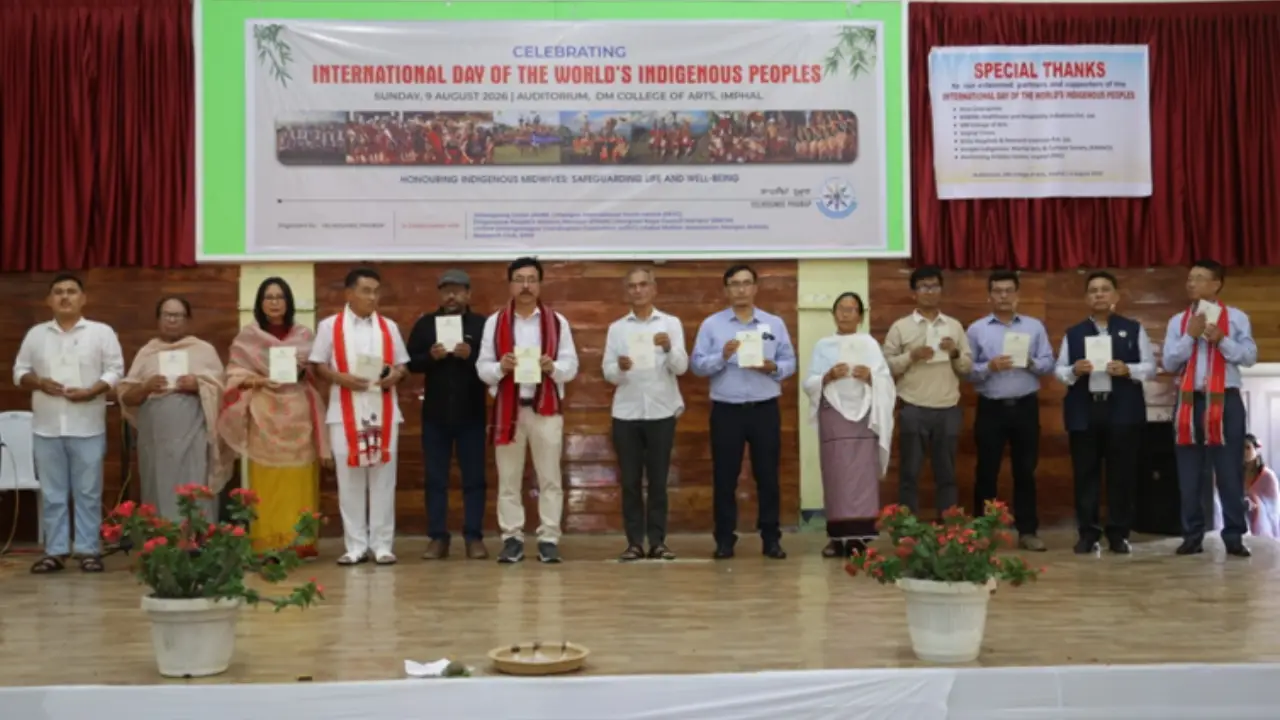
Imphal, August 9: Several civil society and community organisations in Manipur have called for greater recognition of Indigenous midwives and traditional caregivers, along with stronger protection of Indigenous land, forest and resource rights.
The call was made during an observance of the International Day of the World’s Indigenous Peoples 2026 at the D.M. College of Arts Auditorium in Imphal. The programme was organised by Yelhoumee Phurup (YP) in collaboration with the Manipur International Youth Centre (MIYC), People’s Progressive Alliance Manipur (PPAM), United Zeliangrongpui Coordination Committee (UZCC), Rongmei Naga Council Manipur (RNCM), Zeliangrong Union (AMN), Kabui Mothers’ Association Manipur (KAMA) and the Research Club of Dhanamanjuri University.
The programme focused on the global theme “Honouring Indigenous Midwives: Safeguarding Life and Well-being.”
The organisers highlighted the role of traditional caregivers, including Mayok Maibi, Chabok Maibi and Chabokpi among the Meitei community, as well as traditional caregivers among the Naga and other communities in Manipur.
According to the organisers, Indigenous midwives and traditional caregivers have preserved knowledge related to childbirth, postpartum care, reproductive health, traditional medicines and local healing practices across generations. They said these caregivers continue to play an important role in remote areas where access to formal healthcare can be difficult.
The gathering argued that Indigenous midwifery should not be regarded merely as a practice from the past. Instead, traditional caregivers should be recognised as community knowledge-holders whose expertise could be responsibly integrated with formal healthcare systems.
The organisers referred to Article 24 of the United Nations Declaration on the Rights of Indigenous Peoples (UNDRIP), which recognises Indigenous peoples’ rights to their traditional medicines and health practices.
Concerns over environmental degradation
The programme also addressed environmental pressures facing Manipur, including deforestation, biodiversity loss, water scarcity and degradation of forests and watersheds.
The organisers expressed concern over the expansion of poppy cultivation and oil-palm monoculture, as well as the weakening of traditional sustainable practices. They called for stronger protection of Indigenous land and forest rights and urged that Indigenous communities be consulted through Free, Prior and Informed Consent (FPIC) before major land-use changes.
The gathering also discussed health concerns linked to harmful consumption practices, including tobacco products such as kwa, zarda and khaini, unsafe local alcohol production and the use of unsafe additives in fermented foods.
The organisers maintained that such practices should be viewed not only as individual health issues but also in terms of their wider social and economic impact on families and communities.
Six priorities outlined
The participating organisations called for a community-centred and ecologically sustainable development approach in Manipur. Among their key recommendations were the integration of Indigenous midwives into formal healthcare through mutual recognition, sanitation support, emergency training and communication facilities.
They also called for improved emergency maternal transport and peripheral healthcare facilities to reduce risks faced by mothers and newborns in geographically isolated areas.
Other priorities included protecting Indigenous land, forest and resource rights; reviving safer traditional practices such as organic farming and natural food production; documenting Indigenous knowledge through education and research; and developing local economies based on organic production, traditional skills, handloom, handicrafts and community-based industries.
The organisers described Indigenous midwives and traditional caregivers as “living knowledge-holders and frontline caregivers”, stressing that the loss of their unwritten knowledge could mean the disappearance of an entire community knowledge system accumulated over generations.
They urged Indigenous communities, civil society organisations, academic institutions and policymakers to work together to preserve traditional knowledge, protect the environment and strengthen community-based healthcare.
The event was attended by a presidium comprising Prof. Ch. Sheelaramani, former Dean of the School of Humanities at Dhanamanjuri University and Principal of D.M. College of Arts; Prof. Th. Rabikanta Singh, Dean of Students’ Welfare, Dhanamanjuri University; and Dr. L. Phaomei, President of Yelhoumee Phurup.
Dhiren A. Sadokpam, Editor-in-Chief of The Frontier Manipur, attended as the special invitee.
The organisers also acknowledged the support of Arun Enterprises, BABINA Healthcare and Hospitality Industries Pvt. Ltd., D.M. College of Arts, Imphal Times, Shija Hospitals & Research Institute Pvt. Ltd., Kanglei Indigenous Martial Arts & Cultural Society (KIMACS) and Performing Artists Centre, Imphal (PAC).
The organisers concluded that protecting Indigenous midwives, traditional knowledge, land and forests is closely linked to safeguarding the health, culture and future of communities in Manipur.