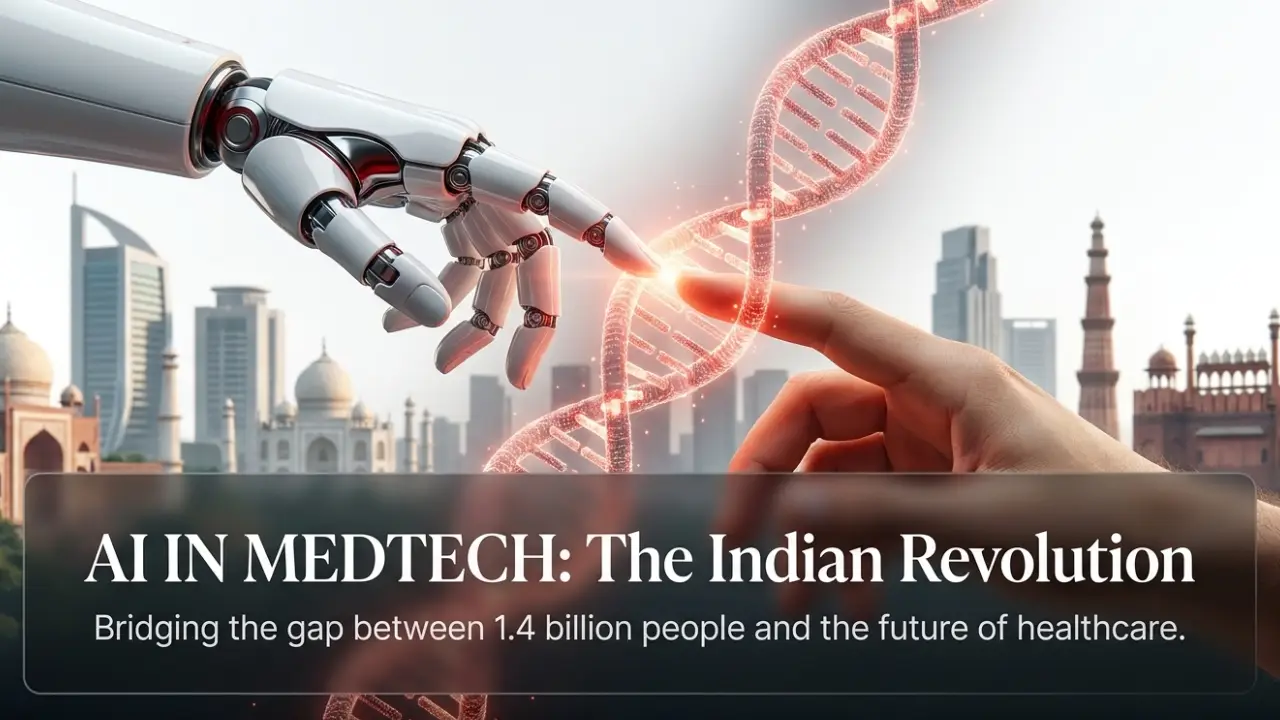
JP Nadda releases AI-MedTech report at Delhi conference highlighting India's specialist shortage, rural-urban healthcare gaps, and regulatory reforms needed to scale AI diagnostics nationwide.
New Delhi, August 8: Union Minister for Chemicals & Fertilizers and Health & Family Welfare J.P. Nadda on Saturday released a knowledge paper on artificial intelligence in medical technology, arguing that India's core healthcare bottleneck is not a shortage of equipment but a scarcity of specialists able to interpret medical data.
The paper, titled "AI in MedTech: Revolutionizing Healthcare Through Artificial Intelligence," was released at Vigyan Bhawan during the 9th edition of the India Medical Device 2026 conference, organised by the Department of Pharmaceuticals along with the Federation of Indian Chambers of Commerce and Industry (FICCI). It was compiled jointly by Praxis Global Alliance and FICCI.
The launch was attended by Department of Pharmaceuticals Secretary Manoj Joshi, Department of Health Research Secretary and ICMR Director General Dr. Rajiv Bahl, Health and Family Welfare Secretary Punya Salila Srivastava, Department for Promotion of Industry and Internal Trade Secretary Amardeep Singh Bhatia, National Health Authority CEO Sunil Kumar Barnwal, NITI Aayog member Dr. M. Srinivas, and FICCI Secretary General Anant Swarup.
The report frames India's healthcare system as caught in a supply-demand mismatch that is expected to intensify. The country's population is projected to reach roughly 1.47 billion by the end of 2026, and non-communicable diseases such as cardiovascular illness, diabetes and cancer already account for more than 65% of all deaths, according to the paper. Managing that chronic disease burden, the report says, requires ongoing screening and diagnostics rather than one-time treatment.
As of 2021, an estimated 315 million Indians were living with hypertension and 101 million with diabetes, the paper states. It also points to a rapidly ageing population, projecting more than 230 million people aged 60 and above by 2036, adding further strain on health services.
Against this demand, the report lays out how thin India's healthcare workforce and infrastructure remain compared with global benchmarks. India has 9.6 physicians per 10,000 people, against a global average of 18.3. Nursing personnel stand at 27.2 per 10,000 people, compared with a global average of 40.5. Hospital bed capacity is 15.9 per 10,000 people against a global average of 33.0, and India's installed base of MRI machines is 4.0 units per million people, compared with a global average of 19.0, the paper says.
The gap is sharper outside cities. While 67% of India's population lives in rural areas, only 30% of hospital beds are located there, according to the report. Rural healthcare, it notes, is largely served by primary health centres, community health centres and small private nursing homes, while specialists, tertiary beds and advanced diagnostic equipment remain concentrated in metropolitan centres. This leaves what the report calls a "missing middle" — people who do not qualify for public welfare schemes but cannot afford or reach high-end private care. The pattern described mirrors long-standing concerns in states across Northeast India, where terrain and distance from tertiary hospitals have historically limited access to specialist consultation.
The report argues that building physical infrastructure in every smaller town is not economically feasible, and instead positions AI as a way to extend the reach of a limited pool of specialists by embedding clinical decision-support tools into point-of-care devices.
According to the paper, the traditional diagnostic pathway in India is centralised: patients in rural areas travel to clinics, samples or images are sent to urban laboratories, specialists interpret the results, and reports are sent back — a process that can take 24 to 72 hours and often results in patients dropping out before treatment begins.
AI-enabled devices, the report says, can instead analyse medical images, ECGs or blood panels on the spot, flag anomalies and support triage within minutes, allowing frontline health workers such as Auxiliary Nurse Midwives and Accredited Social Health Activists to conduct preliminary screening in remote areas without an on-site specialist.
The paper cites several government-backed initiatives already operating on this model, including DeepCXR, which interprets chest X-rays for frontline screening of pulmonary disease, and MadhuNetrAI, which had screened more than 7,100 diabetic patients across 38 healthcare facilities for diabetic retinopathy as of December 2025 without requiring an ophthalmologist on-site. It also references the eSanjeevani clinical decision-support system integrated into teleconsultation and an AI-based tool for predicting adverse outcomes in tuberculosis patients.
Despite these examples, the report describes what it calls an "adoption paradox": AI tools that succeed in pilot programmes frequently fail to move into routine hospital use or large-scale procurement. It attributes this to three structural barriers.
The first is a data and evidence gap. Clinical data in India remains fragmented, the report says, with imaging trapped in hospital-specific archiving systems, laboratory data lacking common formatting standards, and electronic medical record adoption uneven outside premium private hospitals. This makes it difficult to validate AI models on Indian patient populations, a concern the report flags as significant given that algorithms trained largely on Western data can perform poorly or show bias when applied locally.
The second barrier is regulatory. India's Medical Devices Rules of 2017 were designed for physical hardware that does not change after approval, the report notes, whereas AI software is regularly updated and retrained. The Central Drugs Standard Control Organisation issued draft guidance on medical device software in 2025, introducing categories for software as a medical device and software in a medical device, but the report says clear pathways for managing updates and accountability are still not fully in place.
The third barrier concerns procurement and reimbursement. Insurance schemes including Ayushman Bharat PM-JAY and the Central Government Health Scheme pay for clinical procedures rather than software-based diagnostics, the report says, meaning hospitals get the same payout whether or not they use AI-assisted tools. Public tenders, it adds, are largely awarded on lowest hardware cost, with little weight given to software capabilities such as automated triage or faster scan times.
The report points to regulatory and payment systems in other countries as possible references. It notes that the U.S. Food and Drug Administration has authorised more than 1,500 AI-enabled medical devices and has moved to a lifecycle-based review model that lets manufacturers pre-specify future software updates without repeated re-filing, paired with dedicated reimbursement codes from the Centers for Medicare & Medicaid Services.
In the United Kingdom, the report cites the NHS Federated Data Platform, which links hospital data systems while letting individual trusts retain control of their own data, along with the MedTech Funding Mandate, which requires NHS commissioners to fund specific approved technologies. Singapore's Health Sciences Authority runs a dedicated sandbox for testing AI-based medical software under real conditions, according to the paper, while South Korea's health ministry approved national insurance reimbursement in 2022 for an AI tool used in brain MRI analysis, allowing clinics to bill separately for the AI-assisted read.
The report sets out recommendations across three time horizons. In the near term, it calls on the drug regulator to finalise its software-as-a-medical-device framework and set up a technical expert committee, on health authorities to create structured pilot programmes and a faster health technology assessment process, and on developers to run multi-centre trials on Indian patient populations rather than relying only on lab testing.
In the medium term, the report recommends shifting public procurement away from lowest-cost bidding toward evaluations that account for software performance, integrating AI tools into hospitals' existing records systems with dedicated oversight committees, and introducing AI literacy into undergraduate medical training.
In the long run, it calls for public and private insurers to introduce dedicated reimbursement for validated AI-based screening, with public hospital networks scaling proven tools across state health systems to narrow the rural-urban divide in specialist access.
The report concludes that India's position in AI-enabled healthcare will be shaped less by the sophistication of its algorithms than by whether regulatory, data and payment systems are reformed together. It points to India's Ayushman Bharat Digital Mission health data infrastructure, its software industry and its expanding domestic device manufacturing base as existing advantages, but says the ultimate measure of success will be whether point-of-care AI tools reach underserved populations with timely and affordable care.